
The latest novel by Man Booker long-listed author Tash Aw offers a grim portrait of contemporary Asia under late capitalism. We, the Survivors (336 pages; FSG) traces the life of Ah Hock, a Malaysian-born citizen of Chinese heritage living a quiet life of solitude on the other side of a murder sentence. Ah Hock relays his story to a young journalist looking to shed light on the circumstances that led to Ah Hock’s violent crime, a crime he himself doesn’t quite understand. The murder is ultimately connected to Ah Hock’s former career as second-in-command at a local fish farm, as […]
In the Winter Issue
by ZYZZYVA
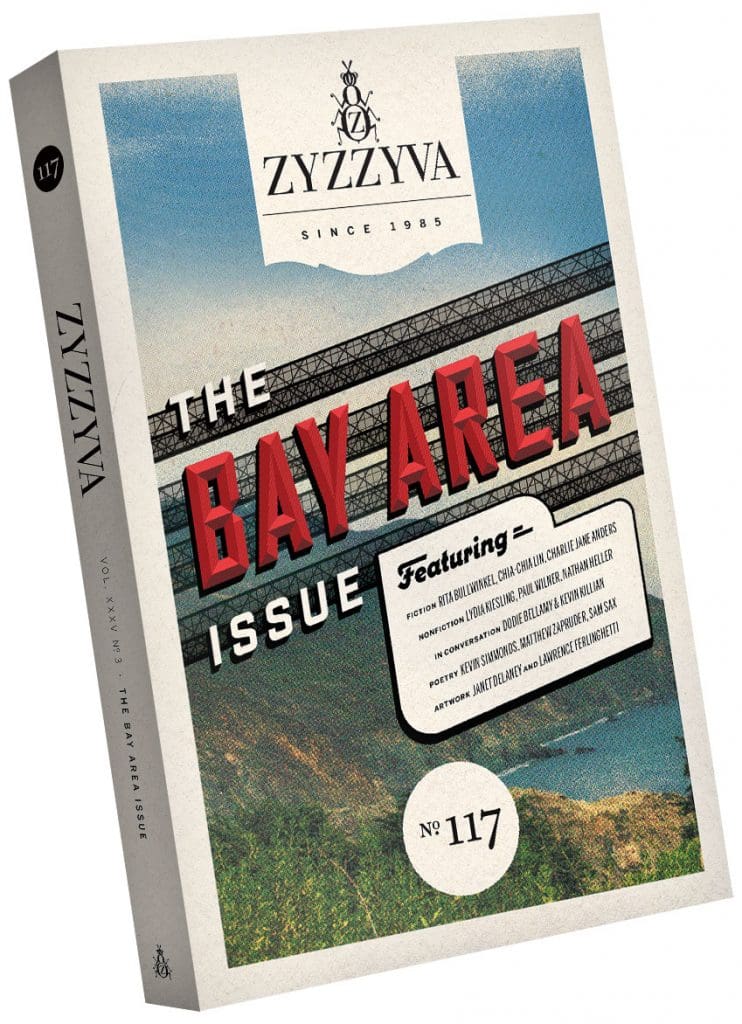
New writing from the East Bay to San Francisco, from the North Bay to the Peninsula. Fiction: Charlie Jane Anders, Rita Bullwinkel, Lydia Conklin, Chia-Chia Lin, Nina Schuyler, Michael Sears, Ingrid Rojas Contreras, and Andrew Roe. Nonfiction: Paul Wilner, Gloria Frym, and Lydia Kiesling. Poetry: sam sax, Meg Hurtado Bloom, Luiza Flynn-Goodlett, W.S. Di Piero, Sara Mumolo, Kevin Simmonds, Lady Nestor Gomez, and Matthew Zapruder. Interview: Dodie Bellamy and the late Kevin Killian. Art: Lawrence Ferlinghetti, Janet Delaney. You can purchase a copy of No. 117 here, or order a subscription to ZYZZYVA now. […]
‘In the Dream House’ by Carmen Maria Machado: No Mere Confessional
by Sophia Stewart
Carmen Maria Machado’s new book, In the Dream House (264 pages; Graywolf Press), begins with a statement of intention. Machado, the author of the acclaimed story collection Her Body and Other Parties, tells us she has written a memoir to add her story of queer domestic violence to the catalog of contemporary literature: “I enter into the archive that domestic abuse between partners who share a gender identity is both possible and not uncommon,” she writes, “and that it can look something like this.” Depictions of intimate partner violence between women have been largely left out of our collective culture, […]
‘The Promise’ by Silvina Ocampo: Remembering How to Die
by John Gibbs
In The Promise (120 pages; City Lights Publishers; translated by Suzanne Jill Levine and Jessica Powell) the nameless narrator, after falling over the handrail of a transport ship, recollects her life in a disparate series of largely character-based vignettes as she waits to drown or be rescued at sea. As she comes to in the ocean, she promises Saint Rita that in exchange for her life she will commit to publishing a book documenting a “dictionary of memories that are at times shameful, even humiliating.” And so the lone novel by the prolific Argentine author Silvina Ocampo (1903-1993) becomes a […]
Q&A with Heather Christle: ‘The Crying Book’ and a Nourishment from Sharing
by Sophia Stewart
Over the course of The Crying Book (208 pages; Catapult Press), Heather Christle examines the phenomenon of crying from every possible angle: social, cultural, biological, and historical. She asks the tough questions, ones that science still can’t answer: Why do we cry? And what does it mean to cry? Christle’s inquiry is rigorously researched, but it is also deeply personal. While she was writing The Crying Book, she was doing a lot of crying herself, grappling with depression, mourning the passing of a dear friend, and preparing to become a mother. The scope of The Crying Book is surprisingly vast—we […]
‘Black Card’ by Chris L. Terry: A Satirical Look at Racial Identity in America
by A.M. Larks
Chris L. Terry’s new satirical and funny novel, Black Card (272 pages; Counterpoint), challenges ideas about race and identity as it follows its unnamed mixed-race narrator as he navigates the complex world of the punk rock scene in the American South, trying to understand where and how he can fit in—or if he can ever fit in. Structured episodically, Terry’s novel manages to address specific and thematically relevant incidents of the narrator’s life minus an overwhelming page count. “I was finally black again,” the novel begins, in 1997. “I sat on my bed, waiting for proof. Gray smoke oozed under […]
How to help those affected by the California fires
by ZYZZYVA Staff
Northern California is once again faced with wildfires. We encourage you to explore this link from the Northern California Grantmakers on ways you can help the many people displaced by the fires. NCG provides a number of options, including vetted wildfire relief and recovery funds such as the Center for Disaster Philanthropy and the Solano Disaster Relief Fund. Please feel free to share links to similar relief efforts in the Comments below. […]
ZYZZYVA Recommends October 2019: What to Read, Watch, & Listen to
by ZYZZYVA Staff
As October comes to a close, the Bay Area gears up for perhaps its favorite holiday: here’s hoping your Halloween involves more treat than trick! In the office, we’re also offering a seasonal Staff Recommends—here’s a roundup of the works we’ve been reading, watching, and listening to: Scout Turkel, Intern: My music taste is defined by habit rather than preference. What makes a song good isn’t necessarily genre or content, but its capacity to fit into my rigorous and specific listening routine: for about a month at a time, I play one song, and one song only, on repeat, over […]
Q&A with Seth Borgen: ‘If I Die in Ohio’ and Some Extraordinarily Unremarkable True Thing
by Anne Raeff
The stories in Seth Borgen’s collection If I Die in Ohio (160 pages; New American Press), winner of the New American Fiction Prize, are like bars where I have learned more about people and about writing than anywhere else, except perhaps from books. And like those bars, they are places where people who would never have crossed paths come together—a retired, well-known architect and a young high school dropout, for example; a slacker, stoner, atheist and a Mormon. The characters do not seek each other out, but once they do, something happens. Nothing huge or life-changing but something that helps […]
‘Mickey Rourke and the Bluebird of Happiness: A Poet’s Notebooks’ by W.S. Di Piero: A Literary Time Capsule
by Sophia Stewart
The relationship between a writer and their notebook is a strange and sacred one. W.S. Di Piero has been keeping a notebook since he first started writing, and, in the poet’s own words, his notebooks have taken on many roles, including “workshop, interrogation room, [and] monk’s cell.” In Mickey Rourke and the Bluebird of Happiness: A Poet’s Notebooks (Carnegie Mellon University Press; 88 pages), we are treated to selections from three decades’ worth of De Piero’s notebooks. Through this collection, Di Piero hopes to “craft a shadow self-portrait composed of hopped-up episodes from my mental and emotional life.” The resultant […]
The Common Reader’s ‘James Baldwin & American Democracy’: Another Country, Another Time
by Paul Wilner
Nobody knows his name. The literary and political legacy of James Baldwin is going through a revival through works like Raoul Peck’s Academy Award-nominated documentary, I Am Not Your Negro, and director Barry Jenkins’ film adaptation of If Beale Street Could Talk. Add to this, the newest issue of The Common Reader: A Journal of the Essay, published by Washington University in St. Louis, and its eleven essays that further explore the lasting work and meaning of the author. High points of the issue, titled James Baldwin & American Democracy, include Cecil Brown’s piece, “With James Baldwin at the Welcome Table,’’ in […]
‘The Painted Forest’ by Krista Eastman: Thoroughly Acquainted with the World
by Sophia Stewart
Krista Eastman had been living away from her native Wisconsin for many years when she began writing her essay collection, The Painted Forest (144 pages; West Virginia University Press), and it was during this time that she began to consider the meaning of home. Once she left the small, working-class town in which she was raised, she told Poets & Writers, she found she often “had to explain myself and my home to others, putting a complicated place onto maps where previously there’d been nothing at all.” That’s when she “became interested in the role of telling about a place, […]