Category Archives

News

ZYZZYVA news.

A Best American Short Stories and Best American Essays One-Two Punch (Update: And Now a Pushcart: We Hit the Trifecta)

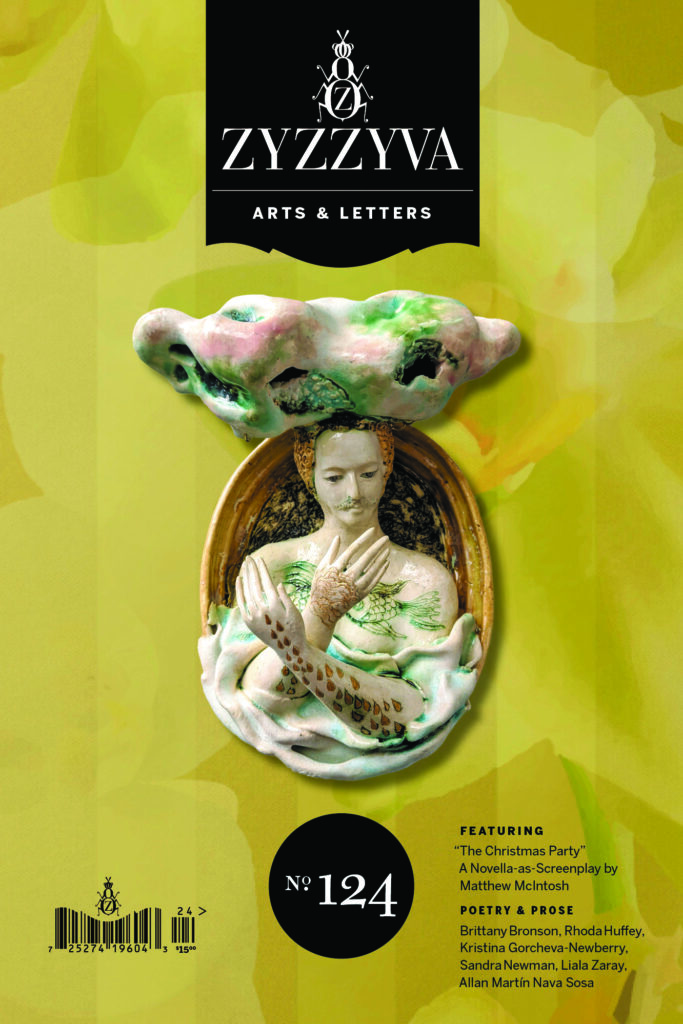
ZYZZYVA95_Fall2012_CoverFINAL_PrintIt looks like the Fall 2012 ZYZZYVA (No. 95) has some sort of magic working for it. Earlier this year, we were thrilled to learn that a story from that issue, Karl Taro Greenfeld’s “Horned Men,” would be included in the 2013 Best American Short Stories. And today, we received a call informing us that Dagoberto Gilb’s nonfiction piece from the same issue, “A Little Bit of Fun Before He Died,” will be included in the 2013 Best American Essays.

We offer our warmest congratulations to Dagoberto Gilb and Karl Taro Greenfeld. And if you don’t have the Fall 2012 issue already and want to know what all the fuss is about, you can order a copy here. (Just scroll a little bit down on the page.)

Update: A letter arrived from the Pushcart folks informing us that W.S. Di Piero’s poem from the Spring 2012 issue (No. 94), “There Were Such Things,” will be published in the Pushcart Prize 2014 anthology. (Di Piero has had an essay appear before in the Pushcarts. This would be his first poem to be honored by the anthology.) Our congratulations to W.S. Di Piero.

Posted in Literary News, News | Tagged , , , , , , , | Leave a comment

In the Spring Issue

The newest ZYZZYVA features a special section of work by authors who divide their time between the West Coast and elsewhere, as well as …

Stories about love and grieving (Marianna Cherry’s “The Endurance”), about love and its opportunities: grand (Chris Leslie-Hynan’s “Hunter’s Moon”) and grim (Herbert Gold’s “The Passion of a Fussy Man” and Michelle Latiolais’s “Gas”), irrevocable (Dani Shapiro’s “Cardioplegia”) and fixed to place (Molly Giles’s “Life Span”). Fiction on the writing life—whether pursued in a classroom (Lori Ostlund’s “Clear as Cake”) or very much alone (Debbie Graber’s “Northanger Abbey”)—and fiction about teachers, young and veteran, learning the truth about themselves (Hilda Johnston’s “In Her Dream the Teacher Apologizes” and Peter Mountford’s “Safari in the Bayou”).

A profile of a beloved uncle and a community of deaf Mexican migrants making their home in the United States (Diego Enrique Osorno’s “A Cowboy Crosses the Border in Silence”), and the pensées of the great poet W.S. Di Piero (“Out of Notebooks”).

Verse from Joseph Di Prisco, Alexandra Teague, Christopher Buckley, Lynne Knight, Amy Miller, Christian Kiefer, Adam O. Davis, Allan Peterson, Michelle Lin, Matthew Nienow, Richard Tillinghast, and Floyd Skloot.

And we introduce young writers Rebecca Rukeyser (“The Chinese Barracks”) and Aaron Jae-Ho Shin (“Erroneous”).

Get your four-issue subscription to ZYZZYVA now and start with the Spring issue.

Posted in News | Leave a comment

‘A Great Scandal Is a Masterpiece’: Q&A with ‘Forged’ Author Jonathon Keats

Interviewing your spouse might sound a little strange, but I’ve done worse. I’ve translated him. Several years ago Jonathon Keats published a collection of fables, The Book of the Unknown (Random House), and I translated the book into Italian. As an experienced literary translator, I found it exciting to have “my” author sitting next to me during the translation process. I could ask him any question I wanted, and I could tell him when I didn’t like his answers. Now that he’s published a new, non-fiction book – Forged: Why Fakes Are the Great Art of Our Age, which just came out for Oxford University Press this week – I’ve welcomed the chance to ask him some questions that he was genuinely interested in answering.

In Forged, Jonathon Keats (who, besides being my husband, is also an art critic, journalist and artist) explores the role of the counterfeit within the history of art, starting from the assumption that “forgers are the foremost artists of our age.” Why? Because by challenging the concept of “legitimate” art, they provoke and explore our anxieties, which is what art should always do.

After describing past attitudes toward forgery that were very different from our own, he  tells the fascinating stories of six modern forgers and concludes by looking at how artists today have appropriated many aspects of forgery, and how open-source “copyleft” strategies have the potential to make legitimate art meaningful again.

I’ve begun the interview by trying to find some connection between the art forger and the fiction writer.

Silvia Pareschi: You have already published two novels and a collection of fables. Do you see a connection between your fiction and Forged?

Jonathon Keats: Writing fiction is one of the few forms of counterfeiting that our society permits. The reason, I think, is that the fakery is blatant, announced right on the cover of the book. If it isn’t, as in the case of James Frey’s deceptive memoir, A Million Little Pieces, readers feel betrayed and the author is punished. But if readers know they’re playing a game of make-believe, the trickery doesn’t seem threatening.

This game of make-believe really appeals to me as a writer because it requires readers to explicitly set aside everything they know, much of which may not be true. The imagination is exercised, and I believe that makes us more open-minded when we return to our everyday lives. We’re prepared to consider points of view other than our own.

Of course relatively few people read fiction. The vast majority simply have no interest in fantasy, and those who are most resistant are probably the ones who are least receptive to alternate perspectives in the first place. So it seems to me that the potential impact of fiction is rather limited.

And that’s why a case like the James Frey debacle is so interesting. A lot of people were drawn to the memoir who never would have read it as a work of fiction. Perhaps they even empathized with Frey’s alleged drug addiction. Then the scandal broke and people realized they’d been had, which inadvertently added another layer to the book. Even those who couldn’t care less about Frey’s story were forced to reflect on the reasons why the fraud worked. People were compelled to question their belief in the written word and printed book.

In a way, that makes Frey one of the foremost authors of our time. As a fellow fiction writer, I’m a little bit envious. And as an art critic, I can’t help but notice that art is in trouble for many of the same reasons that fiction is challenged. Like Frey, art forgers deserve serious consideration for their underhanded counterfeiting.

Continue reading

Posted in News | Tagged , , , , , , , , , | 1 Comment

Serving and Defying the Tyranny of Motive

David Corbett, who lives in Vallejo, Calif., is a former private investigator and is the acclaimed author of four novels: The Devil’s Redhead, Done for a Dime (a New York Times Notable Books), Blood of Paradise (nominated for an Edgar), and Do They Know I’m Running? His most recent book is The Art of Character: Creating Memorable Characters for Fiction, Film, and TV (Penguin).

At nearly 400 pages, The Art of Character, which publishes in late January, is a generous serving of Corbett’s knowledge on the craft of writing. Part reference book, part volume of essays, it’s insightful, entertaining, funny, and incredibly helpful. The following, “Serving and Defying the Tyranny of Motive,” is a short excerpt from Corbett’s book.

***

More often than not, people don’t know why they do things.—William Trevor, “The Room”

The Mystery at the Heart of Character

Sophocles described his heroes with the term deinos, which translates loosely as “wondrous and strange.” A character who lives up to that description possesses a kind of incandescence, reminding us of the unpredictable capacity for loving sacrifice, heroism, fierce persistence—or craven selfishness, cowardice, vacillation—that each of us carries within his heart.

But creating stories and characters is a practical matter, too, requiring craft. The chasm between the ineffable thing we’re after and the simple tools we have at hand can feel discouragingly vast. It’s simple to say: The writer’s task is to balance expectation against surprise, word for word, action by action, scene by scene. Like many things that can be simply put, it’s incredibly hard to pull off.

Continue reading

Posted in News | Tagged , , , | 1 Comment

In the Winter Issue

“The one journal I read cover to cover as soon as it arrives—ZYZZYVA is that smart, that brilliantly curated …” —Junot Diaz

“Zyzzyva is a snouted beetle, as any dictionary kid knows. It’s a word that nearly can’t be played in Scrabble, on account of all the Z’s. But those are novelty uses. The real meaning is this superb literary journal, which has real meaning. If you want to learn the things that literature can do with language, read it.” —Ben Greenman

The newest issue of ZYZZYVA offers the same engaging mix of compelling writing and art you’ve come to expect—but with a twist. For the Winter issue, we offer a section of Noir stories (and one especially menacing and dark poem), set among the barrenness around Barstow to the suburbs of the Bay Area.

Here’s what’s inside:

Stories about finding some truth, and a true friend, in Hollywood (Ron Carlson), on a mother looking to rid herself of all her beliefs (Vanessa Veselka), on a family man adrift in his chilly small town (Earle McCartney), on a teen boy and his father, wounded in different ways (Jennifer duBois), and about two brothers on a long walk through the fields, death on their minds (Bruce McKay).

Verse from John W. Evans, Carolyn Miller, Marci Vogel, Elyse Fenton, CM Davidson, and Jane Wong.

Rick Barot’s essay on the particular power of Giorgio Morandi’s painting “Natura Morta,” and artist Wendy MacNaughton’s pen-and-ink history of a pier in San Francisco and the neighborhood that’s formed around it.

Noir from E.G. Willy (paranoia and gangbanging settles over the old neighborhood—in the suburbs), Dawna Kemper (a woman and a baby race into the desert night, but to what end?), Andy Stewart (a petty, envious music instructor is baffled by a charming, good-hearted peer in ways he couldn’t have anticipated), and Lucas Howell (bloody treachery befalls the coyote).

And introducing Chaney Kwak—and what might be the best Christmas story you’ve read in ages (complete with over-the-top holiday decorations, furtive roadside sex, and a precocious would-be hustler).

Get your four-issue subscription to ZYZZYVA now and start with the Winter issue. (Copies are limited.)

Posted in News | Leave a comment

The Poetry of Apples, Maple Syrup, Blackberries, and Sandwiches: ‘The Hungry Ear,’ edited by Kevin Young

The need for food and drink is universal. The preparation and partaking of meals mark events ordinary and extraordinary. Because of this, food has naturally found itself a subject of poetry for as long as can be remembered. Celebrating the many facets of food and drink, poet Kevin Young, author of seven books of poetry and editor of six previous anthologies, has compiled The Hungry Ear: Poems of Food & Drink (Bloomsbury, 336 pages).

In his introduction, Young writes, “Love, satisfaction, trouble, death, pleasure, work, sex, memory, celebration, hunger, desire, loss, laughter, even salvation: to all these things food can provide a prelude; or comfort after; and sometimes a handy substitute for. It often seems food is a metaphor for most anything, from justice to joy.” The poems that follow certainly demonstrate this all-encompassing nature of food and drink. Divided into four sections, named for each of the four seasons, The Hungry Ear delivers verse for life’s ups and downs, from poets such as Li Po, Robert Frost, Charles Baudelaire, Edna St. Vincent Millay, and dozens more.

Continue reading

Posted in News | Tagged , , , , | Leave a comment

An Alternative Universe, One Where Her Son Still Lives: J. Robert Lennon’s ‘Familiar’

Somewhere on an Ohio interstate, where bored drivers can be counted on to whiz past the paranormal events happening in a middle-aged woman’s Honda, a crack in Elisa Brown’s windshield transports her from one brief, thirteen-page-long reality—of facts and blunt tragedy—to another. She finds her fingers gripping a different steering wheel, her toes jammed inside pumps instead of her usual sneakers, a husband who actually calls to see when she’ll arrive home, and, in place of her once bony frame, a plumper one that hasn’t suffered the death of her youngest son, Silas. J. Robert Lennon’s new novel, Familiar (Graywolf Press, 205 pages), follows this alternate Elisa as she navigates this disturbingly similar domain while attempting to make sense of the sudden shift.

Continue reading

Posted in News | Tagged , , , | Leave a comment

A Publishing World Gone Beastly: Howard Jacobson’s ‘Zoo Time’

Guy Ableman fixates on Amazon.com the way that he fixates on the runaway success of “The Girl Who Ate Her Own Placenta,” or on his mother-in-law, or his wife, or monkeys – with a gleeful sort of disgust. The protagonist, if you can call him that, of Howard Jacobson’s new novel, Zoo Time (Bloomsbury, 376 pages), is nothing short of feral. “Feral!,” Guy exclaims upon described as such. “From the Latin for an unruly beast. Guy Feral. Feral Guy.”

These, however, are feral times. The publishing industry has, in Guy’s view, dissolved and reconstituted itself into a gelatinous mass of insipid children’s literature, vampire-studded bodice-rippers, absurd online reviews, “Twitting,” and “blagging.” Physical books languish outside the timid, tepid minds of the populace, replaced by 140-character updates and digitized fluff. “Readers had changed,” Guy thinks. “Expectations of the book had changed. In a word, there were none.”

Continue reading

Posted in News | Tagged , , , , , | 2 Comments

In the Fall Issue

“Zyzzyva is a snouted beetle, as any dictionary kid knows. It’s a word that nearly can’t be played in Scrabble, on account of all the Z’s. But those are novelty uses. The real meaning is this superb literary journal, which has real meaning. If you want to learn the things that literature can do with language, read it.” —Ben Greenman

The latest issue of ZYZZYVA adds another dimension to the journal’s mission of spotlighting the West Coast’s best writers and artists. This Fall we present “Expats,” a selection of new work by John Freeman, Dagoberto Gilb, Edie Meidav, and Luis Alberto Urrea: authors with deep roots in the region, who have now made their homes elsewhere.

Here’s what inside:

  • Fiction from Gilad Elbom (on an Israeli brother and sister getting by on vinyl records and training for a swim competition), Karl Taro Greenfeld (on a father’s unsettling surveillance of his adolescent daughter in the midst of the mortgage meltdown), Tomas Gonzalez (on a haunted man killing time at a gloomy boardwalk before his flight), and stories from R.T. Jamison and Jennie Lin.
  • Poetry from Jesse Nathan, Judy Halebsky, Darin Ciccotelli, Wendy Willis, John Freeman, Jennifer Elise Foerster, Brendan Constantine, Kathlene Postma, Dan O’Brien, Ryan Ragan, and John Olivares Espinoza.
  • Also in Fiction: Jane Gillette’s timely tale of the mysterious appeal of Ayn Rand, and the puzzling relationship between a newly rich Russian man and an elegant older woman from the States, Tatjana Soli’s retelling of the My Lai massacre, and introducing Brian Boies, with his affecting story of lost souls on a day trip away from the Mission District.
  • Nonfiction from Dagoberto Gilb (a meditation on his “first fiction-writer role model”: a bigger-than-life, debauched man perhaps best known as the subject of a Sheryl Crow song), Edie Meidav (navigating Cuba, with family in tow and a slippery landlord lurking about), and Luis Alberto Urrea on the early job that made him a writer (you might never eat another donut).
  • And featuring a portfolio from acclaimed photographer Lucas Foglia, along with the artist’s notes on the series, titled “Frontcountry,” which looks at the struggling mining, farming and ranching communities of the western United States.

Get your four-issue subscription to ZYZZYVA now and start with the Fall issue. (Copies are limited.)

Posted in News | Leave a comment

ZYZZYVA Makes Best American Short Stories 2012 Notables List

We’re happy to announce two stories published in ZYZZYVA last year—Tom Bissell’s “Love Story, With Cocaine” and Andrew Foster Altschul’s “The Violet Hour”—made the Notables list for Best American Short Stories 2012.

Bissell’s story (you can read an excerpt here) appeared in ZYZZYVA No. 92 (Fall 2011) and Altschul’s story in ZYZZYVA No. 93 (Winter 2011).

Among the other stories named to the Notables list are pieces from The New Yorker, Harper’s, Tin House, and McSweeney’s and work by such authors as Jonathan Franzen, Alice Munro, and T.C. Boyle.

Of special note to our readers: ZYZZYVA will be publishing or will have published work from six other writers named to this year’s Notables list: Will Boast (Fall 2011), Ron Carlson (Winter 2012), Jennifer Dubois (Winter 2012), Karl Taro Greenfeld (Fall 2012), Peter Orner (Spring 2012), and Don Waters (Spring 2012).

Posted in Literary News, News | Tagged , , , , | Leave a comment

Bohemian Rhapsody: ‘Jubilee Hitchhiker: The Life and Times of Richard Brautigan’ by William Hjortsberg

To simplify, Jubilee Hitchhiker: The Life and Times of Richard Brautigan (Counterpoint; 880 pages), William Hjortsberg’s massive new biography of the late, once-iconic poet and novelist, can be roughly divided into three parts:

BUMMER. Brautigan’s childhood years, growing up poor and alienated in a dysfunctional family in the eternally drizzly Pacific Northwest. Highlights included the poet’s hospitalization—and treatment with electric shock—after throwing a rock into the local police station after a girl he had a crush on rejected him.

TRIPPY. Brautigan’s arrival in San Francisco, well ahead of the Summer of Love, whose spirit he briefly seemed to embody, and his immersion into the wild and crazy world of North Beach bohemia.

This section of the book, which comes as a welcome relief from the depression and Raymond Carver-esque solitude which preceded it, also serves as a spirited encapsulation of times and places that now seem as distant as pet rocks.

Despite a less than welcoming literary embrace from Allen Ginsberg, who called him “Frood’’ and a “neurotic creep,’’ perhaps in reaction to a competing literary visionary’s encroachment on his home turf, Brautigan found succor and support from North Beach legends of the time, including Jack Spicer, himself an exile from the main street of Beat bohemia, and Lew Welch, a tortured, twangy poet who ultimately walked away into the wild, though not before providing an entertaining alternative to academic exercises and overheated rhapsodies.

Continue reading

Posted in News | Tagged , , , , , , , , , | Leave a comment

Imperfect Eulogy for Elmer Morrissey

Elmer Morrissey, at the top of an 80-meter waterfall in San Gil, Colombia, in 2009 (photo by Rebecca Daunt)

April 14, 2012. On the 100th annivesary of the Titanic’s collision with an iceberg , the eight crew members of the Low Speed Chase set off on a day-long yacht race. When the 38-foot boat took a turn near the southern edge of the Farralon Islands, erratic and powerful waves threw the crew from their vessel, into the ocean beyond the San Francisco Bay. Three sailors made it onto the island, where the small yacht crashed, and were rescued. One was found dead in the water. Four are still missing.

I’ve been waking up in the earliest hours of the morning, before sunrise. From my window I can see the distant bay and the bridges that cut across it. It’s almost too dark to see the ocean, but I know it’s out there. And I know that somewhere in it is Elmer Morrissey.

I ask myself if the sea is less beautiful for having taken away my friend. I wonder if I have the energy to be angry at the Pacific Ocean. I try to think of what Elmer might say. I decide that Elmer would see the ocean for what it is: a roiling stage of life and death, a setting, not a being. I decide that Elmer would forgive.

I was a little bit in love with him, in the way you can be with someone you’re not romantically attracted to. Is that just love? It feels more like something in between love and in-love. I might have told Elmer this when he was alive. I might have said, “I’m a little bit in love with you, Elmer, in a platonic way that straddles the boundaries of love and in-love.” A simple “I love you” would also have sufficed. But how often do we really say this to our friends? I never throw out a casual “Love you!” at the end of a phone call. I might have said it to Elmer, though, and meant it fully. But I never did, because I’m too damn awkward with that sort of thing, and so I’m left saying it to my computer in a silent and rambling essay.

Continue reading

Posted in News | Tagged , , , , , | 1 Comment