
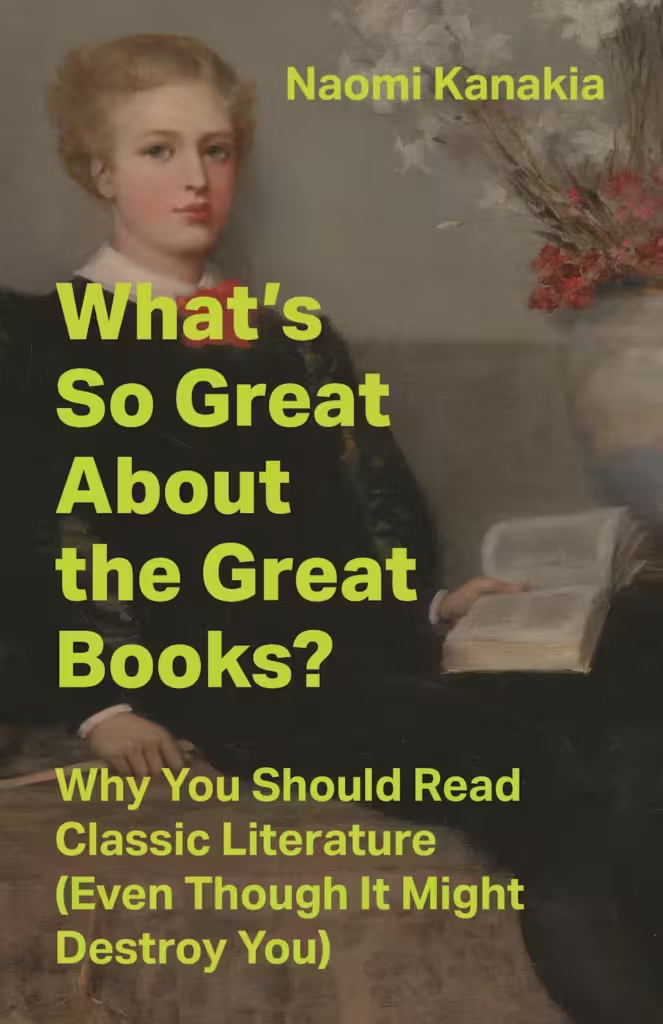
Taste, Naomi Kanakia explains, is one facet of how Great Books shape us. Our ability to appreciate great literature, to “discriminate, to discern fine nuances, and to see what truly exists within an object, versus what we are projecting onto it,” is cultivated by reading classics made timeless by their rigor, honesty, and care.
Through an intimate discourse on identity and literature, What’s So Great About the Great Books: Why You Should Read Classic Literature (Even Though It Might Destroy You) (272 pages; Princeton University Press), interrogates the canon. Kanakia’s comprehensive survey of books draws on several traditions, borrowing from Clifton Fadiman and John S. Major’s The New Lifetime Reading Plan, their list a byproduct of a Great Books educational movement in 1930s-’40s America. That movement, “though it cloaked itself in tradition,” derives its stature not from its perceived social cachet, or any real influence within the mainstream literary world. Actually, Kanakia suggests, the “Greatest Hits compilation of 2,500 years of Western literature […] was a rather new way of educating kids and was a target of ridicule by most cultured people.” Her provocative angle views these titles aslant, considering “works of exceptional quality that will reward the reader’s attention,” challenging their problematic aspects while holding them up as a standard. All the while, in unpacking with dark humor what she refers to as “the curriculum of my own extermination,” she relays her firsthand experience as a transgender person and woman, underscoring the life-affirming importance of recognizing that “we are human beings and deserve to feel safe.”
Kanakia iterates that “great” books can and should be read even without a formal education in the humanities. Though secular universities made these books central to their curriculum, readers were allowed to read them on their own. In fact, to truly experience their enduring beauty, it could be useful to do so solo. These literary touchstones (despite the “health-food quality” to books like Paradise Lost) contained more than immediate pleasure, rather consoling readers with “an element that endures.” By holding up their own ideas to scrutiny, they bring us one step closer to the alternate worlds their storylines convey with both beauty and persuasive power.
For Kanakia, these texts can be morally edifying: “The Great Books teach you how to have integrity.” Their complexity is what makes them beautiful, and the books’ questionable politics, which often veer from a preferred party line, articulate nuanced moral and ethical dimensions, revealing how the good and the bad of a situation are often inextricably linked. She recommends them as a course of self-education that allows readers to shape their own beliefs, eschewing any hint of an ideological program intended to mold their beliefs onto hers. Ultimately, her appreciation culminates in a grand view of how we approach literature today—under what auspices, and for what purpose, we choose to let others’ writing enter our lives, ennobling the way in which we live while radically altering our perspectives.
Danielle Shi is a writer and photographer based in Berkeley, CA. Her work can be found at Michigan Quarterly Review: Mixtape, The Rumpus, La Piccioletta Barca, The Margins, and Common Forms.