
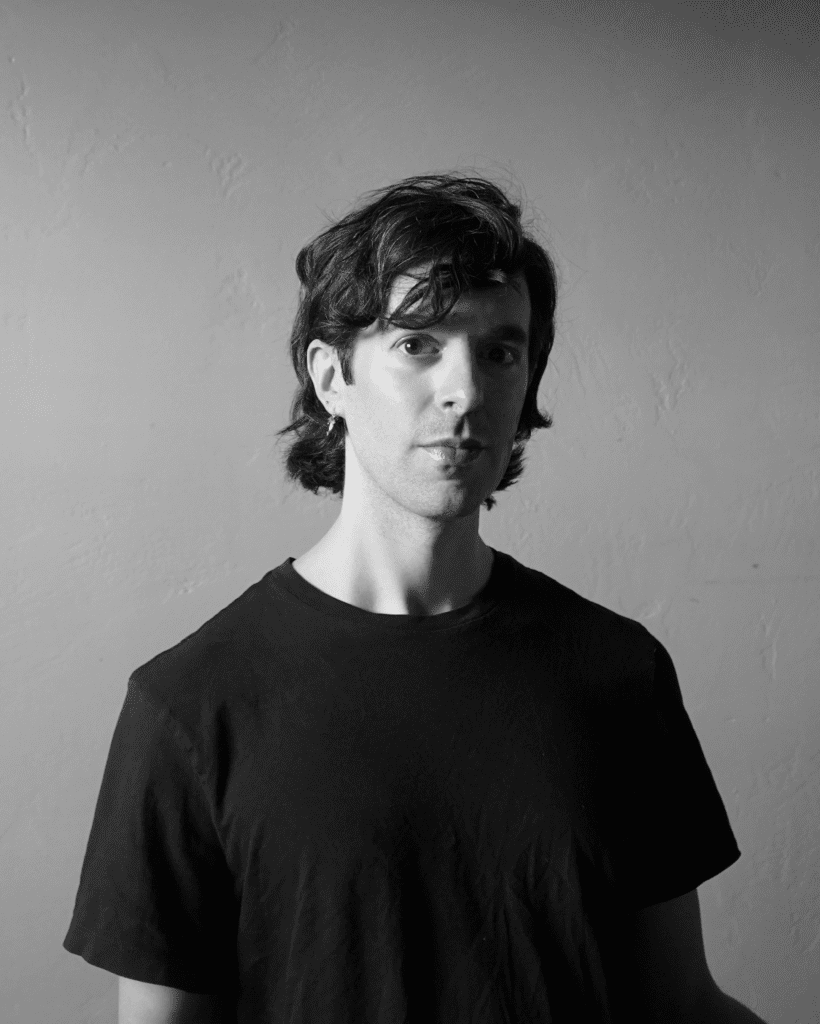
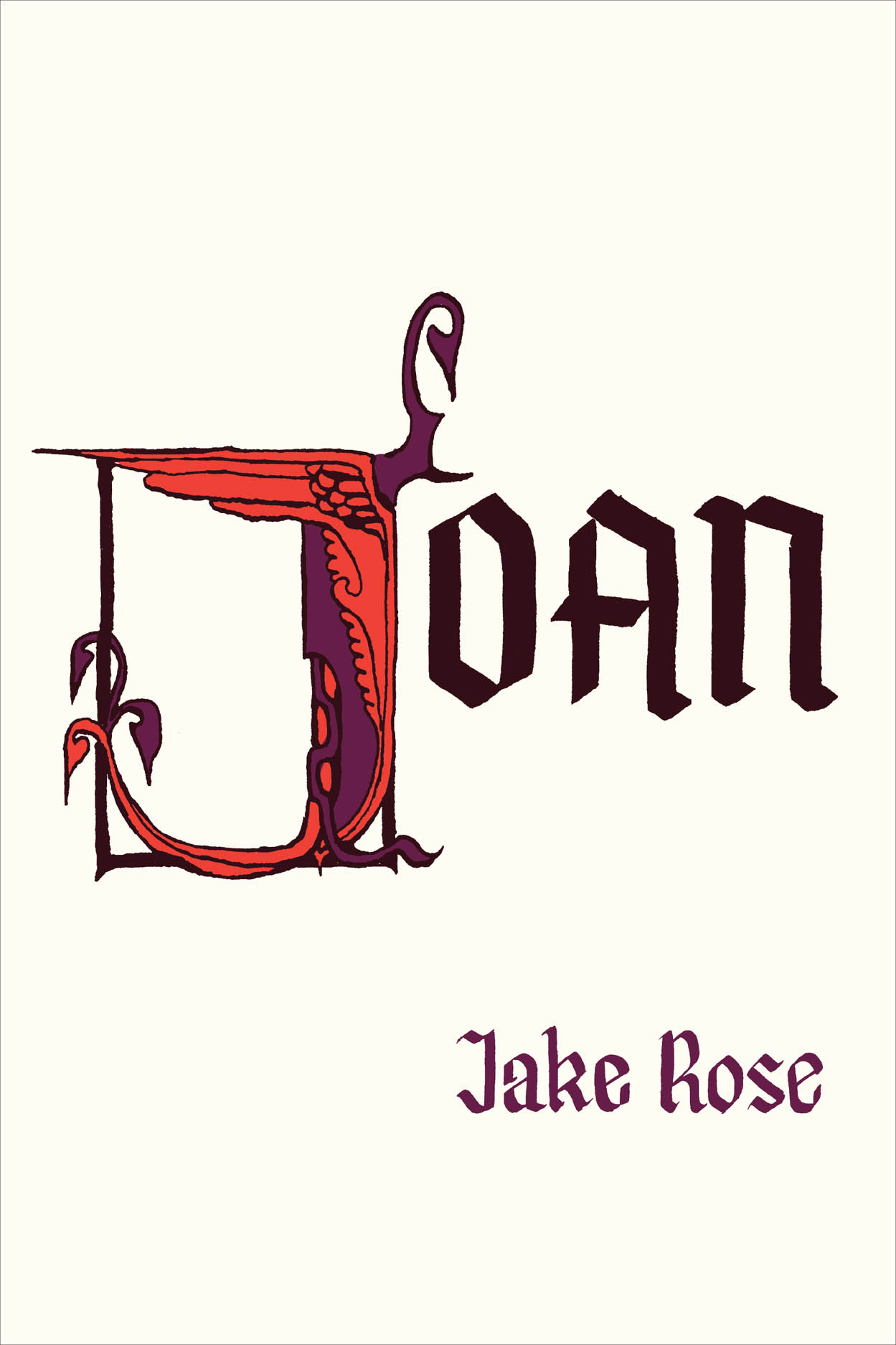
One poem in Jake Rose’s debut collection JOAN, which was published in April,reads: “sometimes a metaphysical door opens and you just have to / gawk and that’s when your mouth gets wide enough / to speak.” This line is an apt descriptor of the collection itself, which was the winner of the 2026 Phoenix Emerging Poets Book Prize. Collapsing biography and autobiography, the poetry of JOAN explores queer identity, grief, and desire through the life of Joan of Arc. The poems stretch and reach—through time, emotions, histories, and selves. They refuse the stagnancy of boundaries and assert transformation.
Rose, a poet, artist, and educator living in the Central Valley, teaches at the University of California, Davis, and has work published or forthcoming in West Branch, The Atlantic, the Academy of American Poets, Foglifter, Coach House Books, and elsewhere. Rose recently spoke to Assistant Editor Annie Delmedico at The Hidden Cafe in Berkeley about the book. The resulting interview has been edited for length and clarity.
ZYZZYVA: It strikes me that we’ve both traveled to be together, face-to-face, to talk about a book that convenes many entities—people, times, vernaculars—that won’t ever be able to meet each other. So, I want to start with a large-scale question: What does a poem make possible for you?
Jake Rose: Right, these people can never meet, but the book opens up the question: Could they meet on the page? Could this historic person and the writer, the speaker, somehow coexist together? The text tries to create that kind of open possibility through archival fragments, through image, through recreating events, through the incorporation of multiple valences and textures of both my life and Joan of Arc’s. It tries to pose the question: How can you represent multiple people in one voice?
Z: Thinking about the voice in this book, I felt a slippage or slide between multiple voices, often within a single poem. One, for example, starts with a morning alarm going off and, in five or six lines, ends up inside a battlefield tent. I don’t know if the terms “polyvocal” or “polyphonic” are quite right as descriptors, but how did you think about voice in these poems?
JR: You brought up voice and time, and I see them as connected. They both don’t move necessarily in a linear fashion, they’re both not compressed to a singular meaning.
When I think about a voice, the transcripts for Joan’s trials were the first texts that I read before writing the book—the first trial of condemnation, the second retrial for nullification. The historian Karen Sullivan analyzed these transcripts and said that Joan’s speech contains speech of both the aristocratic and plebeian, the sacred and secular, and in incorporating them all, her speech remains anomalous within each category. I thought that was fascinating—that at a time in medieval society when groups, especially class and gender, were so separated hierarchically, she was able to, through some kind of plurality or multiplicity of speech and syntax, not conform. That was something that I tried to bring in through voice.
In terms of time, although the book does progress along chapters, time can slip within poems because that’s my experience in life. How we perceive time changes completely based on emotion. If we’re experiencing intense desire or intense grief, we might remember how time passes differently. The book is filled with moments of intense desire and intense grief, and those alter how the book records events.
Z: How did you find your way to the trial transcripts? Why Joan?
JR: I was reading a book of poems that referenced a song lyric about Joan of Arc. It made me think about the historic figure as a living, embodied human being. Normally, she exists as this quasi-mystical character, at least in our American imagination. My next question was: What does she feel? What was her real-life experience?
Then, finding and reading the transcripts, I was so moved by the language and by discovering this whole living and breathing person who was as real as you or me. I wrote a first draft, which sat on my bookshelf for years. About a year ago, I took it down and started from scratch. I realized that I had written a book that was my imagination of Joan of Arc and that I instead had to begin with the question: Why do I want to write a book about Joan of Arc?
This led me to find a few points of connection. We’re both from very small rural places, both from very religious families, and have both had the embodied experience of having to hide something from their family. She had these ecstatic religious visions when she was thirteen that she was unable to share with people; growing up in a small town in a religious family as a queer person, that was not something that I was able to share with my family for a very long time. These points of connection enabled me to find some kind of point of arrival between us. Writing the book from an emotional point of view ultimately led to an excavation of my life and hers together.
Z: Could you talk about God in this book? How do you think about spirituality, the divine, religion as a social, historical structure?
JR: I’m very curious how God will be understood by readers of this book. For people who don’t grow up with religion, hearing God’s name is strange. But growing up in a religious family, God is ever present, and so God appears everywhere in this book. And there was a danger in giving every question to God, but what Joan as a person does so well is bring many questions back to herself. Part of what her interrogators took such umbrage with was that she purported to have this personal relationship with God at a time when that wasn’t particularly encouraged. The book tries to use God in a similar way—as an interlocutor that the speaker can talk to, call up upon ecstatically, resent, that the speaker can move through a multiplicity of emotions with, for, against. That is my experience in faith as well.
Z: In terms of the real events of Joan’s life, war dictated them; violence is hanging over or underneath the whole collection. How did you think about what got put on the page versus what was left unsaid?
JR: I tried to take out as much as possible of the historical events and keep the qualities of the human condition that we all experience—anger, loss, trauma. There are ways in which the politics of her life are deeply relevant to the time we’re living in today, but ultimately that wasn’t the main goal of the book, so it didn’t feel right to spend a lot of time foregrounding or cataloging the actual events of her life.
Z: Earlier you mentioned chapters. I was surprised to hear that. How did you think about organizing the book?
JR: I wanted to maintain some fidelity to the historical events, and for me that meant reflecting their chronology in the chapters—structuring the book in a way that would allow readers to understand the timeline of actual events. This then allowed me to have much greater freedom within the chapters to experiment with how time was represented and with formal elements like punctuation and titling.
Z: The poems have no titles and almost no punctuation—there is very little rest on the page. Can you talk more about these choices?
JR: I wanted the poems to have as little sense as possible of the author’s presence. In my writing practice, I don’t generally title poems. Especially in this book, it felt imperative that readers be able to enter a chapter and continuously read and to have the urgency of the text not be in any way impeded by punctuation. I was thinking about other poets who don’t use titles, like Dickinson—both her poems and her letters. The lack of punctuation and lack of titling reminded me of the epistolary form and this kind of diaristic style of writing. It also connected with me with an excess of feeling—the inability of the writer or the speaker to stop communicating with the reader. I hoped to impart the sense that there’s this urgency to speak, always.
Z: That urgency to speak reminds me of the final poem in the book, which comes after a multi-page series of images. This is only one example, but how did you use images in this book?
JR: In all my writing practices, I like to put image and text together because I feel very intensely the limits of language, our inability to communicate. It’s something that is apparent to me every time I try to write. When I begin writing a book, I’ll create an art object, or a shrine of objects, that will become a part of my generative process. There is something ineffable in an image that helps the writing process. That moment at the end of the book was a moment where there was nothing possible to say, but there was absolutely something that could be depicted.
This connects to something I’ve been thinking a lot about with endings. I’ve been wondering if attention can be resolution. Instead of writing a perfect concluding poem, I experimented with a series of images that, by the reader simply bringing their attention to what is present in them, could act as a kind of resolution. Being able to bring in images is an incredible opportunity to have that beautiful tension between art forms. I like the idea that we have to be willing to shift our mode of perspective and be asked to read differently throughout the book, that this attending-to can be another way of resolving.
Two poems from JOAN
god sent me an absence to tend
a tiny hole of curiosity he didn’t have
but could only give to others &
he never had to explain because
it was taken for granted that we
were already broken sprawled
perpetually onto inconsolable
hydrants of mercy grace and impatience
we arrived here as splinters of shade
caught on the tongues of lumbering giants
foraging in the proximity between
the melodic language of dreams and
the nudity of waking speech I don’t think
anything is perverse or unalike on this earth
I practice writing my name with my left hand
I practice fetching words even on the cloudy days
the sun flamed at noon but too distant
except to make our cheeks blush
what a relief it was to be drowned in sleep
and finally not endlessly divided
this open queer thing my heart
like a tar dipped pearl
heavy and incandescent la charité is visible now
fastened like a bead on the horizon
and my loss too no longer immaterial
as I fell into its open terms
a loosening sensation began to form
after all the meaning
had run out & abandonment rushed in
there is no more sitting in
the mongrel shade of my youth
the unfinished feelings I like to repair to
I want the feeling of having
nothing left to prove
how I always think if I don’t cut my
hair I will be beautiful but then I do
it’s spelled out on my face
what I don’t know I tried to download
when guillaume is speaking in the dark
it sounds like green olives soaked in oil
I swallow and the cave of
my mouth is the end of the world
I wonder can divine attention still see
through my darkest blunders
I display hints of what I want to
myself and then give them to others
with a gentle talent with a fingernail
of fear with subtle habits grown from
watchful years amid these tides of
indecision we sleep back to back you
breathe in my vowels and we
enter each other
like breaking waves
Reprinted with permission from JOAN by Jake Rose, published by the University of Chicago Press. © 2026 by The University of Chicago. All rights reserved.
Annie Delmedico is an Assistant Editor at ZYZZYVA. Her fiction and essays have appeared or are forthcoming in Bennington Review, Action Spectacle, X-R-A-Y Magazine, and elsewhere.