
In 2025, wildfires again broke records. The year began with the Eaton and Palisades fires, and over the course of the year, ten thousand more wildfires burned than the ten-year average. We live in a world where megafires occur with regularity, alongside disasters like the Lahaina, Palisades, and Eaton fires. While we may become inured to political headlines, the again-ness winning out, the proliferation of destructive wildfires continues to increase both in the American psyche and in reality. And who better to write on these fires than those who fight them?
In three memoirs released last summer, authors recount their experiences fighting ever-worsening wildfires across the American West. Each worked on hotshot crews, the elite firefighting crews so named because they are sent into the hottest, most dangerous parts of fires. And while each memoir describes similarly harrowing experiences, the authors relate entirely different experiences fighting these fires. In each of these books, readers will find an intense intimacy on the fireline—with the world of fire around them, with themselves, and with their crew.
Half memoir, half intellectual study, When It All Burns: Fighting Fire in a Transformed World (Penguin Random House; 368 pages) by Jordan Thomas begins with a scene of giant Sequoias aflame. A fellow crewmember radios from his lookout position, wryly noting the 300-foot-tall flames approaching. From this immersive, apocalyptic starting point, Thomas explains how we got here.
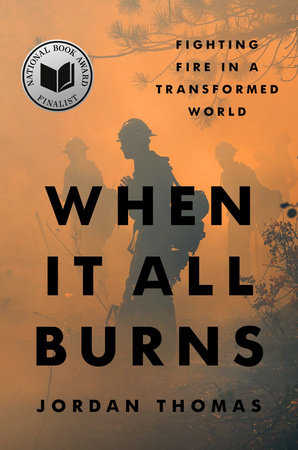
The strength of When It All Burns is its tight anthropological argument. Thomas writes about the fire industrial complex, tracing the money funneled to private contractors, fire retardant monopolies, and logging industry executives. “America’s wildland firefighting effort has further imposed the machines, organizational structures, and mentalities of war onto the nation’s forest,” he explains. He writes extensively on Indigenous burning and fire management practices from the past and present, drawing from primary and secondary Native sources, in the process drawing a direct line from the genocide white Europeans carried out across the Americas to the current fire suppression policies of today. Perhaps simplistically, but effectively, he turns that history into a throughline with a personal end point: his experience of the 2021 fire season while working on Los Padres Hotshots:
I was overwhelmed by exhaustion and the unfolding destruction. Reality quivered. In air that tasted like pine, I hallucinated flurries of snow, the smell of cozy hearths, and flickering holiday lights. But the snow was the effluence of burning buildings, the smell was wildfire smoke, and the lights were indicators that the local power company hadn’t shut off the electricity, which meant that the voltage could jump through the smoke and electrocute us.
He writes lyrically about the fire environment, often producing starkly beautiful imagery alongside humorous bits of conversation with his fellow hotshots. Their camaraderie is one of the book’s highlights.
Though a boon for Thomas, the hotshot culture portrayed in River Selby’s Hotshot: A Life on Fire (Grove Atlantic; 304 pages) deserves the scrutiny and castigation it receives in Selby’s memoir. Their book is likewise deeply researched, featuring many passages and chapters on the United States’s history of Indigenous genocide, land mismanagement, and unfair labor practices. But unlike Thomas’ focus outward, the heartbeat of Hotshot is Selby: their identity as a nonbinary person and how they viewed themself on the fireline. In service of this, Selby delves deep into their personal history.

As a young girl, their mother—who predominates, in life and in the memoir—and stepdad treated them poorly. They “told me I ate too much, that I was fat, and installed a lock on the outside of my bedroom door so they could punish me by locking me in.” Selby’s eating disorder is a constant battle throughout the memoir. Selby started to use substances, including inhalants and meth, as a young teenager; at sixteen, they began to shoot heroin. Selby recalls attempting to hitchhike to San Francisco, a harrowing ordeal that led to them being kidnapped and sexually abused in a dirty trailer with other young children. A large part of Selby’s experience as a young firefighter, then, was dealing with these traumas, while dealing with the intensely masculine and often abusive culture of hotshotting. “I was so focused on how I was supposed to be, supposed to act,” Selby writes, “that it felt like I was losing any real sense of who I was, or who I wanted to be.”
On a hotshot crew, family and teamwork are paramount. As with any culture of groupthink, though, these notions can be used as tools of alienation, can be used to attack. In Hotshot, Selby, then known as Ana, shows this through their harrowing experiences. As soon as they meet their first hotshot crew boss, the toxicity begins: “Within seconds he rendered me self-conscious, eyes trailing my body as if assessing me.” Later, he explains that he believes women mess with a crew’s equilibrium, saying outright that girls “shouldn’t be hotshots.” Selby tells of male harassment, and retaliation; of men joking about previous women colleagues sleeping with every guy on the crew. The crew nicknames Selby “Pee Spot,” because they had to find such a faraway place to pee, as Selby didn’t trust coworkers not to look. Selby’s memoir should become mandatory reading for current wildland firefighters, especially hotshots and those in leadership positions. Importantly, Selby considers a solution: during their time as a hotshot, they work alongside hotshot crews with four or five women on them. “I had never seen that many women on a hotshot crew. Would I be freer?”
In Wildfire Days: A Woman, A Hotshot Crew, and the Burning American West (Scribner; 338 pages), Kelly Ramsey writes about her two seasons on a California hotshot crew, nearly twenty years after Selby’s time hotshotting. Like Selby, Ramsey was the lone woman on her hotshot crew, and the memoir is told from this insider-outsider perspective. More than the other two memoirs, though, Ramsey’s is a zoomed-in, intimate look at work on a hotshot crew, and how Ramsey manages the ordeals of life alongside those of the job.
Even before the narrative starts, it’s clear Ramsey’s experience differs from Selby’s: Wildfire Days’ dedication reads For the boys. Her tone is comparatively lighter, and she often breaks the fourth wall to inject humor. This isn’t to say Ramsey doesn’t approach serious topics with gravity: She writes of grappling with her father’s lifelong alcoholism and recent homelessness. But this seriousness is complemented by Ramsey’s acceptance of her own imperfection, and by her ability to laugh at herself. Wildfire Days is all about relationships: about consoling a sobbing captain who she previously disliked; about her crew’s collective grief after a near-death experience. She lets us in on the inside jokes and peculiarities of each of her coworkers. This story is about belonging, and we feel that she does.

Focused on the action and the emotion that follows, Wildfire Days doesn’t develop a scientific or cultural argument. This is not to say Ramsey avoids these topics completely. In discussing the Klamath, she writes eloquently about the Karuk tribe’s influence on the region. Still, Thomas’s book is much wider in scope, and Selby’s is somewhere in between, allowing for space to wander through complex issues. While Wildfire Days doesn’t feel lacking, it does raise the question: What is the responsibility of these memoirs? The answer, perhaps, depends on intent. Wildfire Days isn’t afflicted with the sense that it’s missing something, though it does seem important to note that the other two memoirs elucidate structural and historical inequities.
It’s no surprise these memoirs were all released in the same summer. All three lay out in detail the seemingly intractable problem of climate change-fueled wildfires across the American West. But they also cut a path forward: Selby writes about the organization WRTEX, or Women-in-fire Prescribed Fire Training Exchanges. Efforts like these must expand, she maintains, and a redoubling of anti-harassment rules must go into effect on hotshot crews. In When It All Burns, Thomas writes extensively about prescribed burning, ending the book with the memory of accompanying an older First Nations Nlaka’pamux man, Harry, on a prescribed burn, one year after Thomas quit hotshotting. The flames are calm; still, Thomas’s training kicks in, and he rises to put the fire out. “You know, Jordan,” says Harry, his back against an oak tree, “why don’t you sit down and let it burn? Let it burn just a little longer.”
In the wake of the American West’s record-setting March heat wave, worries for this summer’s fire season have deepened. Across the West, hotshot crews have already begun preparing for the summer, looking towards summer with worry, but also with excited anticipation. The work of hotshotting is intense, dangerous, and sometimes lethal, and the full extent of its risks—cancer from smoke inhalation and exposure, for instance—remains to be determined. But, as can be found in each of these authors’ telling, there is joy, too. Staring up at a smoke column that Ramsey describes as stretching like “a rope from earth to space,” still standing after working harder than she thought possible, Ramsey describes an exalted feeling, as if everything has been laid bare before her.
These authors write movingly about the burning world around them, and the images they conjure are as powerful as their insights. “The world,” Thomas writes, “had gained a reddish hue under the persistent rain of ash.” The job becomes a real-life allegory: When a new crewmember questions the value of their assignment, Ramsey admits their task “defied logic.” But she had learned not to question it; she embraced the Sisyphean nature of the work. Among hotshots, there is a wry adage: If it made sense, we wouldn’t be doing it.
The world is on fire, the work doesn’t make sense, but still, you get up in the morning and do the work. You do it for the people around you, for the land, and for yourself. A motto Selby repeats when the work gets particularly difficult seems applicable to more than just the work of hotshots: You’re not dead yet, keep going.
Caio Driver is a writer from San Francisco. His writing has appeared in Witness, North American Review, and elsewhere.