
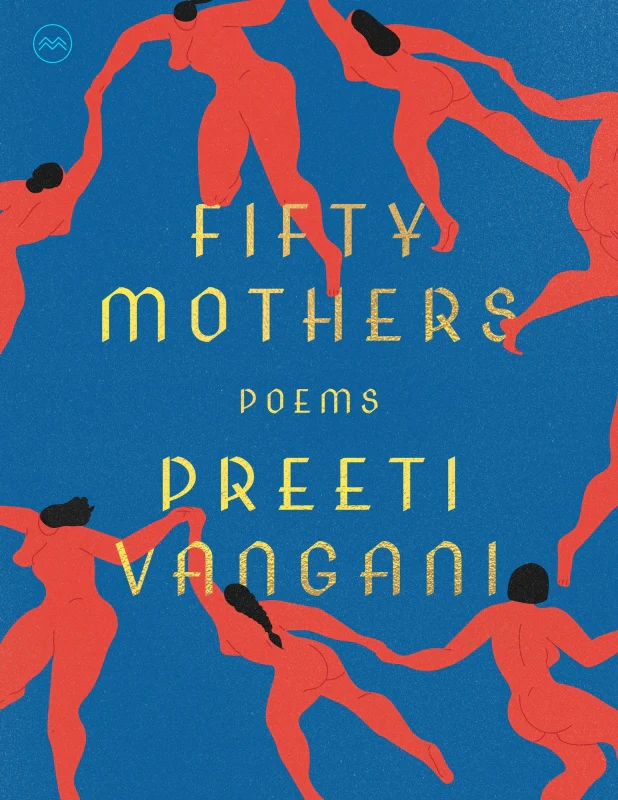
Preeti Vangani’s searing, sharp Fifty Mothers (67 pages; River River Books) captures the essence of grieving a parent. The linked poems in the collection reach for emotional highs and nadirs; rage makes peace with eros and falls back toward love. The collection, set in Bombay though Vangani now lives in San Francisco, is bookended by pages from the poet’s late mother’s college diaries, the first page taken from 1984-85. The diary’s details read like an erasure—what would have been her mother’s narrative overwritten by details about Vangani’s father’s identity, the couple’s shared bank account. The inclusion suggests Vangani’s light humor while helping us peer into her parents’ inextricably fused lives and gendered roles. “Isn’t Mummy smiling too big in this / funeral photo we’ve chosen?” reads the opening poem, the invocation of a picture expected to behave like a fact, a proof of how important she is to the family left behind. “43,44 [sic]/ then gone. God plucks some of us away randomly, / the priest said,” loss igniting a descent into grief. Vangani’s erudite vignettes create a multifaceted “Mummy” larger than life, “tightening her grip around my wrist.”
As she mourns, Vangani experiences coming of age, the “pretend moans” and “hungry boys,” as a distraction from the parallel story of “which parts of my baby-soft mother / must have surrendered to fire first.” Poems such as “Lifelike,” about her mother dressing her in a robot costume for school, lilt into wry humor (“Getting enough air?”) and a precious intimacy, one sweetened by the image of “a sewing needle [that] kept on pricking tiny holes in her foam head.” Vangani draws life from the erotic without forgetting to pay reverence to the dead: “And three buildings down the other way was my make-out spot. Three buildings away from where Mummy died […] Behind dusty scaffolding that seemed romantic as muslin at the time, I’d savored a beautiful boy’s sweat.”
Her father’s constancy is a balm—“the smoke of my father’s loneliness marrying the eye-watering emissions of speeding lorries”—and his grieving gently guides the reader toward an understanding of the interplay between their loss. “Can a song advance the narrative?” she wonders, before reflecting on “what song gripped Papa when he decided to keep from me that Mummy was terminal.” How to cast this omissio —as protection, or as betrayal? She recalls her mother’s admonishment to herself, in her diaries, to be happy. This moment of vulnerability complements the sadness of the mundane that her tight language unwinds: “Those were the days my father with silence, sparser calls and / strategic dilly dallying sold me a world where my mother was being saved.” Then: “New year. My father’s getting married.” As grief causes the external to fall inward, Vangani’s strength of heart is, as metaphor, risen, restored: “After each long glide, the hawk beats her wings, restoring / her flight.”
Danielle Shi is a writer and photographer based in Berkeley, CA. Her work can be found at Michigan Quarterly Review: Mixtape, The Rumpus, La Piccioletta Barca, The Margins, and Common Forms.