
A chapter from Robert Glück’s Jack the Modernist appeared in the very first issue of ZYZZYVA in 1985. It’s the chapter where Bob, Glück’s avatar and the novel’s narrator, leaves Jack, his lover, in bed and goes to the baths. There, he compares “an orgasm that can be read two ways” to a particular Victorian illusion painting that appears to fluctuate between a woman at a vanity and a skull. We vaguely remember an actual image of said painting from twenty or so pages earlier; the pictures in Jack the Modernist are dispersed, sort of like the pictures in Nadja, that other briefly-told story of obsession by Breton (a Modernist of a different sort). Whereas the obsession of Breton’s narrator is ultimately a kind of outward projection of the self, Bob’s love for Jack much more interestingly locates the self in a collective. Compare opening lines: in Breton, “Who am I?”; in Glück, “You’re not a lover till you blab about it.”
Spreading out in either direction from the chapter initially excerpted in ZYZZYVA, Jack the Modernist is an historical feat: a conglomeration of literary traditions and a document of a smart and sexy gay milieu just prior to AIDS. Glück’s workshops in the seventies at Small Press Traffic in San Francisco birthed a community of writers whose writing came to be described as New Narrative. A new edition of Jack the Modernist is now available from NYRB.
The following interview was conducted via email in October 2025, spanning Providence and San Francisco, where Glück still resides.
Z: The novel is awesomely bookish. How do you think about the figure of the reader alongside other sorts of roles that appear in the novel, for instance the writer, the lover, the gay man, the friend? Put differently, what does reading in the novel have to do with sex, writing, or gossip?
RG: At the beginning of New Narrative, we were thinking about reader-writer dynamics by asking the reader direct questions, turning the reader into a writer. I want the reader to feel implicated in my books like the audience of a performance artist—the performer takes a risk by making themself naked in some fashion, but there can be no risk and no performance without a complicit audience. In that sense, I want to create risk on the page, something irreversible. I do mix up reading and writing. For example, I have brought in texts, like Margery Kempe’s autobiography, and a story by de Sade, and retold them in my books, so I am a reader in my books as well as a writer.
Z: In his new introduction for Jack the Modernist, Rob Halpern likens your sentence to “a stage upon which the relationship between body and mind is performed.” He describes your prose as equal in “sincerity” and “theatricality.” Often, the dialogue in the novel is structured scenically with lines of speech attributed very explicitly to characters and non-verbal language placed in parentheses, like stage directions. If theatrical performance is a joining of text and embodied experience, the scripted moments of the novel read like embodied speech, a kind of dialogue that feels closer to two people actually talking. Do you think of your prose as theatrical? What is different between the different forms of dialogue throughout the novel?
RG: The writing in Jack is heterogenous. I used different forms and tones to express different characters and kinds of moments. I describe Phyllis, a writer in my workshop whose son has been killed, with the middle distance of a traditional novel. With Jack the language is more fragmented, with extreme close-ups and so on. The dialogue that appears as a script seems rough to me, crude. I got the idea from Kathy Acker. And I believe she got it from William Burroughs. It tweaks the reader’s expectation. Say it’s like Bertolt Brecht’s alienation affect, to make the familiar seem strange. It allows the reader some distance from the proceedings in which to make their own judgments.
Z: How was Jack the Modernist received at the time of its original publication?
RG: Jack was completely ignored by the literary journals of record, like The New York Times and Publisher’s Weekly. By 1985 there was a vibrant gay press, and Jack was reviewed in every gay newspaper, journal and weekly, from here to Saturn’s moons, including porn magazines that often had excellent culture pages. In fact, when sections of Jack were published, they could be found in serious literary venues but also in porn mags. This pleased me because in the first place I thought of Jack as a Valentine to the gay community. My goal was to be that part of the community that tells the community its story. In Jack being gay was perfectly normal, nothing to hide, no self-doubts, with a life that included family, friends, work, politics, and a spectacularly non-heterosexual sex life. Jack was also directed at my overheated experimental writing community, where it was warmly received for the most part. The Language poet Barrett Watten said, “You have your cake and eat it too,” which I took as a great compliment.
Z: How do you like San Francisco these days? What Bay Area writing are you reading?
RG: There are two San Franciscos at least. San Francisco remains a city of great beauty and disposition. It is also a city that is plagued by the effects of income disparity, a problem at the heart of much that is wrong with our country. Economic markers say the USA is doing just fine. At the same time many of us are experiencing a new great depression. San Francisco has never been a well-run city, more a collection of “cities on the hill.” But the problem of income disparity is too much for a city to solve. Solutions must come from above, as they did in the Great Depression.
The Bay Area still has a wonderful, over-heated writing scene. Some of the writers I enjoy are from old new narrative cohort, like Camille Roy and Bruce Boone, and peers like Norma Cole. There is a barrel of younger (than I) writers to enjoy. The list is way too long: Brandon Brown, Alli Warren, Evan Kennedy, Noah Ross, Eric Sneathen, Jocelyn Saidenberg, Trisha Low, Jacob Kahn, and many many more.
Z: Jack the Modernist is a novel, but much of your work has been published in magazines. Do you feel differently toward your writing depending on how it exists as an object, or depending on how it is circulated?
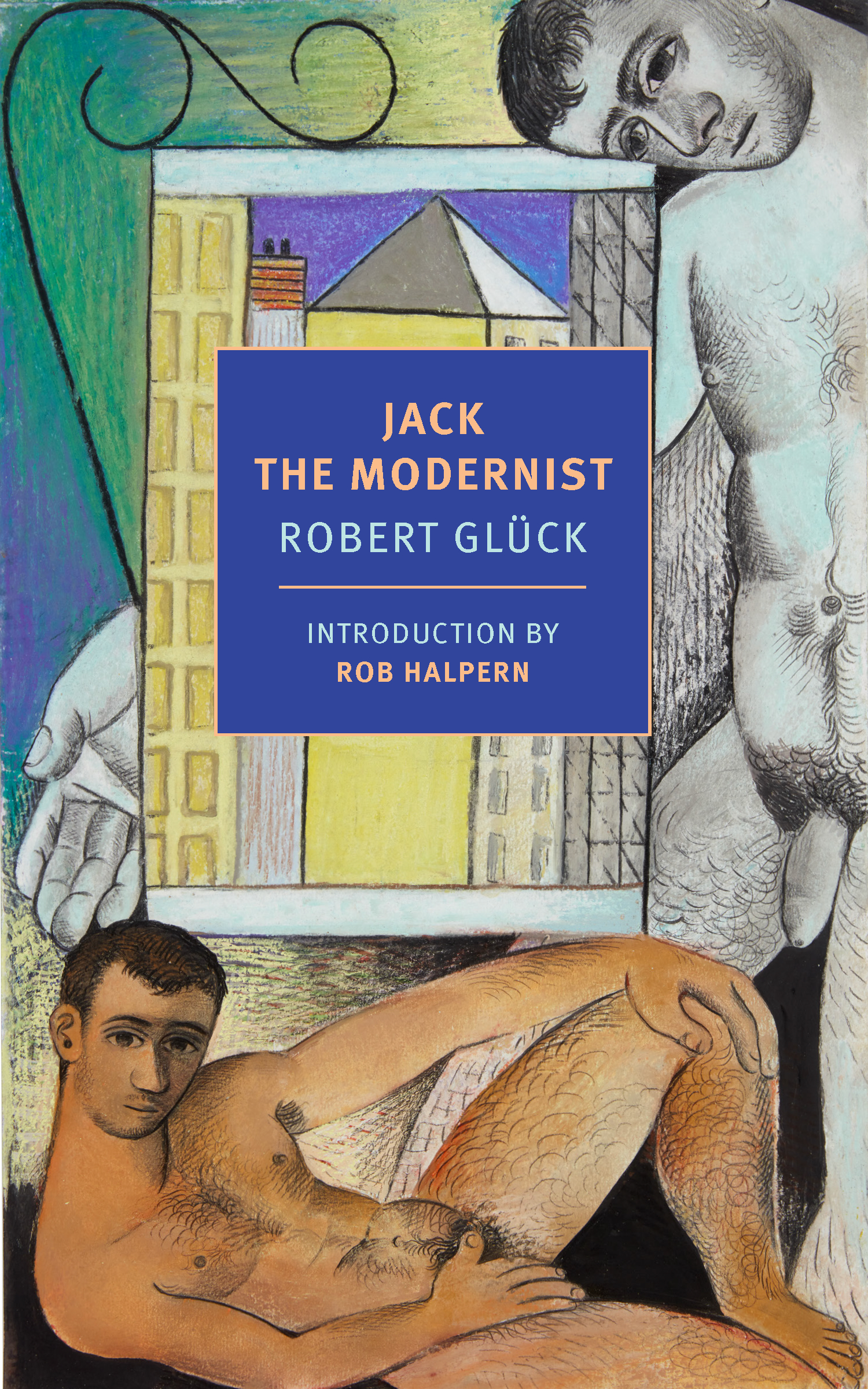
RG: Sometimes my work appears in magazines before I gather it into a book. Magazines and journals can be helpful, seeing the work in print when making revisions. I tend to think in terms of a book. I am always involved in the cover, for example. I know how the text should appear on the page and the size of the type I want. Maybe this comes from being a visual artist as well as a writer. Bruce Boone and I had a press long ago, Black Star Series. I designed the books and presented the “mechanicals” to the printer. It was more hands-on, long before the computer.
Z: Bob gives Jack a definition of community: “Ecstatic sexuality.” Certainly, in the novel, sex is key for understanding how selves can fit together as communities. Did sex, at the time, indeed feel helpful for community? Did it feel like there was community to be found in sex?
RG: Oh, in the seventies and early eighties sex defined pretty much everything. Gay cookbook? Naked chef on the cover. Gay Christmas? Naked Santa. Why were we so frantic? We had lived through an era in which our sexuality was only a crime and only a disease. Can you imagine the energy released in liberation? My description of a community was borrowed from the French philosopher Georges Bataille, who recognized an emptiness at the center of communal life, an emptiness in which the bonds of the self are loosened. Not merging into a group but disappearing into nothingness. A community makes this adventure possible, according to Bataille. He recognized this in different cultures in different rituals, like the celebration of mass in a Catholic church. I sited it in a gay bath house.
Z: For Bomb, you call Jack the Modernist a “young man’s book.” Of your three novels, it was written earliest. Differently but perhaps relatedly, Lucy Ives, in The Paris Review, describes the audience at a reading you gave at the Poetry Project: “rapt twentysomethings.” Do you think the novel, and maybe your writing in general, is somehow youthful in form? Is it possible to think of Jack the Modernist not only as your first novel, but as a specifically youthful work?
RG: Jack is young: I was a young writer still figuring out New Narrative. I was exploring a newly minted gay identity in a story of young love that takes place in a community new to history and inventing itself. I think it explores a young man’s experience, as Margery Kempe explores mid-life, and as About Ed has the point of view of an old man. On the other hand, I’m always trying something new. A book is not interesting to me until it’s impossible for me to write. I must be a different person to write it, and so I become that person. I have to reinvent the wheel each time. I hope young people find something to like in my writing—the future belongs to them, as the song goes. Of course, it’s not for me to say.
Benjamin Flaumenhaft studies Comparative Literature at Brown.