
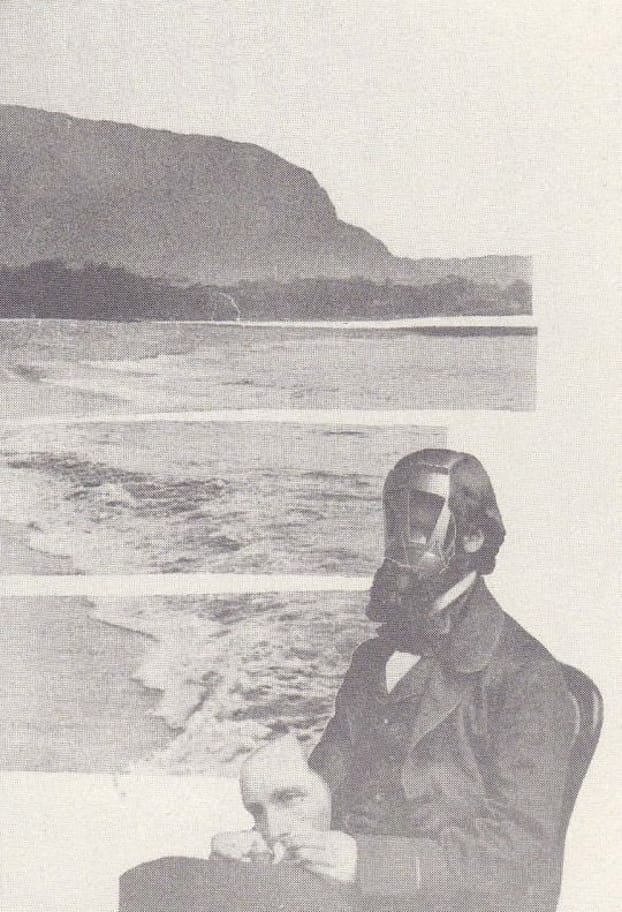
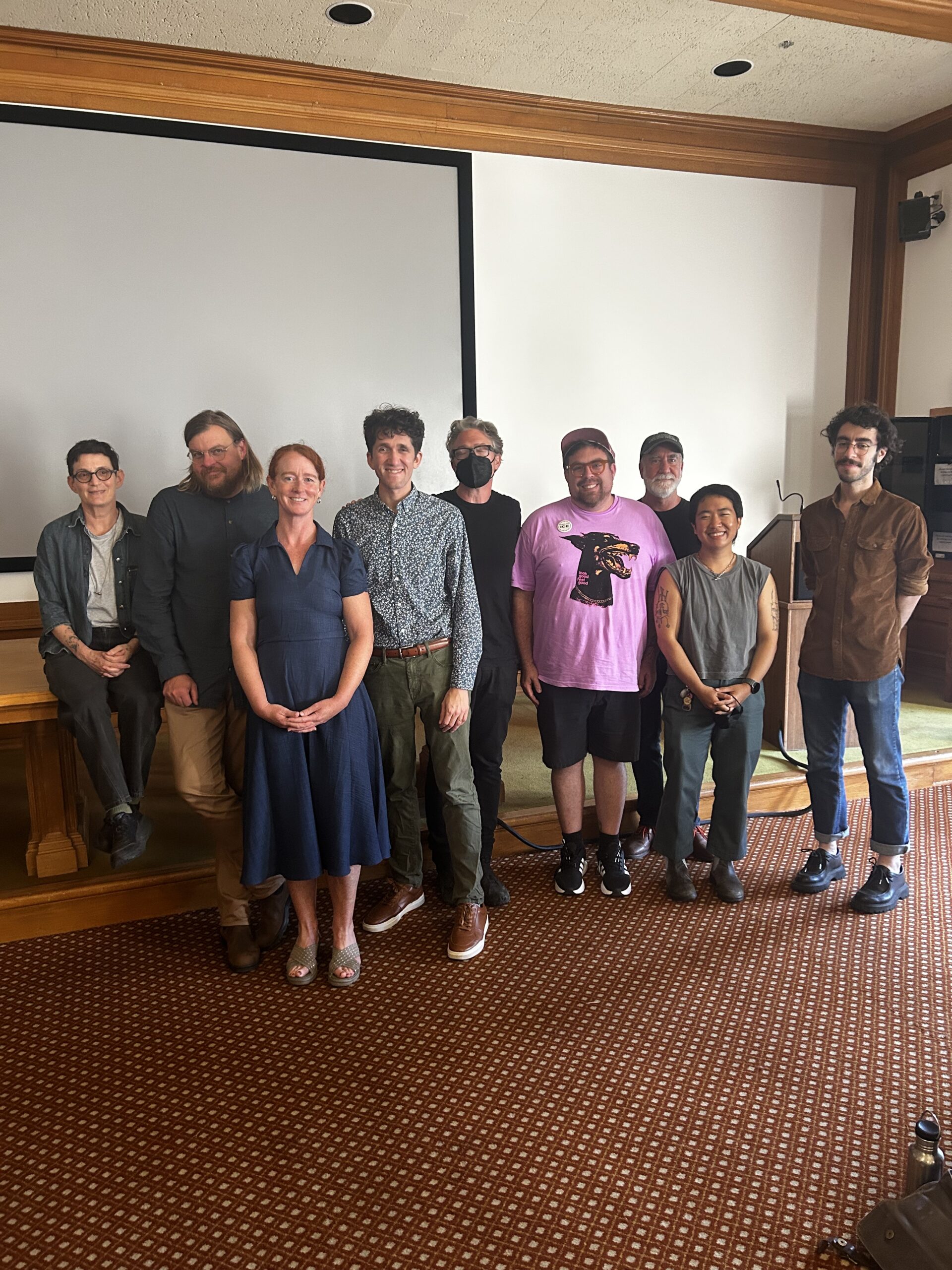
It felt very fitting to launch Even Strange Ghosts Can Be Shared: The Collected Letters at Jack Spicer (Wesleyan, 2025) at UC Berkeley’s Wheeler Hall.
The campus was a key location for the California poet Jack Spicer (1925-1965) at the bookends of his poetic career. Spicer would designate his arrival at Berkeley in 1946 as the year of his birth. In the late 1940s, he organized the Writers Conference poetry workshops in Wheeler Hall, the first of the many alternative poetry spaces he curated on the margins and outskirts of academia. In 1965, Spicer lectured and read at the Berkeley Poetry Conference in Wheeler as well, weeks before his untimely death at age 40.
The letters that were read at the launch event in September 2025 reflect the range of social entanglements that run through Spicer’s poetics, gesturing to past networks of connection and creating new ones as well.
Leo Dunsker reflected on the impact of Ezra Pound on Spicer, through Spicer’s letter to the editors of the Pound Newsletter. The Newsletter, a mimeographed journal edited by Berkeley English professors housed in Wheeler Hall as well, offered a new model for integrating the study of contemporary poetics into the academy and inspired Spicer’s later collaborative work on the Boston Newsletter.
Brandon Brown and Kelly Holt spoke about the contemporary personal connections which emerged from their work on Spicer’s letters. Brandon linked Spicer’s writing of astonishment, to Robin Blaser, with his own astonished participation in the unboxing and processing of Spicer’s papers in the Bancroft Library with Peter Gizzi and Kevin Killian. Kelly, co-editor of the letters along with Killian and myself, read one of Spicer’s many beautiful letters to the printer Graham Mackintosh, and described how her study of Spicer led her into a collaboration and friendship with Graham too.
Finally, Andrew David King read Spicer’s last extant letter to Sister Mary Norbert Korte. Korte was a nun when Spicer met her at the Berkeley Poetry Conference. She ultimately left the convent and dedicated her life to poetry — inspired in part by the relationships she made there. Fittingly, Andy reflected on the many relationships that Spicer’s letters have marked in his life, and how “a body of work, and a body of people, begins rather than ends.”
—Daniel Benjamin
Leo Dunsker
Here [To the editors of the Pound Newsletter] we find Spicer taking up the cudgel on behalf of his former UC Berkeley classmate Thomas Parkinson following the latter’s skirmish with the formidable Hugh Kenner in the mimeographed pages of The Pound Newsletter. The Newsletter, circulated between January 1954 and April 1956 by Parkinson’s fellow Berkeley professors John Hamilton Edwards and William Vasse, seems in retrospect like the herald of a future that never arrived: a version of the “Mimeograph Revolution” in which scholars of poetry participated alongside the poets, concerned with the writing of new poetry and the interpretation of what came before. Like many of the younger poets drawn to Pound’s work in the 1950s, Spicer shared Parkinson’s impatience with those who shrewdly disavowed Pound’s politics as mere “biographical” trivia, fearing that anything else would “start up howls from the mush-heads of the literary world” (Issue 5, 28–29). But Spicer is careful to frame his intervention in more general terms: whether a poet’s politics constitute an “unimportant biographical detail” or an “essential critical issue” depends “on how his poetry, not he, sees the world” (169, emphasis added). To my ear, the precise content of that “how” is less interesting than the implication that poetry sees the world. Dante’s Paradiso narrates the progressive refinement of its poet’s vision; led by his conviction that, in Donald Davie’s words, “the paradisal is real, out there in the real world,” Pound sought in The Cantos to refine and clarify the vision of his readers (Poet as Sculptor 72). Paradise is something you can see—in the political kingdom, but also in luminous details like “unexpected excellent sausage, / the smell of mint for example,” if you knew how to look (LXXIV/438).
It was a similar conviction that hurt Spicer into poetry, impelling his search for communitas among poets as well as his contemptuous invectives against all perceived betrayers of this communal ideal. “What thou lovest well is not dross,” says Pound; and as for what thou hatest well, there is the incantatory proem of Golem (1962), where Spicer takes up the flail of Jehovah against John Wieners, Dave Haselwood, Robert Duncan, and all the others who have driven him away from poetry “like a fast car” (Vocabulary 361). The same knack for invective comes through in this letter: we find the complacent “mush-heads of the literary world” presented in a somewhat more sinister light by Spicer, who attributes the gag order on Pound’s antisemitism to “the fact that there are too many Jews and too many antisemites on most English faculties for the subject to be safe for the employed scholar” (emphasis mine). Here, again, the conceit points back to Pound: the adversaries of the “bellum perenne” described in The Cantos are really co-conspirators (LXXXVI/568). The reader of Spicer’s poetry sees the seeing of paradise, if only fleetingly, out there in the real world. It is not to be confused with the English Department.
Brandon Brown
Seeing Even Strange Ghosts Can Be Shared felt like a loop closing, one that opened for me over twenty years ago, when Kevin Killian invited me, along with other young poets, to join him and Peter Gizzi at the Bancroft Library to review the arrival of the Jack Spicer papers from Robin Blaser in Vancouver. Those days are unforgettable: Kevin and Peter’s excitement at encountering the material for the first time was powerful and infectious. As a young poet, obsessed with Spicer and only beginning to grasp the generosity and commitment Kevin and Peter brought to this work, it offered an early glimpse of something just starting to move from the mysterious into the known.
I love the letter I read in the Maud Fife Room, written to Blaser on December 10, 1956. Spicer’s moods are fully on display: maudlin, bitchy, gossipy, generous, sweet, and visionary. “What I need most, of course, is for someone to astonish me,” he writes, and shortly after, “Poetry only happens, I think, when people astonish each other. And love is a special variety of astonishment.” Reading it helped me understand the meaning behind the enthusiasm I saw in Peter and Kevin two decades ago, the kind of astonishment that we know as love.
Kelly Holt
Spicer’s reflections on the letter as a place outside of space and time permeate his correspondence with Graham Mackintosh. It’s as if the young man Spicer is writing to has, by means of the letter itself, been transported outside of the confines of circumstance: in this case, Graham Mackintosh, Spicer’s former student at the California School of Fine Arts (later to become the San Francisco Art Institute), now in basic training in preparation for the Korean War, takes position as the poetic recipient and through the letters a poetic crowning takes place. Throughout his letters to Graham Mackintosh, we find essential, formative sparks of Spicer’s developing serial poetics along with the humor, inside jokes, absurdity, and truth-telling that establish his collected letters.
I met and got to know Graham Mackintosh many years later, around the time of the Poetry Center’s 50th Anniversary in 2005. He was the printer for some of Spicer’s books published by White Rabbit Press in the early 1960s, and he still had the huge iron press in the garage of his house on 10th Avenue. I lived on 17th and Kirkham at the time, which was within walking distance up the Moraga tiled stairs and through the hills which are now known as Golden Gate Heights. Graham invited me to work on a printing project with him, a broadside of one of Spicer’s poems from Language. He showed me how the press worked, how to set type, and how to add in artistry: Graham designed a ghost signature, using Spicer’s handwriting, to come after the typeset poem. As we worked on the project and talked, I got to know his quick wit and sense of humor as he told me many stories of working with Spicer and others.
This humor is seen in the comics and handwritten mock newsletters sent between Spicer and Mackintosh. Spicer’s “Aware America” accompanied many letters to Mackintosh, and Mackintosh returned with an illustrated comic called John Toilet, which was hilarious.
I would have chosen to read more than one of his letters to Mackintosh, but chose this one, #30, dated December 13, 1954, because in it we can read a central theme that Spicer develops throughout his letters and his serial poetics: the fractioning of the writer and recipient into various objectified personae, based on memory and the loss of immediacy in the relationship. In true form, Spicer describes this process in terms of shadows, ghosts, games, and imagination, extracting a sense of pure being within the ongoing process of becoming:
On the day after I’ve seen you it always seems that I could write a letter to you that could go on forever. Your image is restored to me. What, after three weeks of absence had become a shadowy Graham, a Graham not very far removed from my merely talking to myself, has become a real Graham, a Graham made of flesh and tears. But not completely—the Graham I played chess with yesterday is not the Graham I can play chess with at any time I choose, he was a temporary Graham, realer than the shadowy Graham that I play chess with every day in my imagination, but not as real as the Graham I hope for—the Graham unrestricted by time.
There were so many things I couldn’t get to say to you (for, of course, I was only the half-real Jack—the Jack who is only a little better than a letter)…
His own notion of himself as a “half-real Jack…who is only a little better than a letter” resonates with many of his ideas about the role of the poet in the creation of the poem, especially in relation to the crucial process of emptying the subjective proclivities of the poet in order to engage in an authentic poetry. The temporary Graham and the half-real Jack engaged in a finite game of chess provides a kind of Orphic mirror we see in The Heads of the Town up to the Aether against the shadow-selves within the fullness of memory and eviternity. Through these partial and projected positions that the letters require them to be, Spicer further develops his practice as a poet being at the mercy of a poetic source that demands extraction of his subjectivity. The “letter… that could go on forever” resonates with the poem that could go on forever in “Psychoanalysis: An Elegy,” an early poem that can be read as a predecessor for his practice of the ongoing series. The fragmentation of “Mac” and Jack in this personal letter also resonates with his central construction of the author-text in his letters to Lorca.
Andrew David King
A specter haunted my undergraduate years at Berkeley, and his name was Jack Spicer. I first encountered his ghost around 2012, four years after My Vocabulary Did This to Me had come out; a close friend, also a poet, who had spent days with Spicer’s papers in the Bancroft out of sheer obsession gifted me the collected poems for Christmas. Spicer and other poets associated with the Berkeley and San Francisco Renaissance became the patron saints of our misfit group that huddled on the checkered floor of Julia Vinograd’s Caffe Mediterraneum every week–our own “ghostly symposium” of poets “holding forth on their peculiar problems,” to borrow Spicer’s words from a 1949 essay for Occident Magazine. Our veneration of Spicer was the sort he mocks in the unpublished poem “Birdland, California”:
It is now October 5th (or 6th)
English majors
Can discover the correct date
But, to tweak David Antin, we never knew what time it was. All we knew was that we wanted to zest our poems with real lemons and grass-stained baseballs, and we thought Spicer could teach us the necessary spells. Curious about who or what my friend was contacting in his Special Collections seances, I pulled some of his and Lawrence Ferlinghetti’s materials. My recollection of those visits is fuzzy, but Spicer’s single-line reply to Ferlinghetti’s request for work for an anthology remains clear. “Dear Ferlinghetti, / Under no circumstances may you publish my poem,” he wrote in an outsize hand and what appeared to be red crayon. These are the kinds of encounters that give one archive fever, the kinds of details that the already unprofitable undertaking of academic publishing—once described to me as capitalism in reverse, everyone losing money at every step—can’t, for reasons of time and materials, reproduce in facsimile, however much semantic loss that entails. The Spicer I got to know first, then, was not just sardonic and acidic but vituperative, while also being, of course, deeply funny. This was the poet who bought clothes secondhand rather than wash the ones he already had, who broke a lamp because he wanted brandy and was poured coffee, and who, apocryphally, had sex with Robert Duncan in the fourth-floor men’s restroom of this building.
But behind this was another, gentler Spicer, like the one who wrote to Sister Mary Norbert Korte in July of 1965—the last letter collected in Even Strange Ghosts Can Be Shared. Spicer and Sister Mary had met only days prior, at the legendary Berkeley Poetry Conference held across the street in California Hall, where Spicer had given a polemical lecture on the separation of poetry and politics. A photograph made by Tové Neville that ran later in the Chronicle, and which the reporter mailed to Spicer on his deathbed, shows the two smiling widely, Spicer’s black suit and shirt the inversion of Sister Mary’s white gown and black habit. In the Q&A after Spicer’s lecture, Sister Mary had offered up the songs of the labor and civil rights movements as counterexamples to his thesis—perhaps you don’t consider them poetry, she had remarked, but they still moved everyone to either hate or love. Spicer, for his part, seemed blown away by the observation, admitting that “[i]f I could write popular songs, I’d do it.” Brenda Knight, in Women of the Beat Generation, documents how, at the Berkeley Poetry Conference, Sister Mary “found her true calling… as she experienced an ecstasy in the auditorium she had never experienced in any cathedral.” Not long after sending the letter, on the last day of July, having spent the afternoon at Aquatic Park, Spicer collapsed in the elevator of his building. He would pass away in SF General in the middle of August.
For all his acrobatic thorniness, the last letter we have from him is a document of affection and, in his own punning words, communion. The letter references “Barbry Allen,” an English ballad described by ethnomusicologists Steve Roud and Julia Bishop as the most widely collected song in the English language, recorded by Pete Seeger, Joan Baez, and countless others: A woman spurns a dying man and then dies of regret herself, only for the two to reunite as rose and briar on the graveyard lawn. This Craigslist Missed Connections post avant la lettre is sweet for what it suggests: that the conversation between Spicer and Sister Mary had gone past the Q&A, that they had both continued to dwell on the fusion of political and aesthetic action in instances of communal making. The reference is, I’m guessing, chronologically the last bit of written text through which Spicer dictates a reminder to us of the complexity and pain of his own desire for, and repudiation of, communion—social and aesthetic and sexual and political.
Last month, I met a friend from those Caffe Med days in the city to see the Wayne Thiebaud retrospective at the Palace. We had some time left over, and so I suggested, on a lark, that we drive down to Colma, the city of the dead, to see Spicer’s grave. I’d half-heartedly tried to locate it a few times before, but the necropolis defeated me. We walked around an unfinished mausoleum for an hour before determining that we were on the wrong side of the highway straddled by the colossal Cypress Lawn complex. Before I could get someone from the front office on the phone, we ran into a kind groundskeeper named David—whose ancient namesake appears in the letter. David, who split his working life between the cemetery and a bar, hadn’t heard of Spicer, but he recognized the location by the photo we showed him, and he led us down a locked, dark corridor to a side room lit by the pomegranate-colored glow of a stained glass ceiling brought by rail from Chicago’s United Glassworks a century ago. On one of the earth-brown squares, among thirty or so other names, there he was: A plaque read “John Spicer.” His brother Holt had recalled that Jack hadn’t wanted any grave marking, and in a sense this wish was fulfilled by municipal indifference: He’s buried with a classroom’s worth of people not as Jack but as John, the scribe and evangelist.
I was lucky enough to get involved with this project when, in 2022, Daniel asked me to do some archival work on his behalf, which continued intermittently between then and now. My visits to the Bancroft mostly consisted of taking photographs, checking transcriptions against originals, and noting new letters that turned up. Daniel and I had been classmates in 2012, when we both took Geoffrey’s graduate poetry workshop. I remember how another friend of ours had recited the first of Spicer’s “Love Poems” to kick off one class. The community of Spicer’s readers strikes me, to borrow a distinction from Charlie Altieri, as a community in time rather than just a community in space, one that begins with him and extends onward and outward, through all of Berkeley’s plagues and those to come, as in the first poem in My Vocabulary…:
Plague took us, laughed and reproportioned us,
Swelled us to dizzy, unaccustomed size.
We died prodigiously; it hurt awhile
But left a certain quiet in our eyes.
I don’t know what it means to die prodigiously, but I felt I could’ve given an ostensive definition standing there next to David and Kayla, the three of us gathered with our fingers on the cold metal of Spicer’s given name. The turn towards openness and grace in Spicer’s letter to Sister Mary reminds me of Socrates in the Phaedo, who, in the face of death, reinterprets the recurring dream in which the gods tell him to make music and tries to write poetry rather than philosophy. Not conversion, but revision; in Spicer’s case, and in my own case reading Spicer, the turning of an early death back on itself so that a body of work, and a body of people, begins rather than ends. As Spicer wrote to Graham Mackintosh in 1954: “Now, when a ghost comes into a dream I am still afraid, but I use that fear to force the ghost to tell me something.”
* * *
To the editors of the Pound Newsletter
{ca. 1955}
It seems to me that the spirited but peripheral exchange of insults between Mr. Kenner and Mr. Parkinson in your last issue tends to obfuscate the very important question that Mr. Parkinson had previously raised. Anti-semitism, like every other idea or crotchet of the poet’s mind, can be an unimportant biographical detail or an essential critical issue. It all depends on how it affects the way his poetry, not he, sees the world.
No one gives a damn whether Wallace Stevens is a Republican or a Democrat, but a man would be an idiot to try to understand the Divine Comedy without knowing what sort of Ghibelline or Guelph Dante was. It is merely impolite to wonder whether Cowper was an active homosexual, but it is of central importance to Whitman’s poetry to discover whether or not he was. Was W. C. Fields a crypto-Stalinist? Who cares? Is Chaplin? Can one understand his later movies without considering the question?
There were three hints of anti-semitism in Pound’s Europe: the social kind (ranging from the how odd of God attitude of our aunts and uncles to the more pretentious snobberies of, to name two, Mr. Waugh and Mr. Eliot), the economic-political kind (which stems from the fact that the Jews did control most of the money and governments of Europe in the late nineteenth century), and the mystical kind (which saw in the Jew a symbol and a scapegoat for the evils of the modern world). An analysis of Pound’s anti-semitism (a complex of all three) would seem to be one of the most important problems that a Pound scholar (ugly phrase!) could try to solve, and I can only attribute the absence of such a dissertation to the fact that there are too many Jews and too many anti-semites on most English faculties for the subject to be safe for the employed scholar.
To Graham Mackintosh #30
Monday, December 13, 1954
{975 Sutter Street, Apartment C, San Francisco, Calif.}
Dear Mac,
On the day after I’ve seen you it always seems that I could write a letter to you that could go on forever. Your image is restored to me. What, after three weeks of absence had become a shadowy Graham, a Graham not very far removed from my merely talking to myself, has become a real Graham, a Graham made of flesh and tears. But not completely—the Graham I played chess with yesterday is not the Graham I can play chess with at any time I choose, he was a temporary Graham, realer than the shadowy Graham that I play chess with every day in my imagination, but not as real as the Graham I hope for —the Graham unrestricted by time.
There were so many things I couldn’t get to say to you (for, of course, I was only the half-real Jack —the Jack who is only a little better than a letter), things about hope and courage. This overtime period is extremely important (you lost the last game in an overtime period, remember, by the closest of margins), but when I tried to give you words of hope and courage they would stick in my throat —I guess because, in the last analysis, we can’t give hope and courage to another person —only those things which hope and courage are based on.
After you left, someone gave me a kaleidoscope too. It will give us a sort of a new connection —when I look into it, I can imagine that you may be looking into yours and that we may be seeing the same pattern. Of course the army, which hates kaleidoscopes because their patterns cannot possibly have numbers, will probably confiscate yours, but, if they don’t, we may be able to work out some method of communication with them —looking into them at the same time and your pattern answering mine or something like that. Kaleidoscopes are also good for telling fortunes—ask it a question and look into the tube, then it becomes just a question of interpretation.
This letter has been the most painful to write of any (I guess you became realer to me this leave) and I can hardly wait until you start becoming unreal again and I don’t feel the pain of your pain. Yet the pain is worth it and curiously mixed with pleasure and I have the curious feeling that the permanent Graham and the permanent Jack will be playing chess together sooner than either of them realize.
Yours
Jack
To Robin Blaser #21
10 December 1956
{2208 Parker St., Berkeley, Calif.}
Dear Robin,
I feel more Gulliverlike every day. All these nice little people crawling around me, wanting me to tell them how to grow up and get big, even if they’re all too old and too stupid to do it. Not to mention too small. Why can’t I let people alone?
Am reading Barbellion’s Journal of a Disappointed Man. Marvelous and would be special food for your poetry. Also for sheer bitchy fun Angus Wilson’s Anglo Saxon Attitudes. Write me a punishment, Robin.
What I need most, of course, is for someone to astonish me. That’s what happened in Boston. Almost every poem you, Joe, and Jonas wrote was an astonishment for me. Poetry only happens, I think, when people astonish each other. And love is a special variety of astonishment.
Pat Wilson tells me that the Berg episode caused huge amounts of trouble in the Cal Library and that several careers were permanently blighted. This is all supposed to be dead secret, but I can get you the details if you’re interested. Pat’s mother, who abandoned him when he was six months old, is suing him for non-support.
A magazine sounds like a waste of moral energy. Why not manifestos though. Draft a new manifesto every week at your poetry meeting and send a copy to me. I’ll promise to reply to them point by point. I need a few manifestos to answer. I should give you a word of explanation about the Sonnet Exercise. Allan Joyce is writing a paper on Sh’s Sonnets and I had him and me take the last words of each line of one of the sonnets and make a new poem of them. This was my result and I like it mainly because the imagery was irresponsible. I am gradually beginning to realize that landscapes do not have to be consistent.
What a miscellaneous letter! But I am feeling miscellaneous recently. Give my regards to our mutual friend the Charles River who will never be able to come to Berkeley.
Love,
Jack
To Sister Mary Norbert Körte
{July 1965}
{1424 Polk St., #22C, San Francisco, Calif.}
Dear Sister Mary,
I think that I feel the call of your religion almost as much as you feel the call of the outside world. This world is outside. For Christ’s sake don’t question that.
The communion of hearing each other’s songs is what John the XXIII died for. It’s not a real communion until you can hear them at night and I can hear them in the daytime. It’s a good start and all the static that Pio Nono caused is gradually being erased. It’s only a good start.
I wish that God would come to me like he would come to you, sometimes but worth the some-times. I wish I were a singer like David.
Your poem moved me but has exactly all the constructions poetry has. Your challenge of songs to me should have been met by you. We both (and every poet I know of) need a different voice. When Gregory V invented plain-song he meant just that. I hear yours and mine only from a distance.
Anyway thanks and pray for me. I can’t.
Also remember “Barbry Allen” and sing it often.
Yours in a Christ I can’t quite believe in,
Jack Spicer