
“I am thinking that a poem could go on forever,’’ Jack Spicer wrote in “Psychoanalysis: An Elegy.’’ The brilliant, troubled figure identified with the Berkeley Renaissance—a coterie of fellow littérateurs including Robert Duncan and Robin Blaser—cut his own cartographic path, calling on magic to bring his muse to life even as he was frustrated by the difficulties of finding the broader recognition he courted, and despised.
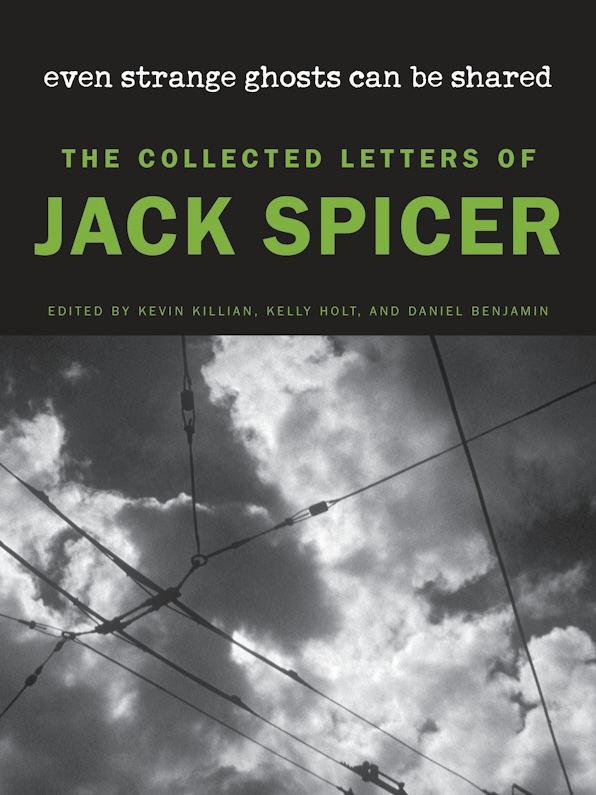
The recent publication of Even Strange Ghosts Can be Shared: The Collected Letters of Jack Spicer (512 pages; Wesleyan University Press) returns us to this complex world in voluminous depth. It was edited by the late Kevin Killian, a Spicer devotee—who, along with Peter Gizzi, co-edited, My Vocabulary Did This To Me, a volume of Spicer’s collected poems—along with Daniel Benjamin and Kelly Holt.
Bitchy, funny, sometimes heartbreakingly lonely, the communications deliver on Spicer’s contention that there was no substantive difference between his correspondence and his verse. As he wrote to Allen Joyce, a former student: “I hope you show other people these letters I write you. They are personal letters for you, and they are also public letters. I measure their success by how well I can succeed in being deeply personal and deeply public at the same time.” Taken together, the letters make up a long poem—or an epistolary novel—of their own.
Although he co-founded the 6 Gallery, scene of the famed Howl reading that put the Beat scene on the map, Spicer was back East at the time of the event. But he often distanced himself from the movement, describing Allen Ginsberg’s epic as “crap,’’ but also noting, in a letter to Blaser: “Only people like us have a right to attack it.’’
Such resentments are offset by his antic wit. Spoofing the politics of the day, he writes to another former student, Graham Mackintosh: “You have probably heard that the governor of Iowa was assassinated last night by Puerto Rican nationalists […] This obviously represents a new technique—terrorism crossed with Dada.’’ Staying with the riff, he imagines a new movement of Dada assassinations, potentially targeting the mayor of Walnut Creek, the Swedish Ambassador, or the Ohio State quarterback in the Rose Bowl.
Among his other quirks, Spicer was a sports junkie, who convinces the artist Fran Herndon to build a monument to Giants pitcher Sad Sam Jones (a.k.a. Toothpick Sam Jones) entirely out of toothpicks. Those tempted to go further down this rabbit hole can check out a Spicer elegy by James Herndon, Fran’s husband, at jacketmagazine.com/07/spicer-herndon.html.
He also had an affection for Martians, both as a comic device and as an avenue to channel the unseen world he was uniquely attuned with.
In a brief attempt to make his mark back East, Spicer failed to crack the code of the New York School of Poets and vented about his disenchantment with the city, including unseemly slurs about “Jews’’ and fellow gays. In the introduction to this collection, Benjamin goes to some length to avoid minimizing these outbursts from “Dirty Jack – the alcoholic, jealous man who growls and hurts those around him.’’
Fair enough. But in a letter to the Pound Newsletter about the Fascist poet’s virulent anti-Semitism, and the ongoing discussion of whether to judge someone’s work by his failings, Spicer critiqued the “pretentious snobberies’’ of “Mr. Waugh’’ and “Mr. Eliot,’’ who offered more socially acceptable versions of similar prejudices. (He also begins a holiday letter to a friend with the salutation, Good Yontif, which is Yiddish for “good holiday.”)
In the end, the Los Angeles-born poet was a Man of the West, and his sometimes ugly comments reflected a defensiveness against an Eastern literary establishment that then, as now, was often patronizing to barbarians at the far end of the continent.
In A Poem for Dada Day At The Place, April 1, 1958, set at one of his favorite North Beach watering holes, he reminds us:
It is not easy to remember that other people died
Besides Dylan Thomas and Charlie Parker
Died looking for beauty in the word of the
bartender.
Spicer had a lover’s quarrel with the world, to quote Auden, a poet he despised (or professed to). But his spikiness concealed a beating heart. At the end, his parting words, coming after the rueful remarks about his vocabulary, ring as true now as they did then: “Your love will let you go on.’’
ZYZZYVA Contributing Editor Paul Wilner is a longtime member of the National Book Critics Circle. A book columnist for the Nob Hill Gazette, his reviews have appeared in Alta, among many other publications.