
Jack Spicer (1925–1965) was a key figure in the San Francisco Renaissance. Spicer’s radical theories of authorship and poetic dictation influenced a generation of poets, and they continue to resonate with contemporary writers and thinkers. Openly gay in an era of repression, he developed a poetics that merged mysticism, political resistance, and linguistic estrangement.
Spicer’s letters are a vital component of his unique oeuvre; they radiate with the brilliance, ferocity, and vulnerability that characterize his poetry. In fall 2025—the year of Spicer’s centenary—Wesleyan University Press published Even Strange Ghosts Can Be Shared: The Collected Letters of Jack Spicer, edited by Kevin Killian, Kelly Holt, and myself. The over 300 fully annotated letters in this volume contribute vital details to Spicer’s biography, and stand alongside Spicer’s previously published works as key components of his inventive and influential writings. (Even Strange Ghosts Can Be Shared will be the fourth volume of Spicer’s collected writings published by Wesleyan.)
In May 2019, when I interviewed Kevin Killian and Dodie Bellamy in ZYZZYVA No. 117, I asked Kevin about how he began his lifelong study of Spicer. “I had been warned by one of the professors in my PhD program,” Kevin told me: “…‘there was this hideous, evil man called Jack Spicer, who luckily died. You want to get out of that scene. It’s demonic.’ That intrigued me.” After Killian arrived in San Francisco from Long Island, Robert Glück set him up with Spicer’s former student, Lew Ellingham, who was writing an oral history of the Spicer circle. Lew needed help turning the book into a readable biography. Their collaboration became Poet Be Like God: Jack Spicer and the San Francisco Renaissance (Wesleyan, 1998), a remarkable work of social history and literary biography.
My association with Spicer’s letters feels equally charmed. In 2012, I wrote to Killian about an unpublished Spicer text he alluded to in an essay, “Spicer and the Mattachine”—one of the many essays in which Killian continued and expanded the study of Spicer and his circle in the decades following the publication Poet Be Like God. He wrote back promptly and generously, sharing the full unpublished Spicer text, and insisting we meet for lunch when I got to California, where I was soon to start a doctorate at UC Berkeley. Over the next several years, we volleyed emails back and forth about obscure textual variants and unpublished pieces in the Spicer archive. Killian read all my work on Spicer, and he was something of an unofficial dissertation advisor: encouraging and enthusiastic, but also willing to tell me when he thought I was arguing out of both sides of my mouth.
In May 2019, Killian invited me to collaborate on editing the selected letters, asking me to write some of the incomplete paratextual material. He was beginning chemotherapy, and though he acted confident that he had a long time left, he was clear that he was prioritizing other projects that summer. He died that June. Over the last several years, I’ve worked with Peter Gizzi, Spicer’s surviving executor and the series editor of the Collected Works of Jack Spicer, to finish bringing the text to publication for Wesleyan University Press.
It’s been a ghostly conversation working with my friend Kevin Killian’s voice in these materials. At so many moments, I have wished that I could write to him with a question about an unknown name or a historical reference, or wished that I could share with him the joy of a research discovery. While a wealth of knowledge of Spicer and his circle died with Kevin, he has also left a tremendous legacy in making Spicer’s writing available to more people.
The selection of letters below reflects the span of Jack Spicer’s creative engagement with the literary culture of California, beginning with his student days curating literary events at UC Berkeley and concluding with his final extant letter, written in the wake of his performance at the 1965 Berkeley Poetry Conference. These letters evince Spicer’s belief in California’s cultural independence and importance, established through collaboration but also through antagonism. While living in Boston, Spicer writes together with his close friend Robin Blaser (1925-2009) to the third primary member of the “Berkeley Renaissance,” Robert Duncan (1919-1988), about their previous days in the Bay Area. They memorialize and monumentalize the period, planning a book which never materialized.
Later letters concern Spicer’s editing of the literary magazine J and his planned editorial project, The Map of California. Spicer edited J with the painter Fran Herndon. Steve Clay and Rodney Phillips call J “in many ways the most beautiful of all the mimeo magazines,” and its eight issues sparked many successors in the Bay Area and beyond. Spicer published in many of these magazines, including the splenetic open letter included here to the little magazine Foot. Spicer’s book project for the Sierra Club, The Map of California, remains more speculative and unfinished. Undertaken with Blaser, there is little evidence of work completed beyond the letter included here and Spicer’s brief poetic series collected posthumously as Map Poems.
To the University of California, Berkeley, English Department #1
{December 1946}
“Can the writer beat the system” Committee decided with one dissenting vote on Henry Miller. Dr. Lehman has refused to allow this invitation. He gives the reason that there is a danger that the legislature would hear of Mr. Miller and cut University funds. He says that he will be glad to approve of the invitation when the legislature is not in session. The legislature will not adjourn until sometime in June.
We resign because
(a) We believe that the will of the majority should not be subject to a veto from above.
(b) We believe that if the Writer’s Conference is to be so careful during the session of the legislature (which lasts for almost all of the school year) that we cannot get speakers adequate or interesting.
We wish to emphasize that we fully sympathize with the attitude of the other members of the committee and our resignation in no sense is a condemnation of them.
A personal note: I dislike Henry Miller.
“Jack Spicer Papers,” BANC MSS 2004/209, Bancroft Library, University of California, Berkeley, draft letter in notebook. This letter is dated based on a brief note in the collaboratively written “Canto for Ezra Pound” about the episode. The novelist Henry Miller (1891–1980) moved to Big Sur in 1944, where he regularly attracted visiting writers, including Spicer in fall 1947. Spicer also wrote a review of Miller’s fiction that appeared in Occident. The Writers’ Conference was a series of creative writing workshops and readings at the University of California, Berkeley, in the late 1940s, which eventually disbanded over power struggles between the student and faculty organizers. Duncan, Blaser, Spicer, and Leonard Wolf were among the student leaders. Benjamin Harrison Lehman (1889–1977) was chairman of the UC Berkeley English department from 1944 to 1949; Mark Schorer (1908–1977), Thomas Parkinson (1920-1992), and Josephine Miles (1911-1985) were also involved with the Writers’ Conference. Miller was to have spoken at an event entitled, “Can the Writer Beat the System?” See Mel Novikoff, “Author Barred from Campus for Unorthodox Ideology,” Daily Californian, January 20, 1947, 7. According to Miles’s recollections, as told by Ekbert Faas, the disagreement about inviting Henry Miller was just a “little ripple of difficulty.” The Writers’ Conference survived until 1950, with Spicer continuing to lead workshops. As Faas recounts, “the real reason for the disbandment was an openly homosexual story by Richard Montague” that appeared in the single issue of the conference’s journal, Literary Behavior. See Ekbert Faas, Young Robert Duncan: Portrait of the Poet as Homosexual in Society (Black Sparrow Press, 1983), 274–80, and Poet Be Like God, 24–25. Richard Montague (1930–1971), then an undergraduate philosophy student, had a brief but brilliant career in the philosophy of linguistics before his untimely death.
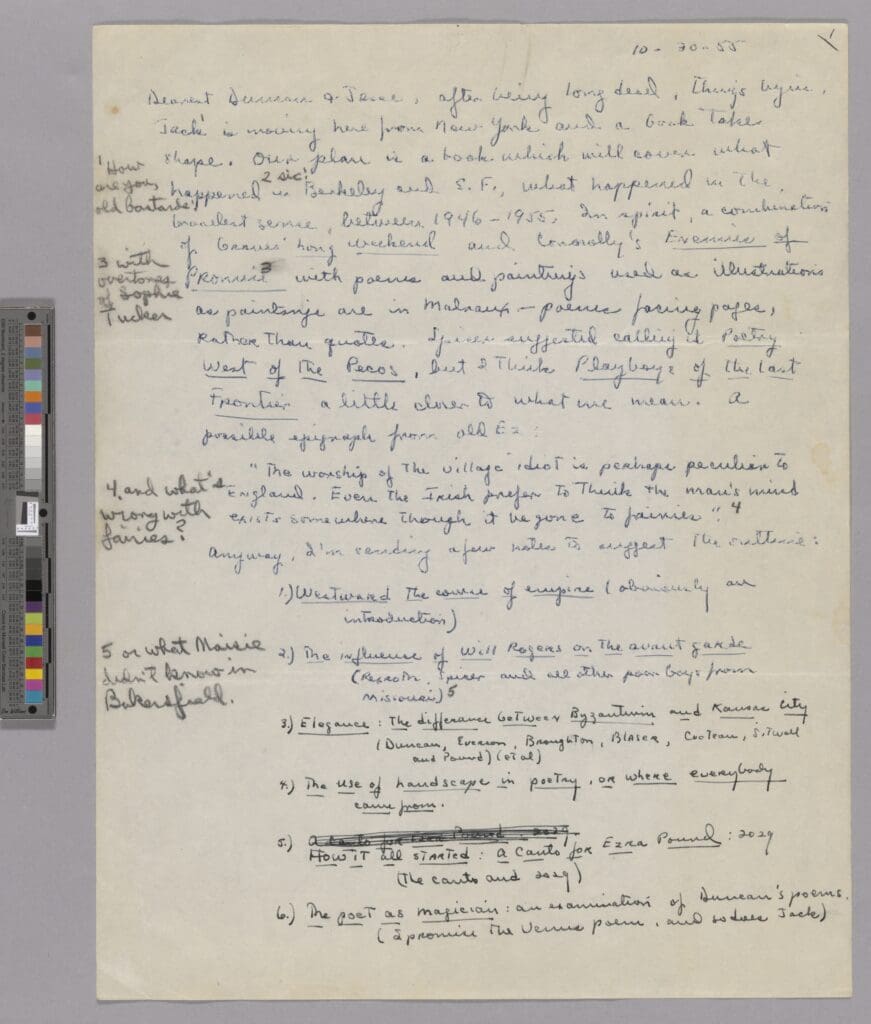
To Robert Duncan and Jess—joint letter from Spicer and Robin Blaser
October 30, 1955
{19 South Russell Street, Boston, Mass.}
Dearest Duncan & Jesse, after being long dead, things begin. Jack[1] is moving here from New York and a book takes shape. Our plan is a book which will cover what happened[2] in Berkeley and S.F., what happened in the broadest sense, between 1946-1955. In spirit, a combination of Graves’ Long Weekend and Connolly’s Enemies of Promise[3] with poems and paintings used as illustrations as paintings are in Malraux—poems facing pages, rather than quotes. Spicer suggested calling it Poetry West of the Pecos, but I think Playboys of the Last Frontier a little closer to what we mean. A possible epigraph from Old Ez:
“The worship of the village idiot is perhaps peculiar to England. Even the Irish prefer to think the man’s mind exists somewhere though it be gone to fairies.”[4]
Anyway, I’m sending a few notes to suggest the outline:
1.) Westward the course of empire (obviously an introduction)
2) The influence of Will Rogers on the avant garde (Rexroth, Spicer and all other poor Guys from Missouri)[5]
3.) Elegance: The difference between Byzantium and Kansas City (Duncan, Everson, Broughton, Blaser, Cocteau, Sitwell and Pound) (et al)
4.) The Use of Landscape in poetry, or where everybody came from
5.) How it all started: A Canto for Ezra Pound: 2029 (The canto and 2029)
6.) The poet as magician: an examination of Duncan’s poems (I promise the Venice Poem, and so does Jack)
7.) Hot oleomargerated rum. (A study of the contribution of Berkeley parties to the dramatic art of Duncan, Rexroth and Spicer[6])
8.) A drunk, a cripple and a giant. (A study of the contribution of the University of California to Berkeley Poetry. Writers’ Conference, etc.)
9.) Sorry, no Jews. (A Study of Campus Textbook Exchange and its contribution to literary anti-Semitism and the Pound Newsletter) (Berg will be called Mr. Swann—a composite of connoisseur [your idea], Mr. Norris of the avant garde [Jack’s idea],[7] voyeur [my idea], and philosopher [his idea]—and all ends in Library School.
10.) Eastern literary magazines and their impact on a provincial culture: or, Western Bards and Jewish Reviewers
11.) Aboriginal literary magazines. (Occident, Berkeley Misc., Contour, Formalist, Circle, Arc[8] and those that didn’t come about.)
12.) Berkeley and Western Civilization: Is Berkeley Byzantine, Irish or Faustian: who cares: or, Poets in a Museum[9]
13.) It’s Sister Jenny’s turn to throw the bomb (a study of Berkeley in politics from Duncan’s article in “Politics” through the Wallace campaign)
14.) The last time I saw anybody—(a study of the celebrities who visited Berkeley)
15.) Some kinds of love—(sexual imagery in Berkeley poetry: Kantorowicz, Swans, etc.)
16.) Poets and painters, or can they sleep peacefully together? (King Ubu, Six, Jesse,[10] etc.)
17.) Poems and novels: which is which, or, the bear came over the mountain. (a study in Berkeley sources from Mary Butts to Malaparte—Ackerman, Jaime d’Angulo, Richard Rummonds)[11]
18.) Voices in poetry: must they be so high pitched? Probably. (chapter on presentation and how Berkeley never met the challenge of W.C.Wms.) Will you help me hold up my end against Jack?[12]
19.) Poets and their jobs. (How poets survive: how to make a living.)[13]
20.) Solutions— Dianetics
Suicide
Catholicism
Library School
Analysis[14]
Science
Drugs
Professors
Mary Simons
Marriage
21.) Exiles: why everybody left town and probably will go back—a conclusion.
This, I’m afraid, will appear to be an elaborate joke, but I’m deadly serious on the matter. This is meant to be for poetry, for all of us—and against America the Beautiful, the East and all sorts of Career Things. Jack and I will disagree often, but we’ve decided to let the quarrels show. Whenever we diverge too far we’ll appear and argue in dialogue:
Laura and Robert
or Pound and Everybody
or Olson and Johnson
or Gallagher and Sheen
or Pentheus and Dionysus
or Toynbee and Jerry Fabian
We need your ideas, suggestions, arguments and love. Also documents of all sorts that may seem to you to fit in here and there. Also, please, a copy of the Korean poem. Old papers of any sort that tend to recall things,[15] conversations, collisions. We’ve already gone over what I have, but still need more—2029 and Throckmorton.
Letters are now going off to the West for material—old Occidents, letters, notes, diaries.[16]
On the matter of the new book you two are putting out, I very much want the copy and will send some cash as soon as I can get my hands on some. Boston thus far has cost me a fortune in money and spirit.[17] I promise my regularity will begin again.[18]
Did you receive the last two Pound cantos?[19]
Your remarks on the need for beautiful people I’ll take up in my next letter.
Love,[20]
Robin[21]
P.S, Don Allen has promised to publish this brainstorm.
And lovely things to Jimmy Broughton. I’m told we’ll see his movie here in Boston.
[1] How are you old bastards?
[2] sic
[3] with overtones of Sophie Tucker
[4] and what’s wrong with fairies?
[5] or What Maisie Didn’t Know in Bakersfield
[6] or From Fruit Punch to Faust Foutou
[7] Not Norris Embry
[8] Robin forgot Berkeley: A Magazine of Vultures
[9] looking for a Men’s Room
[10] Hi!
[11] This section will not mention Dorothy Richardson
[12] A most obscene suggestion!
[13] I’m unemployed
[14] Going to bars
[15] Recherchez our temps perdu, mother-fucker!
[16] We are printing all your love-letters to me in an appendix.
[17] New York has circumsized my spirit. It only needed an erection.
[18] Serutan
[19] Didn’t they smell of Chinese feces?
[20] More love—if possible
[21] Jack, the Ripper
Robin Blaser papers, BANC MSS 79/68 c, Bancroft Library, University of California, Berkeley. Spicer added numbered footnotes to the letter, which he wrote in the margins. The poet Robert Graves and the historian Alan Hodge collaborated on The Long Week-End: A Social History of Great Britain, 1918–1939 (1940). Critic Cyril Connolly’s Enemies of Promise (1938) combined autobiography with a discussion of contemporary literary styles. The epigraph is drawn from Pound’s essay “Mr Housman at Little Bethel” which appeared in Literary Essays of Ezra Pound (New Directions, 1954). Vaudeville actor Will Rogers (1879–1935) was born in Oklahoma and became a well-known political columnist and humorist. In a typically complex and layered allusion, “Mr. Norris of the Avant-Garde” most likely refers to Christopher Isherwood’s novel Mr Norris Changes Trains (Hogarth Press, 1935) though perhaps also to Frank Norris (1870–1902), author of the San Francisco novel McTeague (Doubleday, 1899). The painter Norris Embry (1921–1981), one of the models for the title character in Duncan’s Faust Foutu, stayed regularly with Duncan and Jess in San Francisco in the early 1950s. Berkeley: A Magazine of Vultures may be a mocking reference to Berkeley: A Journal of Modern Culture, edited by the poet and professor James Schevill (1920–2009), who left Berkeley after refusing to sign the loyalty oath in 1950 and went on to become head of the Poetry Center at San Francisco State. The modernist novelists Dorothy Richardson (1873–1957) and Mary Butts (1890–1937) were both favorites of Duncan, and Butts was a touchstone of the Berkeley Renaissance. When Spicer was a teaching assistant at Berkeley in the late 1940s, he lectured on Butts’s experimental grail novel Armed with Madness (Wishart & Co., 1928); Blaser would later publish an edition of Butts’s Imaginary Letters with an afterword (Talonbooks, 1979). Gerald Ackerman (1928–2016), a boyfriend of Duncan’s from the early Berkeley days, went on to become a noted art historian. Richard-Gabriel Rummonds (1931–2023) was only six years younger than Spicer, but the latter treated him very much as the apprentice poet. After Spicer’s death, Rummonds, now one of the preeminent letterpress printers in the fine arts world, published a lavish, oversized book, Some Things from Jack (Plain Wrapped Press, 1972). Spicer first met Jaime de Angulo (1888–1950), the American anthropologist and folklorist, in 1947 in Big Sur. The fiber-based laxative Serutan was known for touting its “natural” provenance in its radio slogan, “Serutan spelled backward is ‘nature’s.’”
To Robin Blaser #25
{late December 1956}
839 Leavenworth, Apt. 309
San Francisco
Dear Robin,
In case I already have not sent it to you, you will not be receiving the Ode to Walt Whitman until you write. Duncan also finds your silence unbearable.
I moved to San Francisco Saturday night. My apartment is in the same district and of the same type as the others. It is all very depressing. To make things worse, I had to agree to teach full-time at State.
My Poetry Workshop class is to be called—Poetry and Magic. How about sending me some ideas. My main one so far is that Houdini is the figure of the poet and that translation is cheating at poker.
You, of course, are too depressed to write and do not have the wonderful excuse for writing bad letters that this very Monday routine gives me. I keep hearing from others of the long poem that you 1) have written, 2) are writing, 3) have torn up, 4) talked about writing. I suspect that Don’s good suggestions on how to revise your poems hurt your poetry. One can only take advice on specific poems when one is full of confidence, otherwise it just depresses. Any revision that is valid will come from other poems shoving inside you.
Some general advice, however:
1) Start a journal
2) Move to Berkeley
3) If you do neither, at least take the finger out of your ass.
Love,
Jack
“Jack Spicer Papers,” BANC MSS 2004/209, Bancroft Library, University of California, Berkeley. “Ode for Walt Whitman; A Translation for Steve Jonas” would become the centerpiece of Spicer’s first book, After Lorca (see My Vocabulary Did This To Me, 126-130). Robert Duncan, who was working at the San Francisco Poetry Center as assistant director to Ruth Witt-Diamant, helped Spicer get hired to teach a workshop in spring 1957. Spicer advertised a course on “Poetry as Magic.” He circulated a questionnaire that asked prospective students to answer, “If you had a chance to eliminate three political figures in the world, which would you choose?” and “What ordinary playing-card deck (or Tarot deck) represents the absolute of your desires? The absolute of your fears?” Workshop participants included Helen Adam, Ebbe Borregaard, James Broughton, Duncan himself, Joe Dunn, John Allen Ryan, and George Stanley.
Open letter on J #1
{August 1959}
The first issue of J will appear in the early part of September. J will be a 16-page mimeographed flyer very much like Beatitude. It will sell for the same price or lower. It is non-copyright.
POETRY—I especially want poems from people who have written very few poems. Criteria of selection will be personal and arbitrary but poems will be selected mainly on the basis of whether, for one reason or another, they are likely to be exciting to other poets. Good or bad, beat or square, rhymed or unrhymed will, I hope, have nothing to do with it. This will not be a little magazine.
PROSE—Prose will be entirely secondary to poetry. Anything that is temporary (out-of-date in three weeks) will be acceptable. Letters, ill-tempered comments, suicide notes . . .
ART—Each issue will contain several [full-page, 8 1/2 x 11] drawings. These must be line drawings that can be reproduced on stencil or actually submitted by the artist drawn on a stencil. Painters, students, even instructors.
Jack Spicer
Fran Herndon
Manuscripts and drawings should be submitted to the Box marked J in The Place, 1546 Grant Ave.
“Jack Spicer Papers,” BANC MSS 2004/209, Bancroft Library, University of California, Berkeley. Fran Herndon (1927–2020) grew up on a farm in North Carolina. She was working for the US Foreign Service in France where she met Spicer’s former college roommate Jim Herndon, and the couple moved to San Francisco in 1957. “The story goes that Fran had no intention of making art until Spicer saw something in her that she didn’t see in herself and began encouraging her. This was Fran’s version as well,” writes George Albon in an obituary for Herndon (“Fran Herndon: A Remembrance,” Open Space blog, June 14, 2021). Herndon was art editor of J; they produced five issues in 1959. Issues six and seven were edited by George Stanley, and an eighth issue was edited by Harold Dull from Rome. Herndon would later collaborate closely with Spicer on The Heads of the Town Up to the Aether (Auerhahn Society, 1962), producing a series of lithographs that accompanied Spicer’s texts.
Open letter on J #2
If J is going to be a little magazine I don’t give a damn about editing it. A little magazine prints poetry (or prose or drawings) by friends or friends of friends of the editor. My friends (and the friends of my friends) are good poets but, with some notable exceptions (mainly so far in J2), they have ceased to surprise (Dragalev’s word to Cocteau A S T O N I S H) me.
There is a box called J at the Place, 1546 Grant Ave. So far a lot of crap and some beautiful things have gone into it but most of it (both) from friends and friends of my friends.
George Stanley tells me that the poets and prose writers and artists I imagine are imaginary. J is a mimeographed flyer that sells for twenty-five cents and usually comes out every three weeks.
Jack Spicer
The original of this letter has not been located; a transcript appears in the typescript provided by Kevin Killian to Daniel Benjamin. In the manuscript of this letter, “Dragalev’s” is corrected to “Diaghilev’s” by Fran Herndon.
To the editors of Foot
{1962}
{1650 California St. #35, San Francisco, Calif.}
I am not submitting the poetry I promised to the magazine. One of the three editors of your magazine is participating in the San Francisco State College Poetry Festival.
This editor (who will receive ten dollars for his participation) is as aware as I am or you are that 1) SF State College would like to turn all poets into cable cars. 2) A poet is not a cable car. 3) If a poet is gradually becoming a cable car he is gradually ceasing to be a poet. 4) He is telling others, who are too young to know better, that there is no difference between cable cars and poetry. 5) Poetry in a funny and metaphysical sense of the word is a Union and making it or yourself (which happens first) into a cable car is scabbing on the Union which can’t be broken but sure as hell can be scabbed upon. 6) Everyone who ignores these instructions ends up on KPFA or writing for the Examiner.
If it is a question of financial need, I would be very glad to give this editor eleven dollars not to read in the festival.
Jack Spicer
Foot was a little magazine edited by Bill Brown (1918-1994), Richard Duerden (1927-2000), and Philip Whalen (1923-2002). The editor in question in this letter is Whalen. This letter appeared in Foot 2 (1962).
To Lewis Ellingham #2
October 8, 1963
Robin Blaser
73 Waltham St
SF 10
Mr. Louis Ellingham
The Sierra Club
The Mills Tower
San Francisco 4, California
Dear Lou,
You have asked us to summarize the conclusions of our discussions with you as to our plans for the form of the anthology tentatively titled The Map of California.
The book’s name indicates the central notion of the anthology, the presentation of poetry related to specific areas of the map of California, both as a geography of place and of the mind. At present some thirteen chapters are planned, each introduced by the reproduction of a section of a road map of the State published in 1912 by the California State Automobile Association.* {at bottom of page: *The California State Automobile Association. Tour Book, S. F., The Association, c.1912. 630 p.}The particular maps we suggest are interesting to the contemporary reader for what they show as changed in California—names of cities which have disappeared, roads which have completely changed their contour—, keeping always as constant the same outline in map as in poetry, linking the present and the past. The series of maps form a median point historically (in taste, mood, and potential of contrast) orienting each poem in a relationship without straining for interpretation. The choice of poems will necessarily keep just this kind of consideration in mind, favoring not necessarily some ‘gem’ meant for anthologies and fitted into a scheme arranged for that poem, but rather relating each poem to its geographical unit, and, ultimately, to the total balance of the book.
Chronologically, the approximate division in space for the anthology is: 1/3 to 1900; 1/3 to 1935; and 1/3 to the present. In any given chapter, or section, the relationship in space may vary radically; but assuming a structure of something like one long poem for each era, or a selection balanced to yield the tone of the period as a whole, the result of the book should be a concise, interesting presentation, designed to a single emotional effect—a series of impressions which make the book clearly valuable in general, and equally important, accessible in the tension of its particulars.
The work so far has been some attempt to discover whether or not a book of this kind is really possible, whether for example enough poetry of the 19th century could be found to support the special purposes of the anthology, concerned in the fullest sense with the ground of poetry disclosed in space and time in California. This has involved less contact with poets and editors than a thorough examination of all the published material from the earlier periods of poetry in the State, with a view to the probable relationship of what is discovered to the period best known to us, the recent and contemporary. At the point when we believe the book adequately planned, with all our tentative selections of text made, then the question of approaching the particular poets concerned, and in some cases, their publishers arises. Certainly it would be premature to attempt this before we can seriously discuss with a poet or publisher the use of a given poem, for naturally assurances and expectations are at once involved which require the right moment for such contacts.
[…]
Finally, we would like to mention one or two interesting facts about the history of anthologies of California poetry of recent years. Few have been successful, although at one time such books were virtually assured multiple editions. The reason seems mainly the lack of imagination brought to them by the editors, a certain stogginess and failure of intensity in the selection and presentation of the work. It is precisely this problem we hope to solve.
While the work of selecting the text goes on, an informal meeting with you, Lou, and Mr. Brower, would help in maintaining the direction and relevance of the work in the development of the anthology, since the concerns of both the editors and publisher must, obviously, be kept in mind by us all.
Sincerely yours,
Jack Spicer
Robin Blaser
Copy to: Mr. David Brower,
Executive Director,
Sierra Club
Sierra Club Office of the Executive Director Records, BANC MSS 2002/230 c, The Bancroft Library, University of California, Berkeley. The voice of this letter reflects Blaser’s more significant involvement in this unfinished project. As Blaser recalled, “We were working on the anthology of California poetry, and—Jack didn’t do anything. That was so unlike Jack. I was grabbing books, trying to read the most God awful stuff, and we were going to make maps . . . But he couldn’t do anything . . . There was no engagement at all. It didn’t matter at all” (Poet Be Like God, 304–5). Spicer’s poems connected with this project were published posthumously as Map Poems (My Vocabulary Did This To Me, 365–69).
To Sister Mary Norbert Körte
{July 1965}
{1424 Polk St., #22C, San Francisco, Calif.}
Dear Sister Mary,
I think that I feel the call of your religion almost as much as you feel the call of the outside world. This world is outside. For Christ’s sake don’t question that.
The communion of hearing each other’s songs is what John the XXIII died for. It’s not a real communion until you can hear them at night and I can hear them in the daytime. It’s a good start and all the static that Pio Nono caused is gradually being erased. It’s only a good start.
I wish that God would come to me like he would come to you, sometimes but worth the some-times. I wish I were a singer like David.
Your poem moved me but has exactly all the constructions poetry has. Your challenge of songs to me should have been met by you. We both (and every poet I know of) need a different voice. When Gregory V invented plain-song he meant just that. I hear yours and mine only from a distance.
Anyway thanks and pray for me. I can’t.
Also remember “Barbry Allen” and sing it often.
Yours in a Christ I can’t quite believe in,
Jack Spicer
Mary Norbert Körte (1934–2022) became a nun at the age of seventeen; while in the convent, she earned BA and MA degrees in Latin, and she wrote poetry throughout her life. She attended Spicer’s last reading at the Berkeley Poetry Conference and spoke to him afterward. They were photographed together by the Bay Area journalist Tove Neville, and the photo was included in Neville’s obituary for Spicer that appeared in the Chronicle. As Brenda Knight describes in Women of the Beat Generation, at the Poetry Conference, Korte “found her true calling—poetry—as she experienced an ecstasy in the auditorium she had never experienced in any cathedral.” She corresponded with Spicer and other poets including Diane di Prima, Lew Welch, and Michael McClure. Korte’s first book, Hymn to the Gentle Sun, appeared from Oyez Press in 1967. She left the convent in 1968 and after 1972 she lived in the forest in Mendocino County.