Latest Posts from the Blog

In the Spring Issue

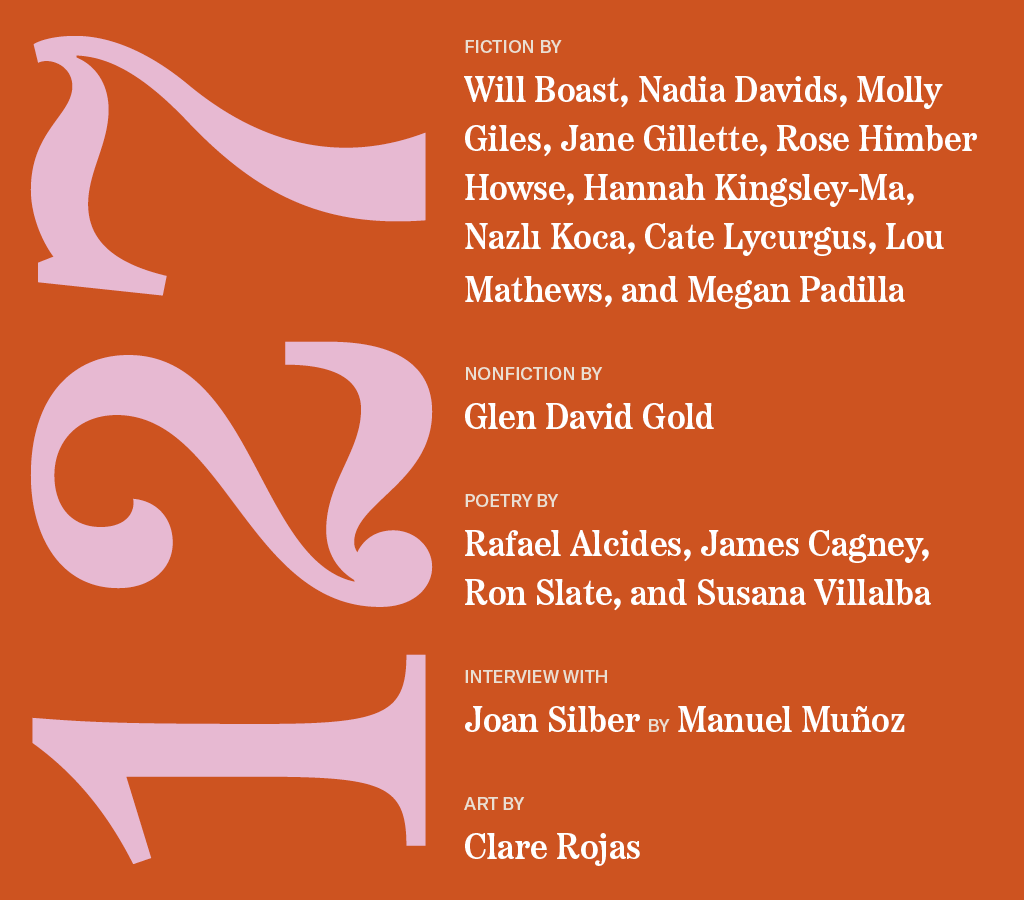
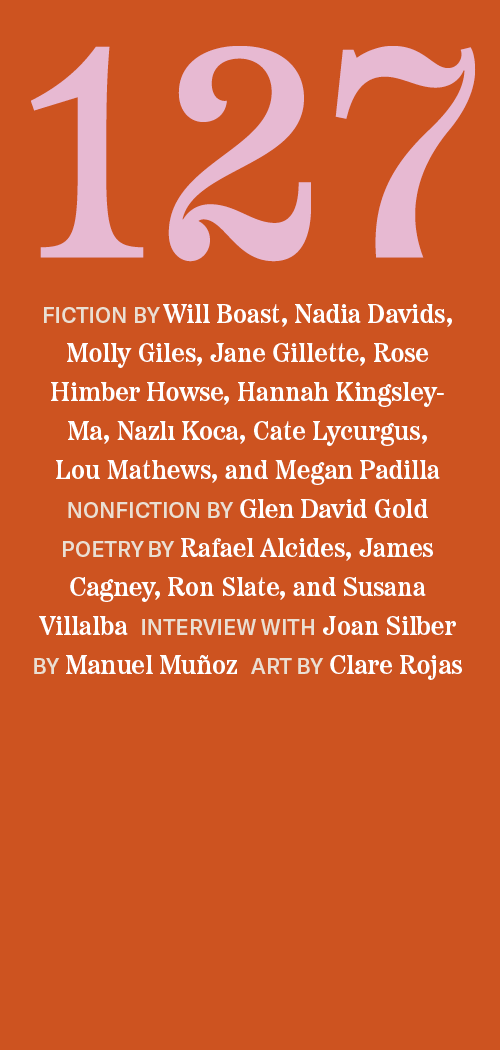
The newest ZYZZYVA features a special section of work by authors who divide their time between the West Coast and elsewhere, as well as …

Stories about love and grieving (Marianna Cherry’s “The Endurance”), about love and its opportunities: grand (Chris Leslie-Hynan’s “Hunter’s Moon”) and grim (Herbert Gold’s “The Passion of a Fussy Man” and Michelle Latiolais’s “Gas”), irrevocable (Dani Shapiro’s “Cardioplegia”) and fixed to place (Molly Giles’s “Life Span”). Fiction on the writing life—whether pursued in a classroom (Lori Ostlund’s “Clear as Cake”) or very much alone (Debbie Graber’s “Northanger Abbey”)—and fiction about teachers, young and veteran, learning the truth about themselves (Hilda Johnston’s “In Her Dream the Teacher Apologizes” and Peter Mountford’s “Safari in the Bayou”).

A profile of a beloved uncle and a community of deaf Mexican migrants making their home in the United States (Diego Enrique Osorno’s “A Cowboy Crosses the Border in Silence”), and the pensées of the great poet W.S. Di Piero (“Out of Notebooks”).

Verse from Joseph Di Prisco, Alexandra Teague, Christopher Buckley, Lynne Knight, Amy Miller, Christian Kiefer, Adam O. Davis, Allan Peterson, Michelle Lin, Matthew Nienow, Richard Tillinghast, and Floyd Skloot.

And we introduce young writers Rebecca Rukeyser (“The Chinese Barracks”) and Aaron Jae-Ho Shin (“Erroneous”).

Get your four-issue subscription to ZYZZYVA now and start with the Spring issue.

Posted in News | Leave a comment

The Captivating Voice of an Irish Traveller: Gavin Corbett’s ‘This Is the Way’

This Is the WayOver the past few years, thanks in part to a TLC reality show, many of us have become fascinated with Irish Travellers, a group of unsettled people that moves about Ireland in caravans. For the most part, Travellers are a secretive culture, wary of outsiders, and in turn are viewed with a certain amount of disdain by “settled” people. In his second novel, This Is The Way (Faber and Faber; 230 pages), Irish writer Gavin Corbett explores the trials and tribulations of an Irish Traveller in an increasingly rooted world.

Anthony Sonaghan fears a rekindled feud between the two halves of his Traveller family, the Gillaroos and the Sonaghans. It’s a war so ancient and ingrained between the two families that there are myths about how the feud was started. Scared of getting caught up in the violence to come, Anthony hides out in a bustling tenement house in Dublin, away from his people. One day, the dullness of his life in hiding is upset by the appearance of his Uncle Arthur, who shows up with his hand heavily bandaged, missing a toe and obviously on the run. While taking care of the impish Arthur, Anthony is forced to face the past along with the troubles it presents and the questions it raises about his future.

Corbett’s greatest accomplishment and his novel’s true strength is the voice of Anthony. Nothing he says or does feels untrue, and one could easily imagine him wandering the streets of Dublin and the countryside of Ireland. He is an original, strong, and imaginative protagonist; equal parts beautiful and jolting, he captures the reader’s attention from the first sentence and holds it throughout the work. Through Anthony, Corbett is able to explore the difficulties of a man who grew up a Traveller trying to assimilate into an average life, all while coping with his warring family.

It is because of the strength of Anthony’s voice that it’s possible to forgive Corbett for leaving us at the end with little or no explanation about intriguing episodes of Anthony’s history, such as the death of his brother Aaron and about where the brothers’ mother and sister went after they left Anthony and Aaron with their father. The author’s reasons for doing so, though, are completely understandable and commendable. As Anthony is telling the story, it makes sense the narrator would gloss over these unpleasant memories, only mentioning them in passing.

Corbett’s commitment to Anthony’s voice also means the story doesn’t unfold chronologically. Rather, we’re guided by Anthony’s jittery thoughts, jumping from living with Arthur in Dublin, to the summer before he left his father’s house, to the old myths of the Sonaghans and the Gillaroos. This can make the plot hard to follow, but in the end, whatever little frustrations and confusions that crop up are easily overlooked. Corbett has crafted an amazing storyteller in Anthony and rewards the reader for sticking with him.

Posted in Book Reviews | Tagged , , , , | Leave a comment

A Refreshing Story Set in a Rundown Town: Michelle Tea’s ‘Mermaid in Chelsea Creek’

Mermaid in Chelsea CreekIn a post-Twilight, post-Hunger Games world, the Young Adult literary scene is fraught with sparkly neutered vampires, teens struggling against the shackles of their dystopian societies, and bland heroines who are somehow sucked into irritating love triangles. This new YA craze has even spawned a Paranormal Romance sub-section in the Young Adult shelves of Barnes and Noble, crammed tight with the types of book covers you cannot help but judge. There is hope, however, and it comes in the form of Michelle Tea’s newest protagonist, a thirteen-year-old, dirt-layered, scabbed-knee girl named Sophie Swankowski.

In her first installment of a YA trilogy, Mermaid in Chelsea Creek (McSweeney’s Books, 333 pages), Tea, the award-winning author of Valencia and Rose of No Man’s Land,  brings us to Chelsea, Massachusetts, a broken-down town that has seen better days. (Tea wrote a memoir, The Chelsea Whistle, about growing up there, which was published in 2002.) There are girls who play the pass-out game, roving groups of aimless teenage boys, and old immigrant women who left everything behind for a better life, only to end up in Chelsea. It is a hopeless place, but there is a story about a girl who will be able to fix their dark and twisted world, a girl who will bring the magic back. Sophie, with her grubby clothes, strange need to eat straight salt, and visions of a foul-mouthed Polish mermaid, might just be that girl.

Tea successfully sheds new and loving light on what society usually paints as filthy and less desirable. Indeed, nothing may be what people think it is. A grandmother might be a bad witch, a dog might be a grandfather, and a town floozy might actually be possessed by a Dola, who is attempting to get you back on track with your destiny. Chelsea may be run down, but by the end the reader cares for the pot-holed streets, mangy houses, smelly dump, garbage-filled ocean and pollution-rotted creek. Pigeons, those rats with wings that everybody hates, play an integral role in Sophie’s development through the story, morphing from grey, disease-carrying beasts to beautiful orange-eyed birds more befitting of their other name, Rock Dove.

Even Sophie, as she is first introduced, is a less than desirable as a heroine while she gulps down sludgy creek water in front of her germaphobic best and only friend Ella. She is slightly neglected, with dirty tangled hair, grubby clothes and scabbed knees, but her spunk, curiosity and her genuine heart and ability to care for others endear her to the reader.

Another great strength of Tea’s book is her use of narrator. Sophie, with her spunk, curiosity, genuine heart and empathy for others, endears herself to the reader. And while the point of view stays mostly with Sophie, there are many occasions where the perspective shifts briefly into those of other characters, mimicking Sophie’s own power to read people’s hearts and capture their true feelings. This all goes to deepen the characters, and makes it possible for the reader, much like Sophie, to forgive key protagonists for their failings.

Tea’s novel is a refreshing breath of air in the world of YA, equal parts eerie, heartbreaking and fantastical. This modern fairytale harkens back to the wonderful days when the genre wasn’t all about vampires that could frolic in the sunshine.

Posted in Book Reviews | Tagged , , | Leave a comment

Self-Doubt, Rage, Compassion in Measured, Perfected Poems: Jason Bayani’s ‘Amulet’

AmuletAmulet (Write Bloody Books, 89 pages), the first poetry collection from East Bay Area native Jason Bayani, is a blistering examination of American life, as seen through the lens of a poet struggling to define himself. The poems are lyrical yet direct, with a clear voice that evokes humor while scuffling with questions of racism and artistic identity.

Bayani, who’s Filipino American, doesn’t shy from the blunt racism he’s experienced. In “Playgrounds and Other Things,” he writes: “And the old lady leaning into the wood / at the corner of Sutter and Stockton: / I heard her tell it like broken glass, / ‘Go back to your own country.’” Yet within the same poem, the author is willing to accept that racism is a complex issue, and one for which, despite his unfortunate experiences, he doesn’t have the answer: “What is more difficult / is the velocity of how I love you. There, dawg, / is all the complex racism any of us can handle.” The juxtaposition of love within a poem about hate exemplifies how Bayani is able to move past the injustices he’s seen in his own life and write delicately about the process.

Addressing racism is not the defining theme of Bayani’s collections. He also voices his anxiety about being raised a millennial in America. “Surviving America is learning / the limit of want,” he states in “Strange Velocity.” The poems capture a young man struggling to identify the goals of adulthood. In “After Manny Pacquiao,” he writes “We were born to outrun / ‘nothing.’ So we’d never have to say it like / they did. ‘We come from nothing.’ But nothing / never did nothing but keep coming for us.” Some of the poems in Bayani’s collection speak to an unavoidable problem for an entire generation of Americans—the empty feeling that accompanies being young today, For those who share in his feelings, though, solutions are not offered, simply the chance to commiserate with another lost soul.

Despite the multiple struggles it addresses, much of Amulet focuses on Bayani wrestling with his identity as poet. “A lot of people say that writing is their therapy. / Me, I go to therapy,” he writes in “Depression.” Bayani deftly uses humor to leaven such sticky topics as racism, drug addiction, and a looming empty existence—and witnessing him as he wonders why he chooses to write proves cathartic, especially when the answer encapsulates the sweetest of our emotions. “Maybe all this living comes down to the encryption—,” he writes in “Sonnet for Lauren.” “(T)oday I’m working with simpler mathematics: / ‘Jason + Lauren.’ I wrote that shit on a tree.”

Even as his poems touch on various social and artistic tribulations, they are united by Bayani’s voice. A veteran of international slam poetry competitions, the verses come at the reader as if he’s performing each piece in front of them, his speech resonating through each line of the book. The words permeate with self-doubt, rage, and compassion, yet the poems themselves feel measured and perfected. There’s also his referencing of the East Bay, where he was raised and whose culture he clearly loves. In “History of the Ardenwood B-Boys,” he writes: “I’m from Fremont, California. That shit was no South Bronx.” He namedrops his elementary and high schools, and writes a sonnet to rapper E-40. It feels as if his hometown has his back while he, a poet, boldly navigates social problems and an uncertain future.

Posted in Book Reviews | Tagged , , , , | Leave a comment

The Absurdity of War, the Absurdity of the Media: Robert Perisic’s ‘Our Man in Iraq’

Our Man In IraqOriginally published in Croatia in 2007, Our Man In Iraq (Black Balloon; 202 pages), Robert Perisic’s finely crafted and witty novel, is now the first of his books to be translated into English (with translator Will Firth). American readers should delight in discovering Perisic’s work, while lamenting this inexplicable delay.

The novel opens in 2003. Toni has patched together a promising life: the Economics editor for PEG, an independent local newspaper, he lives in Zagreb with his beautiful girlfriend, Sanja, an actress who has just landed her first major stage role. Marriage seems to be on the horizon, and perhaps a move to a grander apartment as well.

But trouble simmers beneath the slick surface. Sanja’s big break gradually but inexorably draws her into another world and another echelon of fame. The new apartment Toni views as a way to keep their lives and relationship evolving will require taking out a massive loan. And most urgently of all, there is the matter of his man in Iraq. Despite his determined efforts to break free of the family he considers pre-modern and all its associated tribal encumbrances, Toni has nevertheless become a kind of fixer for his extended family. His latest improvisation in that role has far-reaching consequences: to provide his cousin Boris with gainful employment, he has set up the veteran in a correspondent’s role, covering the American-led invasion of Iraq for PEG. For reasons that are never entirely clear, Toni seems to believe he can keep his employers from discovering that Boris has no training as a journalist. Inevitably, the reports Boris sends from the field are not fit to print: rambling and pensive, they are elliptically insightful about war in general while devoid of factual information about this war in particular. But they betray far more disconcerting traits than amateurism—Boris’s most distraught missives suggest he may be suffering from Post Traumatic Stress Disorder. When the reports cease altogether and Boris seems to disappear, Toni observes, horrified, as his life unravels rapidly on all fronts.

Continue reading

Posted in Book Reviews | Tagged , , , , , | 1 Comment

The Hairline Fractures of Relationships: Gregory Spatz’s ‘Half as Happy’

Half As HappyHalf as Happy (Engine Books, 186 pages), the new story collection from novelist Gregory Spatz (Inukshuk, Fiddler’s Dream, No One But Us), examines faltering relationships and the unhappy people struggling to hold them together. The collection’s eight stories are remarkably honest, driven by moments both funny and painful that uncover deep rifts in the lives of Spatz’s characters.

In “No Kind of Music,” Patrick is drawn to the symphony after his wife leaves him for a younger, one-legged man. Most of the excitement remaining in Patrick’s life is centered on his eclectic neighbors, an elderly couple raising their rebellious daughter’s child. Patrick involves himself with them to mask his loneliness, but when the couple’s daughter comes to town and causes trouble for Patrick, he has to escape to the outdoor symphony, where he runs into his ex-wife and her new lover. “Why wasn’t he part of anything, anywhere, ever?” Patrick wonders to himself as he struggles to hear the concert. Alone amid a sea of spectators, he realizes that without his wife his existence has become empty.

“A Bear for Trying” is about twin brothers who do everything together until one of them falls into a coma. When the other begins to invade the intimate areas of his comatose brother’s life, their relationship is jeopardized. “Happy for You” tells the story of an elderly mother giving out Easter recipes to her son over the phone till  she realizes no one will be joining her for the holidays; her son will be spending them with his estranged father. The mother finds herself constantly at odds with “that feeling in the middle of the night when you wake up and can’t think of a single good excuse for your existence.” In both of these stories, the protagonists struggle to define their lives within the context of their closest relationships. Once those relationships change—whether suddenly because of an accident, or slowly because of time—the boundaries of their self become blurry.

The collection’s title story displays the hairline fractures of a seemingly happy marriage. Each day at lunch, Stan sits by his pool, eating and drinking beer, enjoying the view of his naked wife swimming laps in the sunshine. But since the beginning of summer, Heidi has become obsessed with her self-image, losing so much weight her husband no longer recognizes her body. While Heidi is driven by an insecurity rooted in the small, distant problems in her marriage, Stan tries his best to find the right way to tell her she’s gone overboard. “Too much of a good thing, honey, is still a good thing, but it’s too much,” he tells her in one of his subtle attempts to save her from herself. Soon, his overtures become less subtle, and a twenty-year marriage that appeared stable just months before is on the verge of implosion.

This constant search for happiness and meaning winds through Half as Happy, and often ends without a perfect resolution. The first story, “A Landlord’s Dream,” is about a couple who rent a new home as they look to run away from the painful memories held in their last residence. But Carolyne and Seamus’s real problem is a lack of intimacy. “If her instincts had taught her one thing by then,” Carolyne thinks, “it was that they were seldom to be trusted, and never where men were concerned.” Carolyne and her husband are always trying to find easy solutions to their issues—new house, new toys—that only touch the outskirts of the actual problem. They, like most of the characters in Half as Happy, don’t have a problem understanding they are unhappy; their difficultly lies in determining the next step to take. Spatz guides us into the most intimate parts of his characters’ lives, and often concludes their stories with an uneasy lack of resolution. The indication being that the future of these relationships may be as doomed as you would think.

Posted in Book Reviews | Tagged , , , | Leave a comment

A Cult Built Out of Anguish and Desolation: Fiona Maazel’s ‘Woke Up Lonely’

Woke Up LonelyWoke Up Lonely (Graywolf Press, 336 pages), the new novel from author Fiona Maazel (Last Last Chance), is an imaginative thriller about a cult leader and the ex-wife in charge of spying on him. By balancing humorous adventures with an indictment of our modern world, in which solitude reigns despite all the new methods of communication, Maazel delivers a wild read teeming with emotion.

Thurlow Dan is the founder of the Helix, a cult based on the principle that lonely people need someone with whom they can share their feelings. At the start of the novel, the Helix has grown to almost 160,000 lonely members. But once they are banded together, the group’s ideology starts to grow. Discontent over the 2000 elections and the war in Iraq have sparked rumors of an uprising among Helix members. Empowered by a cash influx from the North Korean government, revolution seems imminent.

Thurlow, however, is simply a lonely man caught in the middle of the mayhem. He started the Helix to deal with his emotions after the frequent arrivals and departures of Esme, his only love. Thurlow has been trying to track down Esme since she bolted with the couple’s newborn daughter nine years ago. In the book’s opening pages, Thurlow spots them from a bus, but unable to persuade Esme to come back to him, he retreats to the Helix compound in Cincinnati.

Esme, it turns out, is a spy for the Department of Defense. Tasked with bringing down Thurlow and the Helix, she’s prepared to double-cross the government to keep him safe. Though she can’t communicate her feelings to her ex-husband, she realizes that “They had been happy once. Since then it had been x days, months, years, and she still missed him with a degree of agony that would have sent most people running back to him a long time ago.” Esme decides to send four bumbling surveillance lackeys to the Cincinnati house with hopes that they fail.

Maazel dips into the point of view of each of these “secret agents,” demonstrating how, in an age when technology can connect everyone to anyone, people are most often lonely inside their own homes. For example, Bruce, an aspiring documentarian and gambling addict, feels his pregnant wife slipping away from him. And Anne-Janet watches her mother die in a hospital as she tries to suppress memories of childhood molestation. While Thurlow and Esme drive the madcap narrative, the supporting cast of misfit agents manifest realistically Maazel’s theme. The splintering of a loving relationship is what started the Helix, but as we see the relationships of the four agents also fall apart, it becomes apparent that the affliction that fueled Thurlow from the beginning is widespread.

As it romps through the households of Washington, D.C., the passages of an underground city beneath Cincinnati, and the streets of Pyongyang, Woke Up Lonely shows how one man started a movement he couldn’t control. In the aftermath of a government attempt on Thurlow’s life, one congressman reflects, “Thurlow Dan was probably a nut, but couldn’t a nut still be spokesman for that anguished and desolate feeling you had every morning just for waking up alive?” That desolate feeling grips Maazel’s characters and elevates her novel from a crazy spy adventure to a literary work that reflects upon the inherent loneliness of an age in which loneliness isn’t supposed to exist.

Posted in Book Reviews | Tagged , , , , , | Leave a comment

Truth Dressed in Lies: Kristopher Jansma’s ‘The Unchangeable Spots of Leopards’

The Unchangeable Spots of LeopardsIn his first novel, Kristopher Jansma examines the idea of truth and the very nature of writing fiction. The Unchangeable Spot of Leopards (Viking; 253 pages) follows the life of the unnamed narrator, starting from the time he is eight, sitting in an airport waiting for his mother, to well into his adulthood, when he sits in a very different airport and deserts a manuscript on a café table.

The narrator’s name shifts many times through the book. To the members and debutantes of Raleigh’s Briar Creek Country Club, he is Walter Hartright, a soon-to-be Ivy League student; to an audience at a short story reading at Berkshire College, he is Pinkerton; to the students in an Introduction to Journalism class he’s the eccentric Professor Timothy Wallace, and, finally, to the rich boy whose papers he writes for cash, he is Outis. With great skill, Jansma creates within his narrator a character and a voice that both encapsulate the everyman and the “nobody.”

The plot of The Unchangeable Spots of Leopards follows the worldwide travels of this expertly crafted, yet hopelessly unreliable narrator and of his two friends: an alcohol-addled collegiate literary rival and a high-society Broadway actress. As the trio globetrots from Sri Lankan mountains and Manhattan jazz clubs to a wedding on the lip of the Grand Canyon, they pursue love and experience success and failure.

But Jansma’s coming-of-age tale is just as much about the nature of truth and the role of lies in writing. He calls attention to the half-truths of the writing life, quoting one of Emily Dickinson’s most famous lines, “Tell all the truth but tell it slant.” This novel is an exercise in slanting the truth. With each successive chapter, earlier details the reader had taken as fact change slightly, but never to where they truly contradict what had been stated before, so nothing is ever wholly unrecognizable. (For example, at the beginning of the novel the narrator says he was a great golf player in high school, but by the end of the novel he says it was tennis.)

The same can be said for the narrator’s two friends, whose extraneous details, such as their names or the royal pedigree of a spouse, vary but whose core characteristics remain the same. This particular steadfastness among the whirling chameleon changes makes Jansma’s protagonists seem lively and even authentic.

Despite the narrator’s woeful lack of credence, the reader stays with him, following the story as he boards a plane to Dubai, runs from an Internet café to his train in Sri Lanka, and even as he rides in a truck through Africa. That’s because despite the lies, his is an engaging tale and he is honest in his own fashion, dressing the truth up in falsehoods to expose it more poignantly. Jansma’s skillfully crafted novel is the kind of book that stays with you, hovering around the edges of your mind long after you have put it down.

Posted in Book Reviews | Leave a comment

Amid a Failing City, a Marriage in Jeopardy: Patrick McGrath’s ‘Constance’

ConstancePatrick McGrath’s new novel, Constance (Bloomsbury, 229 pages), is a chilling tale of family destruction set against the backdrop of a crumbling New York City. Set in the 1960s, Constance follows the marriage of two people as long-hidden secrets threaten to break up them apart.

Sidney Klein, a single father and poetry professor, meets Constance Schuyler at a book party and is immediately swept up by the much younger woman’s “air of angry untouchablility.” During their courtship, he learns she was solely raised (along with her younger sister, Iris) by her father on the banks of the Hudson River. After Sidney and Constance marry, Iris moves to New York where she falls for a suave piano player named Eddie Castrol. Life appears to be moving along for Sidney and Constance, while Iris’s unpredictable life orbits on the outskirts of their marriage.

Continue reading

Posted in Book Reviews | Tagged , , , | Leave a comment

A Best American Short Stories and Best American Essays One-Two Punch (Update: And Now a Pushcart: We Hit the Trifecta)

ZYZZYVA95_Fall2012_CoverFINAL_PrintIt looks like the Fall 2012 ZYZZYVA (No. 95) has some sort of magic working for it. Earlier this year, we were thrilled to learn that a story from that issue, Karl Taro Greenfeld’s “Horned Men,” would be included in the 2013 Best American Short Stories. And today, we received a call informing us that Dagoberto Gilb’s nonfiction piece from the same issue, “A Little Bit of Fun Before He Died,” will be included in the 2013 Best American Essays.

We offer our warmest congratulations to Dagoberto Gilb and Karl Taro Greenfeld. And if you don’t have the Fall 2012 issue already and want to know what all the fuss is about, you can order a copy here. (Just scroll a little bit down on the page.)

Update: A letter arrived from the Pushcart folks informing us that W.S. Di Piero’s poem from the Spring 2012 issue (No. 94), “There Were Such Things,” will be published in the Pushcart Prize 2014 anthology. (Di Piero has had an essay appear before in the Pushcarts. This would be his first poem to be honored by the anthology.) Our congratulations to W.S. Di Piero.

Posted in Literary News, News | Tagged , , , , , , , | Leave a comment

Discovering L.A., and the Mother She Never Knew: Anna Stothard’s ‘The Pink Hotel’

The Pink HotelIn her second novel, The Pink Hotel (Picador Original, 280 pages), just published in the United States, Anna Stothard tells the tale of a 17-year-old girl’s attempts find out more about the life and death of her party-girl mother, Lily, while on an extended trip to Los Angeles.

The book opens on the nameless narrator at the wild, drug-filled party that is meant to be a memorial for Lily, exploring her mother’s room in the Venice Beach hotel she owned. Having been abandoned at the age of three, the narrator barely remembers her mother and the other people at the memorial have no idea who she is. With the party in full swing, the narrator walks out of there carrying a pink suitcase filled with some of Lily’s clothes, make up, and letters.

The novel follows the teen girl as she wanders around Los Angeles dressed in Lily’s clothes and trying to piece together her mother’s life. She connects more and more details about her mother’s failed marriages, her changes in careers from a waitress to a nurse to a hotel manager and owner, and becomes entangled with a paparazzo named David, who she is convinced was involved with Lily in some way.

Stothard, a British author, makes L.A. come alive, describing the sweltering heat, the complicated public transportation, and even the bars and nightlife of the city. She does not shy away from the seedier side of L.A.—the excessive use of drugs, self-harm or the destructive draw of celebrity culture. Some of her characters are among the most beaten and downtrodden people in the city, and Strothard brings their gritty reality to life.

The color red plays an important role in the story as well. On almost every page, a shade of red or pink is seen, whether in the form of blood, the suitcase the narrator takes, the pink hotel, a dress of Lily’s, or even the red that appears over and over in the love letters stashed in the suitcase. Strothard’s use of red provokes a sense of urgency in reading her incredibly short chapters, pushing the reader onward. (After this bombardment of red imagery, the narrator’s revelation in the middle of the book that green is her favorite color is almost like a cool breath of air.)

While Stothard is able to make L.A. and her secondary characters vibrant, her unnamed protagonist (who blatantly lies to everyone she encounters, making her highly unreliable) at times falls flat. At times, when Stothard seems to be trying to convey the narrator as tough but engaging, she ends up coming across as mostly cold and rational. And despite everything she experiences journeying through L.A., and she experiences a lot, she doesn’t seem to change or develop. The novel ends almost exactly as it began, with her wandering a now empty pink hotel, wondering about her mother.

Still, Stothard’s work is thoughtful and engaging, and she makes L.A. and its many denizens glow on the page like neon lights. That and novel’s compelling plot make The Pink Hotel a satisfying read.

Posted in Book Reviews | Tagged , , , , | Leave a comment

Finding the Right Note for Admired Works of Poetry: Q&A with Michael Zapruder

Pink ThunderMichael Zapruder’s recent album/poetry anthology Pink Thunder (Black Ocean, 64 pages, 22 audio tracks) combines the poetry of twenty-three poets—including Gillian Conoley, Dorothea Lasky, Mary Ruefle, and D.A. Powell—with Zapruder’s music to create songs that do not alter the original form of the poems. We talked with Zapruder via email about the process of putting poems to music, and collecting them for an album.

ZYZZYVA: Pink Thunder is an ambitious experiment mixing poetry with music. Can you explain how you came up with the idea for this record?

Michael Zapruder: I wanted to make songs from poems—without changing the poems—to see if there’s as much unexplored, great potential for songs as I think there is. Potential for songs to be very different from what we generally have come to expect them to be, and for those very different kinds of songs to not only be good but to still really feel like songs.

Also, I LOVE these poets, these poems, and the fundamental effort in which these works are engaged. These poems are trying to discover and express truths that really feel like truths to me. These poems say things like: “Then something strange happened. / His giant bald head rose into the window frame followed / by his one green eye, one blue eye, then his red / veined nose and finally his beard fuzzed mouth / which sang out in a clear human voice / I have been afraid of ever since.” That’s from the poem “Florida” by Travis Nichols. Or like: “and cold enough to trouble / the ghost in you still riding your bike / under pink hi fidelity thunder” from “Twenty Poems for Noelle” by my brother Matthew Zapruder.

I’ve always tried to make songs that feel like those words. I wondered what would happen if I just used the words themselves.

Continue reading

Posted in Interviews | Tagged , , , , , , , | 1 Comment

So Close to Each Other, Yet So Far Apart: Jessica Francis Kane’s ‘This Close’

This CloseJessica Francis Kane’s new story collection, This Close (Graywolf Press, 192 pages), is an interior examination of the closest of relationships. Kane reveals in these thirteen stories how easily conflict, jealousy, and pain can create distance between family, friends and neighbors.

In “The Essentials of Acceleration,” Holly is the lonely woman on her block, sharing a house with an elderly father who leaves flowers on the porches of the neighbors. Her father easily befriends the people who live near him while Holly remains confused about her father’s affability. To Holly, being a neighbor does not necessitate friendship. “Let’s have laminated sheets up and down the street announcing all our personal disasters and resentments,” she thinks. As her father grows closer with the young mother living across the street, Holly’s eventual jealousy breeds resentment toward her father during his waning days.

“American Lawn” opens with Pat renting out a portion of her yard to Kirill, a Croatian immigrant looking for a place to garden. Pat grows jealous of the familiarity Kirill shows her younger neighbor, sparking a subtle antagonism between the two women. Kirill, who acts as the objective observer to the ever-widening rift between Pat and her neighbor, later wonders if he has any chance of surviving in a country ripe with such strange disputes. “ ‘America,’ he sighed, shaking his head, ‘I’m am still wondering how to win her.’ ”

Through two blocks of narratives, Kane shows the development of families over time. In the first, consisting of four stories, Mike Leary grows up with a stubborn single mother and eventually builds a successful life. As a child, Mike fails to understand his relationship with his mother, or her friendships with other men. When adult Mike dies prematurely, his mother and his friends struggle to maintain the relationships they’ve built with each other now that they are left with only memories of him. Neither Mike, while he’s alive, nor his mother can understand the friendships each has built in his or her own life.

The next grouping begins with the “The Stand-In,” which introduces Hannah, vacationing in Israel with her father while her mother is bed-ridden at home, spurring her first experiences in the adult world. In the two stories that follow, her parents grow old while Hannah evolves from a young, naive girl into a powerful woman able to hold a conversation with her father’s friends. Soon she becomes barely recognizable to her father, and he realizes he no longer understands the connection he has with his daughter. In these pieces, we see how people can grow together yet move apart over the span of their lives, often without realizing what’s occurring.

“Next in Line” is the tale of a couple grieving the loss of their infant child. The mother spends her days wandering through the CVS in which she believes an old woman cursed her daughter. What she’s looking for, she doesn’t know. But unlike many of the characters in This Close, the mother is able to bond with her husband, and together they begin to move past the child’s death. Finally, the mother does: “With that, a subtle shift was complete: there was now a time after S was gone and that was not the present. The world had changed again.”

Kane, whose last book was the critically acclaimed novel “The Report,” often leads her characters into discovering the emptiness in their relationships, but she also shows how conflict can bring people together instead of drive them apart. Like the mother in “Next in Line,” people don’t always hide from their emotional turmoil. Some face it directly, saving their relationships rather than destroying them.

Posted in Book Reviews | Tagged , , , | Leave a comment