
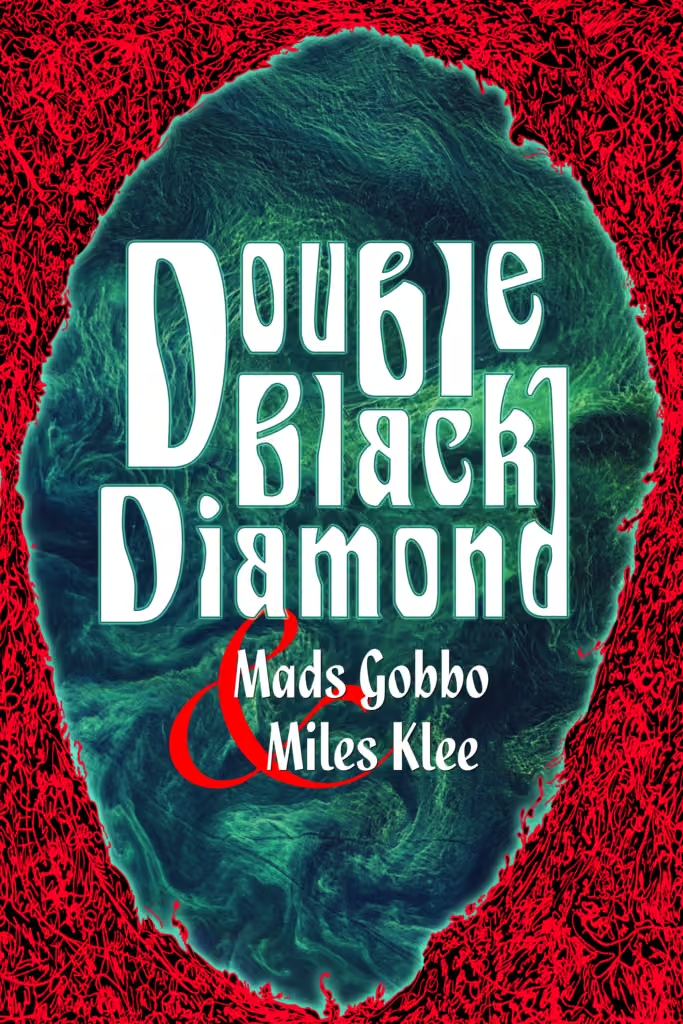
“There are bigger things that eat the shrimp, and they’re poisoned, too, and worse, they know it.” So warn—or admire—the narrators of “99% Pure,” one of the dishes on offer in the mutant buffet of Mads Gobbo and Miles Klee’s story collection, Double Black Diamond (222 pages; Double Negative), published last summer. The characters in “99% Pure” are among the few humans to survive a chemical plant explosion. As food supplies dwindle, the glowing shrimp in the radioactive water start to look pretty good. So our protagonists (who speak in a first-person plural voice that evokes shrimp-mind) barbecue the little buggers and embrace the change that’s coming.
Who or what outlives the end of the world? How much of a bastard must you become (to borrow the title of another story) to thrive in a nuclear lagoon, a psychic epidemic, a hostile takeover by corporately competent birds? In Double Black Diamond, survivors bend into new shapes so they don’t break: a mother violently inoculates her neighborhood against a rising tide of violence; a park ranger plots the destruction of his patch of forest; teens living in a post-death future yearn hornily to be murdered. These are sick gains, fitspo for the doom generation. As our own era increasingly resembles a whack-a-mole of cataclysms—with climate disaster, oil war, and fascism all vying for top billing—these stories offer an unsentimental hope. The underdogs here are stubbornly strong and build new kinds of solidarity.
The authors themselves offer a case study in the ever-shifting forms that human connection can take. Klee and Gobbo composed these stories while pining their way through a bicoastal relationship—a friendship that evolved, crabwise, into something more. The pressures of distance might have shattered other romances, but here they forged a slimy gem.
Gobbo, an illustrator and book worker, also composed the ink illustrations that accompany the stories. She is the co-founder of the queer and feminist art studio Hand Follows Eye. Klee is a senior culture writer at Wired and the author of Ivyland, a novel, and of the story collection True False. They live together in Los Angeles. The following was edited for length and clarity.
ZYZZYVA: A lot of the stories in Double Black Diamond feature violence of some kind, and all of them are funny. Really funny. Is there a relationship between those two things, for you both, in your fiction—bloody event, comic tone?
Mads Gobbo: Looney Tunes is a big inspiration, and a good example of art that understands the relationship between violence and humor. Both are kinetic and rely on an exchange of energy, the push and pull between Coyote and Road Runner. They both relieve pressure: a violent act or a good joke punctures the tension, literally or metaphorically. A lot of the art I resonate with seeks to wake its viewer from their sleepwalk, to liberate us from the crushing conditions of our material reality.
Miles Klee: Violence is the idiom of reportage, and cruel humor is the main aspect of how we interpret the news. Funny and gruesome just makes everything believable.
Z: Some of the cruelest humor in the collection comes from young characters: the teens in “Total Farce” (who needle each other mercilessly as they vie to be murdered), or the protagonist of “Her Miserable Destiny” (who puts her psychic powers towards a very adolescent revenge at an aquarium). What do child characters unlock for a story?
MK: Children are well-suited to themes of mutation, change, and upheaval. They have a heightened capacity for visiting Darwinian cruelty on their peers, as anyone who has been a child knows, but it’s viciousness that makes them such adaptable survivors (see also: the feral tribe of youngsters in “The Ambassadors” who attack a bourgeois adult dinner party). Children can always shock and destabilize because they have not internalized the unwritten rules we take for granted. On the page, they present an opportunity to cut humanity down to the snarling id.
Z: Do any of the stories in the collection reflect the particular political and social dooms that the 2010s and 2020s have wrought?
MK: Amusingly, they all do, whether we intended them as such or not. “The Stench” began as a portrait of a town afflicted by a horrible smell, sort of a juvenile concept, yet it escalates to the level of climate catastrophe. “Castle Doctrine” and others deal with extreme inequity. “What It Actually Does” observes a world in which the U.S. pursues complete surveillance rather than basic gun control. Scarcity, extraction, private equity, all of that is between the lines everywhere.
MG: “Total Farce” is for Gen Z. They’ll know what it means.
Z: It’s true that the collection doesn’t pull punches when it comes to the shock of its events. But I also find it to be admirably restrained in terms of worldbuilding. It’s full of quick snapshots of freaky places and characters whose rules and backstories you could’ve easily overexplained. (What caused these many apocalypses? Why is that old man tormenting that baby in the diner?) Instead, you offer readers a tantalizing glimpse and then GTFO. How did you know when a given story was done?
MG: The method we used to compose these stories gave us a structure to play in. We wrote relay-style, passing drafts back and forth with a general duration in mind. We were new lovers and lived on opposite coasts. The distance made us efficient and audacious. We wrote to impress each other. There’s nothing sexier than a savage last line.
Z: That initial writing process took place a decade ago, right? What was it like to revise drafts from your younger selves as you turned the stories into a book?
MK: It was impossible not to notice the ways in which we’d been writing to each other across a vast distance, uncertain of our future together, heartsick, but always hoping to dazzle and impress each other. There were narratives in which we were openly wrestling with what was possible for us—and in certain cases we had to more thoroughly eliminate ourselves from the text so as not to clutter up a story.
Z: Could you talk about a specific story that still, in its final form, carries something of that roman à clef quality?
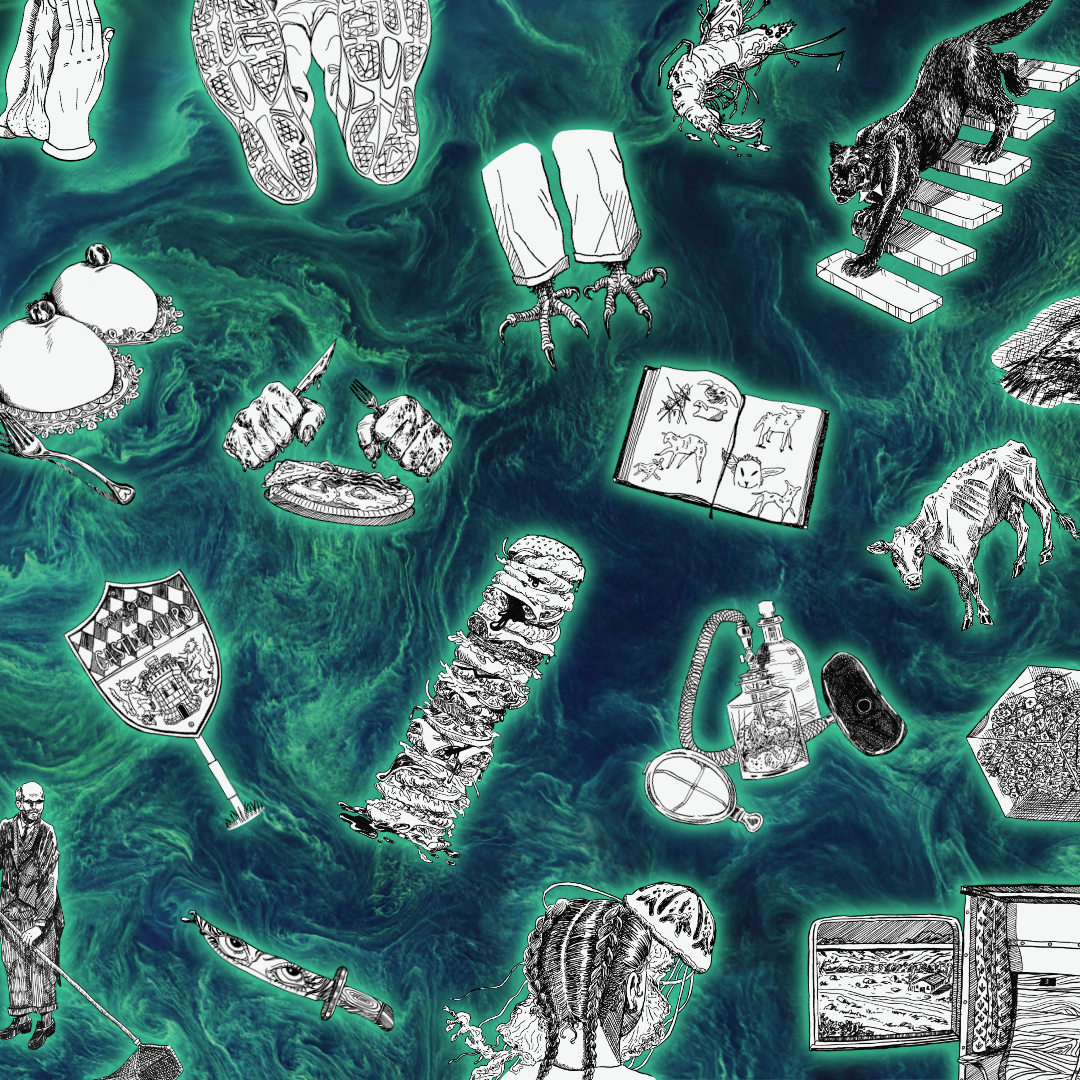
MG: For me, that would be “Heavy Mystery,” which also features one of my favorite illustrations: praying hands clasped around an erect, leaking penis. This is our smuttiest story, and the story about which my mother could only say, “It was interesting.” But it’s also full of an earnest hope that love might save us. Miles and I were both raised Catholic. I recall a date early on in our courtship where we visited a cathedral while tripping. Miles fell back in the pew, petrified by the vaulted ceiling. I used my Virgo powers to process out of there before he leveled up to full panic attack. This story was born from that moment, the moment when you realize the tremendous sea of emotion accessible to all of us when we open our hearts to the divine, a lover in crisis, or a potential future child.
MK: Well, exactly. Also, my own mom cited this as a favorite story in the collection.
Z: Since you mentioned the prayer-hands penis: the visual qualities of the book—illustrations, cover art, typefaces—cohere so well. What was your design vision, and how does it speak to the stories?
MG: I worked closely with our publisher Nick at Double Negative to develop the overall look and feel of the collection, as well as the individual illustrations. The small press offered us Renaissance artisanal levels of customization and ornamentation. It helped that Nick and I had previously collaborated on an erotic comic (comic book publishers, we’re taking offers!). I had a hand in everything from fonts and margins to the hand-drawn endpapers and the way the barcode integrates with the cover image. The stories are filled with zany scenes I wanted to bring to life in ink with a feral, scratchy hand. For liveliness of line, I looked to children’s illustrators: Quentin Blake, Tove Jansson, Maurice Sendak. The cover image started as a reference to Duchamp’s Origin du Monde: a peephole through which you view a nude, supine woman. Over time, the images evolved into something more interdimensional and cryptolinguistic. Most of all, I wanted the reader to enjoy the physical experience of reading these stories, to be surprised by the turning pages and seduced by the feeling of the cover in their hands. Once a bookseller, always a bookseller.
Z: I think you succeeded; the book is really fun to read. Despite (and because of) its tendency towards crisis, plot-wise. It features more flavors of apocalypse than any other book I’ve encountered: chemical, botanical, political, dairy, avian, olfactory, psycho-spiritual. As writers, what drew you to the end times as a setting, again and again? Does apocalypse continue to make its way into your current work?
MK: It’s easy to become narcissistic, or solipsistic, about the apocalypse—of course we would be born to face the catastrophe that ends our lives along with all others. What a prismatic approach to this scenario reveals (we hope) is that none of the possibilities are inevitable, and none are really an “end” to history, despite what the protagonists may think. These are the evolutionary bottlenecks that lead to radical transformation. The extreme conditions mean that suddenly, anything is fair game: a talking jungle cat, worldwide telepathy, prank phone calls from an artificial intelligence. We’re bound to keep writing stories about the collapse of some old order because there’s no other way to imagine the future.
Chelsea Davis is a critic from San Francisco. Her essays have appeared in the Los Angeles Review of Books, the San Francisco Chronicle, and the Brooklyn Rail, among other publications. More of her writing is available on her website, https://chelseamdavis.net. She holds a PhD in English literature from Stanford University.