
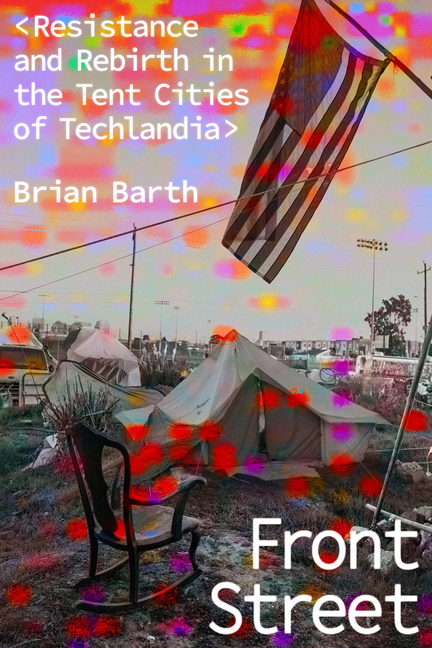
The Bay Area was a groundswell for experiments in communal living during the 1960s and ’70s. Few would associate the utopian spirit of those projects, which were often motivated by the desire to leave the city and its ills, with the urban encampments that have come to shape the region’s public landscape in more recent years. In Front Street: Resistance and Rebirth in the Tent Cities of Techlandia (304 pages; Astra House), however, Brian Barth makes a case for a spiritual lineage leading directly from the countercultural collectivism of the ’60s to the camps cropping up in San Jose and Oakland. It’s part of a larger argument Barth constructs: that encampments, rather than being blights on society or “necessary ills,” are actually essential spaces for survival and social repair, and as such they deserve not only tolerance but respect.
Front Street’s empathetic core is built out of Barth’s commitment to building lasting relationships with unhoused people, often over several years. Some of the most striking scenes in the book document encounters between the residents of encampments and those tasked with removing them: cops, independent “construction” contractors, judges. In one, Barth shows up during a sweep attempt at the “Crash Zone,” a (now defunct) encampment located at the edge of San Jose Airport. Police and workers from a city agency called “BeautifySJ” are attempting to clear the camp of a man named Rudy, but he fends them off with a strategy Barth describes as “[making] yourself such a pain in the ass that they question whether it’s worth the trouble to remove you.” Perhaps in part due to Barth’s presence as an observer, Rudy manages to hold his ground, if only for another week. Barth, who is an independent journalist with bylines in Mother Jones and the New Yorker, recalls a conversation with James, a relatively sympathetic cop at the scene, who agrees that sweeping “solves nothing” and there are too few shelter options for the people being driven from encampments. But James does not support letting tent cities persist, claiming that “letting the unhoused choose how and where to live” is “not realistic.” “They refuse [to leave] because they’re more comfortable here,” James argues. “It’s really a hard thing to have to be the one to force it to happen.”
James’s position may reflect that of a majority of the liberal Bay Area—there is an awareness of the futility of sweeps, but the idea that a person would choose to live out of a tent or vehicle rather than accept a bed in a shelter is hard to swallow. Barth challenges that position, steering readers toward a deeper understanding of the communal, radically defiant spirit of encampments, a lifeline with which to ward off the spiral of shame and isolation that often accompanies living in extreme poverty. The book’s title is taken from a conversation between Barth and a man named Dave, who lived in the Wolfe Street camp in Cupertino, right down the street from the Apple compound. “‘Front Street is when you’re not hidden…when all the public, the ones that hate you, the ones that like you are aaaahhhhlllllllll there,’” Dave explains. Barth extends his own interpretation: “It means owning who you are, facing the world on the other side of the poverty veil. It means communicating to that world that your existence is as valuable as, say, Steve Jobs’s.” While reporting on the tense relationship between Silicon Valley’s wealthy workers and the makeshift camps of the poor next door, Barth reminds us of the common ground they share: Jobs’s work with apples started with “a stint at the All One Farm, a commune where he worked in a Gravenstein orchard.” Perhaps, as Barth suggests, one can even imagine “a young Steve Jobs digging the communalism of today’s Bay Area camps,” but the political ideals of Silicon Valley have since followed a trajectory toward individualism and post-libertarianism, a path that only intensifies inequality.
Front Street features a unique blend of investigative reporting and memoir-like self-reflection, allowing Barth to examine the ethical considerations of writing a book about unhoused people from an outsider perspective; he is conscious of the risk of slipping into “poverty porn” territory, and of offering empty, worn-out solutions. As such, other voices are often foregrounded. The most prominent among them is Lisa “Tiny” Gray-Garcia, the founder of POOR Magazine, a “poor people–led/Indigenous people–led, grassroots, non-profit arts organization” that takes inspiration from the Landless Peoples Movement. A good deal of Front Street is dedicated to dialogue between Barth and Tiny, and she appears to have had an enormous influence on his approach to the project. “People such as yourself,” Tiny tells him early on in the book, “have been lied to a whole lot about access and privilege and authorship, and what is grist for the story mill, and how you deal with it in a way that does not perpetuate the violence of about-us-without-us.”
Barth returns often to the idea of the veil that separates the realities of the unhoused from that of the housed—“piercing the veil” becomes a primary goal. At times, though, he struggles with whether such a thing is even possible from his position of privilege as a white male journalist. In a seeming gesture of transparency, he offers readers personal details that distance him from the label of “activist,” like the fact that he makes some passive income as an Airbnb host and doesn’t consider himself to be an anti-capitalist. At times these confessions are perplexing: How does someone stand in solidarity with unhoused people and still believe in the system that failed them? My guess is that Barth’s candor reflects his desire to reach an audience that perhaps also feels morally compromised by how they benefit from capitalism’s pyramid scheme of wealth accumulation and upward mobility. Accordingly, Front Street does not seek to blow up that pyramid or interrogate the ways that companies like Airbnb may be propping it up.
Rather, Front Street focuses more on clear-eyed acceptance of capitalism’s brokenness, and there is a different kind of value in this. The cost-of-living crisis won’t be disappearing anytime soon, which is especially true in the Bay Area amid the AI “gold rush.” Here and elsewhere in the U.S., the absence of tents in a city is not a sign of prosperity; more likely, it’s a sign that poverty has been aggressively policed into invisibility. Piercing the veil starts with accepting encampments as an essential part of our contemporary social fabric, however uncomfortable that may be for some. Barth doesn’t shy away from acknowledging the ugliness of most encampments—both visually, in terms of disorganization and debris, and societally, when it comes to the behaviors of some residents, who might have drug habits, steal things, or engage in toxic relationships, all things he witnesses. It’s not easy to bear witness to this kind of chaos, even as a passerby, but learning to live with it is the humane alternative to urban “beautification” that relies on the threat of incarceration.
Homelessness, Barth suggests, can be viewed as a problem of broken relationships. Near the end of his book, he explores how frameworks of interdependence and Indigenous consciousness, which Tiny promotes, might foster new ways of repairing those bonds: “to behave as though other people’s problems are also collective problems.” We might start by simply expanding our idea of what a neighborhood might look like during an ever-unfolding era of crisis; perhaps toward something like Oakland’s Wood Street Commons, once the largest encampment in Northern California, and a public gathering space hosting dinners, film screenings, and a health clinic, a place Barth comes to think of “as a single community, in which housing status was a blurry and unimportant delineator.” The Commons, however, is gone. It was cleared by Caltrans and the City of Oakland in 2023.