
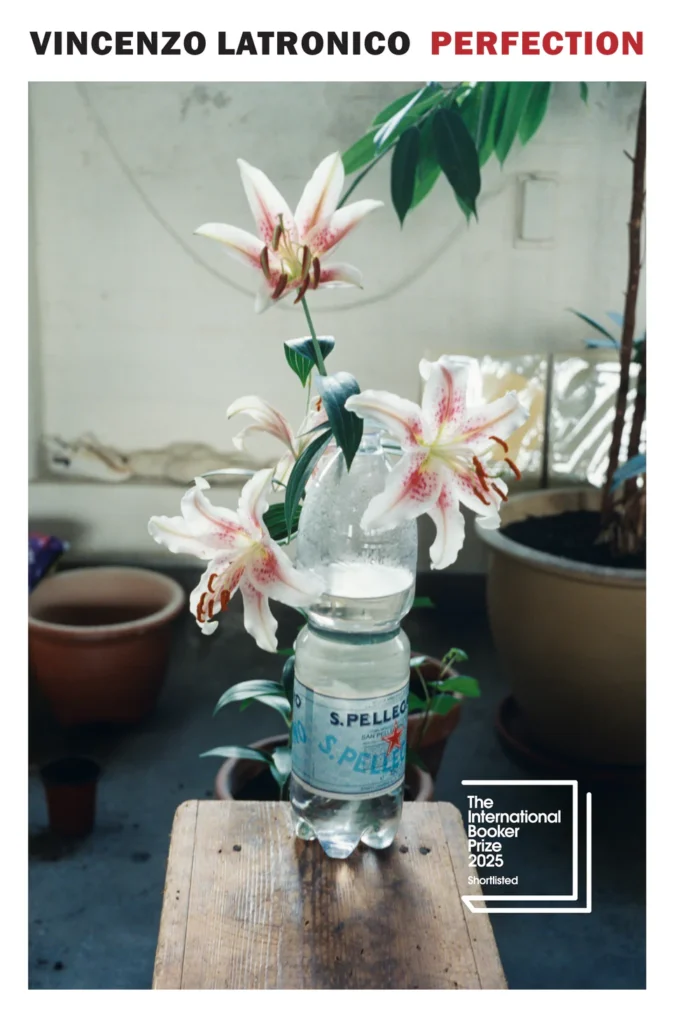
Popular novels about the internet tend to deride, explicitly or not, a certain perceived generational disaffectedness. “We don’t want to do anything challenging, such as what living requires,” declares the narrator of Lauren Oyler’s Fake Accounts. Instead, we––meaning mostly younger Millennials with jobs and social lives inextricable from the internet––want to live in an effortless and lifeless montage of familiar images. This aversion to difference and agency seems to flow from the alienation of social media. It also shapes the visual appearance of the world, producing a sanitized urban aesthetic that author Kyle Chayka called “Airspace” in 2016, referencing the generic global design influence of Airbnb.
Anna and Tom, the protagonists of Vincenzo Latronico’s novel Perfection, are derived from this cultural environment.Living in Berlin’s Neukölln neighborhood over the course of the 2010s, they often rent their apartment out on Airbnb, and the novel opens with an extended description of the inoffensive images they post to their listing: “the perforate leaves of a monstera… brush the back of a Scandinavian armchair.” Their objects–from Japan, Spain, France, Denmark––reflect the aesthetic appetites of potential guests coming to experience Berlin’s tenuous cosmopolitanism. The infrastructure furnishing this fantasy is a doppelganger of that precarious alliance: there is the Ukrainian cleaner, the French gig-economy company, the American hosting platform, all mustered to make possible a facsimile of hospitality.
Anna and Tom’s dedicate their lives to the curation of this apartment and to the life of taste, leisure, and material ease it might suggest. The couple work as digital brand strategists, consulting for clients around Europe and North America. They pass their time at galleries, barge parties, and Berghain. Mostly, though, they exist online, switching between social media, news, and tabs open for work. Perfection is unsubtle: “They lived a double life. There was the tangible reality around them, and there were the images, also all around them.”
The novelis an homage of sorts to George Perec’s Things, which follows a young couple working as market researchers in the early 1960s. Like Anna and Tom, Sylvie and Jerome in Things are paralyzed by the weight of desire, antsy for pleasure and wealth, which they accumulate as––and they are not unaware of this––mere costume, in the department stores and antique shops of Paris. They pass their days at the cinema, dazzled by characters whose lives “they would have liked to live.” They, too, are discontented with the fact that their money will never be abundant, much less old. Anna and Tom, freelancers burdened by class envy, are close analogs. Amidst these mirrors, Perfection tasks itself with identifying the specific ennui of a life lived not only in the register of fantasy, but on the platforms of the internet. In Things, Sylvie and Jerome’s lives are contoured by the Algerian War, a burgeoning culture of advertising, and the popularity of American cinema; by contrast, Anna and Tom experience the internet and social media as inescapable pressures. Modifying Perec, Latronico is betting that Anna and Tom may embody something particular to the twenty-first century, something new.
Perfection’s disaffectedness mimics both the style of Things and the lethargy of the doomscroll. Its distinguishing passages push apathy to its limits. Of being on the internet, Latronico writes, “It was like walking through the world’s most hectic street market on cocaine. It was like channel-hopping an entire wall of TV sets. It was like telepathically tuning into the thoughts of a stadium packed with people. But really it wasn’t like anything else, because it was new.” Articulating this novelty, however, is where Perfection falters most. In an extended sequence of scrolling, images pile up as banal and incoherent clutter: “The faces of strangers. The faces of handsome criminals. Avocado slices.” History passes as a mere accumulation of events deadened through the prism of a screen:
An egg became more famous than the pope. A highly contagious virus raged through West Africa…A man went around filming first kisses. A plane vanished en route to Beijing. A woman was beautiful. An apartment full of plants was beautiful. A vegan quiche was beautiful. A child needed money for chemo.
These images are physically inescapable, too––they swallow Anna and Tom while they wait for public transit, while they use the bathroom, and whenever they go out for lunch, “hover[ing], midair, a foot above their plates.” They are compulsively scrolling, forever inundating themselves with visual media. If Perfection is tasked with sketching the novelty of the internet, it seems intent on painting life online as less interesting, more mind-numbing, and less narrative than media of generations past.
The fact of Perfection’s relation to Things ties its depiction of the present day to the middle of the twentieth century. Anna and Tom are the spitting images of Sylvie and Jerome, down to the irony of their politics, the social signifiers they chase, and the prose that constructs their characters. Both couples wish to have already acquired everything they want, without understanding that desire outstrips acquisition. But if these thing-filled passages are meant to distinguish Anna and Tom’s inertia from that of Sylvie and Jerome, they do so only by exchanging cinema and advertising, the touchstones for Perec, for the infinite scroll. Readers already know that that tension, between apathy and overload, never resolves in the form of the internet––we might hope for the novel to do more than metabolize it all into a great, big sigh.
Instead, disaffection abounds. About his characters’ political affiliations, Latronico notes that they donate ten dollars a month to an LGBTQ rights foundation, “which came to just under nine dollars after the Californian payment platform took its commission.” They feel conflicted over the causes to which they ought to be obliged––supporting Hillary Clinton out of deference to feminism or frowning upon her pharmaceutical industry ties. Gathering donations for migrant camps, Anna and Tom exchange looks with people “bearing bags of tattered sheepskin jackets and American Apparel organic tees,” their exchange “charged with a silent recognition of their shared struggle.” (To be fair, similar sardonic punches are landed in Things: as Algerian independence gains ground, Sylvie and Jerome rise at five in the morning to help comrades paste up informational posters.) The de rigeur politics of it all are more frivolous than performative.And the personal mimics the political: discontented with their sex life, the couple “would read a piece by a New York journalist about how she’d taught her boyfriend to use a double strap-on, and then send the affiliate link to the other over Slack.” These are punchlines, vindictive appraisals that make Anna and Tom disappear into caricature.
Latronico’s assaults soften a bit in the presence of Anna and Tom’s class precarity. The internet has made the conditions of freelance work much worse: Anna and Tom pass much of the novel trying to piece together a portfolio and an income from ad-hoc gigs, favors, and short-term contracts. As they watch friends acquire the Eames chairs and Hartwig chessboards they’ve always wanted, one can’t help but pity the futility of their hustle. Zeroing in on the gig economy’s paradox of freedom, which has augmented the very sense of potential that paralyzes Anna and Tom, Latronico turns their materialist vapidity into a coping mechanism. If young people have always felt malaise at the impossibility of career advancement, the internet has turned that precarity into a condition. Even Anna and Tom’s friendships are unreliable––“looser and more ill-defined” than in their youth.
Immobilized by their own precarity, Anna and Tom are still in Berlin in the summer of 2015, as millions of people detained in Middle Eastern migrant camps seek asylum in Europe. After Germany opens its borders to Syrian refugees, Anna and Tom feel an urge to assist––though, of course, their graphic design skills are useless in the grand scheme of history. Viral images and infographics, along with news delivered through social media and email, galvanize them into organizing meetings with peers. An uncanny twin dynamic, the expat and the migrant, is clear––especially because Anna and Tom feel rootless, even as they enjoy the “vague Anglophone displacement” of Berlin.
They go first to Lisbon, on a contract to serve as creative directors of a new location of a hotel in Berlin. It is seductive, at first: “it felt like they were in languorous southern Europe, which, of course, they were.” But the monsteras and Danish teak recall Berlin; both cities sell fragments of old walls. They move again to a house on the outskirts of Noto, Italy, hoping to get a head start on the crowd for the summer Biennale in Sicily. But it “looked like any old countryside, which was what it was.” They search for an image and find only the stubborn fact of their own consciousness, and even that they can hardly parse. Like Sylvie and Jerome, who leave Paris for Sfax in search of the real thing, Anna and Tom come up short and live, in Perec’s words, “a life sans everything.”
Anna and Tom are ever frustrated by the reality which creeps into the frame: piles of old receipts, a migraine, the burned-out cars blocking their view of the sea. In Berlin, they half-heartedly want a threesome––or want to want it––but, in the club, they scuttle away because the kiss is too rough, the man too balding, the dick too limp. The residue of another person’s aliveness interferes with the inert fiction of their lives. They want only to have lived, to behold a picture of their whole life. Before they move to Lisbon, they walk around Neukölln, noticing the apartments of their friends and former MDMA dealers, the restaurants they used to frequent. Though they lived a life here, they can only enjoy it as a memory. Perfection is, after all, delivered almost entirely in past tense.
Most fiction that takes on digital culture finds itself primarily concerned with how the images and artifices of social media come to shape everyday experience. In Fake Accounts and Kate Brody’s Rabbit Hole, as the phenomenology of life is one of paranoia and conspiracy; in Alexandra Tanner’s Worry, which includes similarly trite sequences of images the narrator encounters online, claustrophobia and distress keep totalizing apathy at bay. In Esther Yi’s Y/N, artifice is simply what writing is, and is therefore a mobilizing condition of creating art.
Perfection does not seem to believe that narration––of one’s life, of a novel––is made more proliferate, conspiratorial, or exciting by the internet. We are denied access to Anna and Tom’s interior life just as much as they, presumably, are incapable of having a good one. Anna and Tom do not have the power to tell their own story; they do not have the power to live. Social media’s dark allure ends in incapacitation.. It doesn’t just make people live solipsistic lives––it makes them not want to live at all. Anna and Tom cannot, categorically, be narrators. Perfection is their life, without anyone to experience it: prose for a life without a narrator.
While reading Perfection, I thought of Ivan Goncharov’s novel Oblomov, whose eponymous main character is a lazy, fussy aristocrat defined by his relentless dread. He spends most of his time in bed, daydreams about renovating his house (it never happens), and complains to his servant about the frivolity of his acquaintances––writers and businessmen engaged in the bustle of modernity in 1850s Russia. He fulfills his infantile tendencies by marrying his landlady and dies, unceremoniously, as serfdom collapses nationwide. After his death, Oblomov’s former servant recounts his master’s life to a writer in town ––“he told him what is written here.” Retroactively set up as a memory, Oblomov has been dead the whole time.
Anna and Tom might as well be dead. Augmented by Latronico’s past tense, even in their own present, Anna and Tom live life as if it were a memory: they regularly look at photos of their recent vacations, replacing the real experiences of dissatisfaction with the pictures. (“Like anyone else, they could have made it,” Perec writes in Things, “but all they wanted was to have it made.”) Perfection ends with a shift to the future tense, foretelling an inherited house in an unnamed coastal town on the Mediterranean sea that the couple will convert into another Airbnb. They will have quite literally turned their passion––rendering––into a job. They will still be dissatisfied and overworked, but the reviews (“It’s just like the pictures”) will prolong the fantasy.
Katherine Williams is a writer living in New York.