
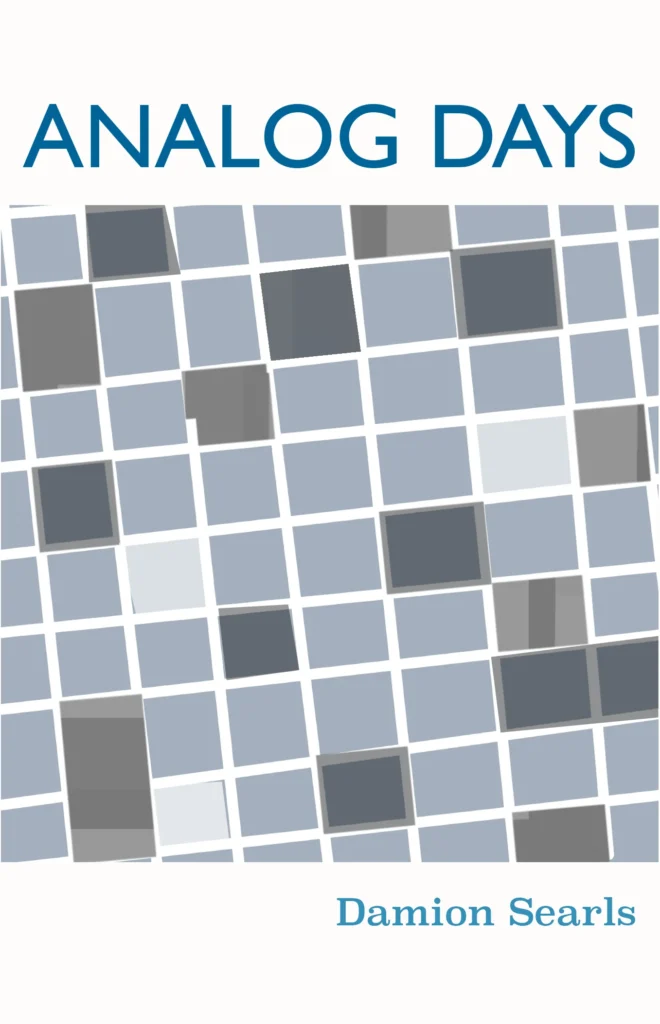
One day in June, the narrator of Damion Searls’s debut novella, Analog Days (120 pages; Coffee House Press), steps away from the narrative, allowing ambient coffee-shop dialogue to populate the pages: “Decaf soy latte! / Here. Thanks / It’s hot / Ooh!” It’s the first instance where the text seems to adhere to the reportage implied by the time stamps that structure its chronology (June 29, 2016), shedding story and morphing into notes in a journal. Here, the scene appears exclusively as quoted language, as information, the present breaking through the past tense that governs the novella up to this point.
Not for long, however, does such immediacy last. The narrator soon returns with a grand and reflexive reflection on the very role of narrative in his present. Already nostalgic for his historical moment, he declares, “It was a time, they will say, when we had lost the thread of the story.”
Sometimes the subjectively vacated narration of Rachel Cusk’s Outline, sometimes the essayistic, all-the-world’s-a-text prose of Ben Lerner’s Leaving the Atocha Station, Searls picks up a number of recognizable tricks from the slim-volume penmen of fairly recent. Nonetheless, his novella is not so precisely autofictional: the narrator is a freelance “coder,” while Searls himself is a prolific and acclaimed translator of Norwegian, German, French, and Dutch literary works, including the fiction of Nobel Laureate Jon Fosse.
It’s early summer 2016, and the narrator lives in Brooklyn. He visits friends in San Francisco and is visited in turn. He sees a movie and then another. He remembers childhood scenes and summers of the recent past, all the while, in the present, his injured foot swells and bruises and heals. Most of all he hears from friends, admitting early on, “our group does more than trade stories and images, but the rest doesn’t matter that much to be honest.”
The novella is epigraphed by a quote from Joseph Conrad’s A Personal Record: “Every generation has its memories.” Plentiful are the autofictionalists who write personal records in the interest of investigating the personal as such. To read things cynically, this preoccupation with the personal merely mirrors the commercial obsession with memoir and authorial gossip. Though Analog Days reads from time to time like generic autofiction, it steers clear of the genre’s fixation on the figure of the author. Instead, Searls takes up the problem of memory, sometimes his narrator’s own, but ultimately the collective memory of his generation.
Analog Days seems less interested in providing a personal record than in playing out some reminiscences, some memories of summer 2016, when the truth started loosening and nostalgia settled itself in the lives and ideas of the narrator and his circle, a set of information-drenched, Gen-X liberals. One day, on July 3, 2016, the narrator attends a screening of Jim Jarmusch’s Dead Man and ponders the meaning of allegory. He reads an article that gives him a nice definition: “when something means something else, a story that isn’t the real story but points at one.” Such deferral of meaning is fairly well descriptive of the novella’s own mode of narration: the sometimes wavering, sometimes digressive focus, the layering of memory, and the resultant displacement of scenes.
Herein lies an exciting doubling of the novella’s title. The book is certainly replete with familiar reflections on digital technology (people used to read more on the subway, people used to be more present). This is the characters’ longings for the analog. But such nostalgia also structures the novella’s narration, the narrator frequently remembering a scene in which a character remembers a different scene (as, in the opening scene on June 21, when a barroom conversation is nested inside of a different barroom conversation). These are scenes with analogs, stories pointing to other stories. In this way, the novella’s nostalgia for the analog world is accompanied by an analogical movement in its very narration.
Reading Analog Days is like listening to some guy tell stories about his friends telling stories. But sometimes it is different, as when the narration completely gives way to overheard dialogue, or when the narrator suddenly reports on Donald Trump’s campaign or lists facts about climate destruction. Frequently fluctuating narrative distance, Searls gives a compelling portrait of the not-so-distant past, a time when “fake news” was a principal political concern and collective truth and memory were in the beginning of a particular and ongoing crisis.
Benjamin Flaumenhaft studies Comparative Literature at Brown.