
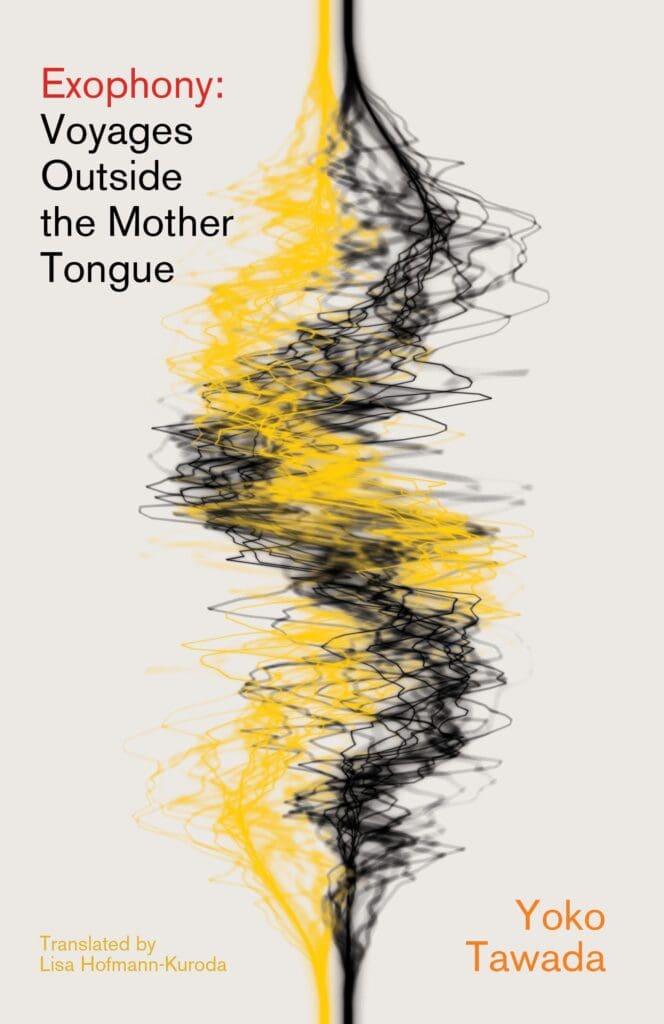
Exophony: Voyages Outside the Mother Tongue (192 pages; New Directions), acclaimed Japanese-German author Yoko Tawada’s first essay collection available in English, explores Tawada’s lifelong fascination with language, foreignness, and, more generally, “exophony,” which she understands as existence outside one’s mother tongue.
The book, writes Lisa Hofmann-Kurada in her translator’s note, “is clearly addressed to a Japanese readership. In many ways the book is about the Japanese language itself.” As a result, it’s hard to shake the feeling that the actual matter of the essays—Tawada’s discussion of familiarity, understanding, and ignorance—and the writing’s sensibilities, associations, and perspectives, out of which its meaning emerges and develops, lay just beyond the grasp of its translation. And yet, we comprehend her insights and thoughts all the more powerfully for it.
At one point, for example, she embarks on an unusual analogy, saying of a writer-acquaintance that he “has a talent for picking up words and expressions that are only used in certain dialects, cultivating them like seeds in the pages of his writing.” Tawada continues: “Muroi-san told me that the English word ‘seminar’ is etymologically related to the word ‘seed,’” and she then uses this linguistic connection to build up a more general vision of learning and of creative poetry as a kind of “fieldwork.” Suddenly the comparisons make perfect sense. It’s fascinating to experience—in English—a Japanese writer piece the English language together backward, as it were, through etymological associations.
Elsewhere, Tawada writes, “There is a saying in German, Das kommt mir Spanisch vor (‘it’s all Spanish to me’), meaning something is completely unintelligible.” She mentions the phrase in the context of a dream she had, in which she could not understand what anyone was saying because they were all speaking Spanish—and concludes she must have been dreaming from a German perspective because of this saying. Reading about Tawada’s dream, an English-speaker may not help but think of the story in the context of the phrase “It’s all Greek to me.” Whatever the foreign tongue used in the expression, it’s clear that languages are more than merely systems of words: They are ways of constructing the world, and none are universal.
There’s a section in Exophony that perhaps perfectly encapsulates its magical effect. Tawada recalls attending a Japanese experimental theater performance with a German friend. The theater group was interested in questions of language and linguistic boundary-crossing and so the actors leaned into their native accents when speaking their German parts. Tawada remembers her friend saying afterward that at one point in the performance he assumed from the sounds of their words the actors were speaking Japanese and was astonished that he understood what they were saying. “When the hell did I learn Japanese?” the friend thought. “But when I listened more closely, I realized they were speaking in German.” Reading Exophony was almost a similar experience: although the words themselves were English, the perspective is so rooted in a Japanese understanding of language that one may forget completely they are reading in their mother tongue.
Maisie Bilston is a Senior at Yale University, where she studies English with a Creative Writing concentration. She is founding editor at Cherry Road Review and has interned at American Short Fiction and Curtis Brown Ltd,; she is also the Managing Literary Editor at the Yale Literary Magazine. Her poetry has won several prizes, most recently the Yale University Academy of American Poets prize and the Albert Stanburrough Cook Prize for undergraduate poetry, and she was the university representative on the 2025 Connecticut Poetry Circuit. When not writing, she enjoys reading Agatha Christie novels in the bath, taking long walks, and spending time with her dog, a black Labrador called Mephistopheles who has yet to live up to his name.