
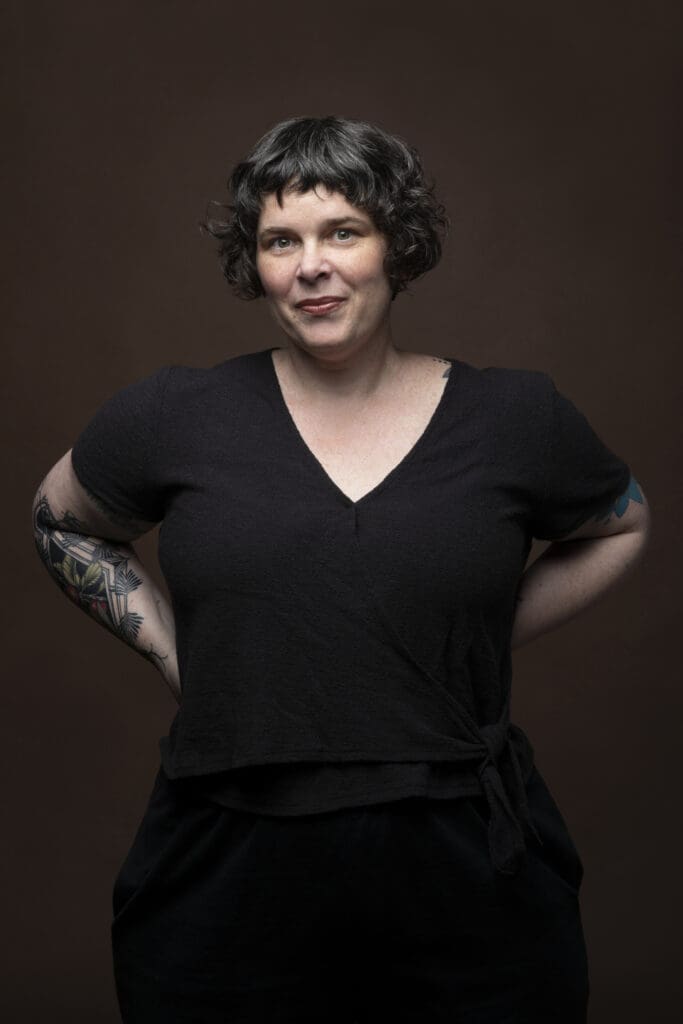
Manjula Martin joined ZYZZYVA’s masthead this April as our new Senior Editor. Previous to ZYZZYVA, she was the managing editor of the lauded Zoetrope: All-Story, the literary magazine owned by filmmaker Francis Ford Coppola which won the National Magazine Award for fiction during her tenure.
Martin is the coauthor of Fruit Trees for Every Garden, winner of the 2020 American Horticultural Society Book Award. Most recently, she is the author of the acclaimed bestseller The Last Fire Season: A Personal and Pyronatural History, which was a finalist for a National Book Critics Circle Award this year and has been reissued in paperback. Her work has appeared in The New Yorker, Orion, Los Angeles Review of Books, and other publications.
The following interview was conducted by Editorial Assistant Annie Delmedico via phone. It has been edited for length and clarity.
ZYZZYVA: Could you tell us what your path has been before coming to ZYZZYVA?
Manjula Martin: I have had almost every job you can have in the literary sphere. I worked at bookstores for a really long time in my dirtbag youth, including Green Apple Books in San Francisco. I’ve done editing, I’m an author, I’ve published books, but magazines were really my first love. I was living in New York in the 1990s and ended up working at magazines during that peak magazine era. While a lot of what literary journals do is different than mainstream magazines, a lot of the skills are the same, so I’m really excited to be back working in a magazine format.
Just prior to coming to ZYZZYVA, I had taken a couple of years off to write my book. (ZYZZYVA was probably the first magazine that ever rejected me as a writer. I think I got a rejection letter from [founding editor] Howard Junker in the ’90s.) It’s a San Francisco institution, and I lived in San Francisco for most of my life until I moved up to Sonoma County. I really admire what [editors] Oscar [Villalon] and previously Laura [Cogan] were doing with the magazine, and I’m really excited about being here.
Z: I’m curious how you think about the literary magazine—what it can offer or make possible that other forms of publication do not. This question feels particularly important right now, amid the recent NEA funding terminations.
MM: Literary magazines are a valuable venue for writers when they’re just emerging. A literary magazine is a place where you can discover new writers, and it’s also a place where established writers are free to experiment away from the demands of the market, which I think is equally important as discovering new voices—allowing people to really be creative without the pressures of selling something. We support bohemian, artistic expression in all its forms.
ZYZZYVA feels like a community and not just a physical publication. It’s an incredibly welcoming place, and I have always had this fondness in my heart for ZYZZYVA because of that. It really feels like a literary home that’s very alive, and not just doing the same thing over and over again. I think part of that may have to do with the fact that it’s not tied to another institution. We are a nonprofit and we’re not housed at a university or any other literary institution. I think this is one of the ingredients of the ZYZZYVA magic—that we are absolutely independent.
The recent funding cuts by the NEA are obviously terrible, and unfortunately probably just a beginning. Having those takebacks happen as I’m coming on board with ZYZZYVA has actually made me feel really fired up. I’m dedicated to keeping this magazine going and helping give Oscar the time and space to help raise the funds that we need to raise to make it happen.
Another thing about the current political and artistic climate is that I think there’s something really clarifying about having a dominant culture that is repressive. Obviously, it’s not great, but it is clarifying. As artists and creative people, it brings us more in touch with who we are and what we stand for—the value of what we have to say, and the value of our artistic communities. One of the remarkable things that has happened in the past few weeks since the NEA cuts is all these organizations that have had money taken away—publishers, magazines, arts nonprofits—have been talking with one another. It’s actually brought us closer together in a type of solidarity that I think is going to be very important for everyone going forward.
Z: What you said about solidarity makes me think about community and place. Sonoma County is at the heart of your book, The Last Fire Season. ZYZZYVA has been published out of San Francisco since it started in 1985. What is your relationship to Northern California and the literary community here? What does it mean to you to work here?
MM: There is a famous writer quote floating around, I probably saw it on Instagram, and the gist is, when you want to write about something big, you actually need to bring it in small—make it specific. That’s a lesson I really took to heart in writing my book, which is about a very specific place but also a very universal experience, that of climate change. California has a big cultural legacy, it’s a huge cultural presence, but it is made up of a zillion different very specific people and artists and communities.
ZYZZYVA is one of those communities. It’s been around for 40 years, really focusing on West Coast literary movements, which is somewhat unusual in the publishing business. I think being far away from the New York publishing world is actually a huge advantage in that way.. California has always been at the forefront of cultural movements and also not beholden to trends, which is part of the ZYZZYVA spirit, too. There’s a part in my book where I’m talking about the West Coast, and what I say is, the West is the place that the sun touches last every day. I think that’s a fabulous place to be.
Z: Earlier you talked about having every job in the literary world. You’re currently both a writer and an editor. Does your writing practice differ from your editing work in any ways that feel significant? Or are the two interconnected for you?
MM: I have been editing almost as long or perhaps longer than I’ve been writing. The two are indistinguishable for me in many ways. Some people are just writers, some people are just editors. I really feel like I’m both. I think there’s a particular skill involved in pulling that off—you need to be able to turn off the different parts of your brain at different times. It’s very important at certain parts of the writing process to turn off the editor in your brain. Otherwise, you’re never going to get anything on the page. At the same time, later on when there is something on the page, you need to come back to it with a bit of an arm’s length perspective and actually be able to see it as a shape and see it as a whole piece. The ability to turn that switch on and off at appropriate times is really important.
For me, what writing and editing have most in common is a type of sustained concentration that is very intense and very effortful. Writing a book and holding it all in your brain is like the most difficult thing I’ve ever had to do—sustaining an awareness and a concentration on this object at all times. It’s wild, it’s indescribable. I think the editor part of me allows me to do that successfully because the editor part is all about the wide-angle view, as well as the line-by-line.
The other thing I would say is that both writing and editing require you to be a reader, first and foremost.
Z: What are you reading right now?
MM: After I finished writing my book, which is a memoir that gets into natural history, a cross-genre memoir, I found that I could not read nonfiction for quite a while. So I was reading a lot of novels. I’ve been on a big Natalia Ginzburg kick, an Italian writer who was a political radical and who wrote through fascism in Italy. She’s a great example of capturing the micro aspects of everyday life under a larger political regime. I’m especially loving her epistolary novel, Happiness, as Such. It’s letters, all centered around a young man who has had to go into political exile because he’s an anti-fascist. I’m now able to dip into nonfiction again and I’m reading Lauren Markham’s new book, Immemorial, and a book called This Radical Land: A Natural History of American Dissent by Daegen Miller. I have also just picked up Marie Howe again because she just won the Pulitzer and I adore her. I just finished reading Hisham Matar’s new novel, My Friends, which is excellent. I picked it up when I was at the National Book Critics Circle Awards. He was another nominee, and he read a bit, and I was captivated by his voice, so I got the audiobook. He narrates, and his voice is like butter. His delivery is perfect. It’s a lovely novel.
Z: I’m struck by all the different forms and different genres you’re reading at the same time. I see the resonance between that variety and the experimentation in literary magazines you were describing earlier.
MM: I recently did an event with the author Rita Bullwinkel about writing at the edge of genre norms, and she said, “Genre is a lie.” Which I love, but obviously genres do exist. I write fiction and nonfiction, so working across genres is super important to me, and it’s delightful as well. It keeps you sharp. I think a lot can be learned from engaging in multiple genres at once. When I was writing my memoir, I actually tried to think of it more like a novel in terms of structure. And moving between genres makes whatever you’re coming back to more exciting. Like, I’m working on a novel right now, after publishing a memoir, and I’m luxuriating in it.
Z: Is there anything else you’d like to add?
MM: I have a secret theory that I’ve been cultivating for the last year or so. And my theory is that the Bay is back. You know, we’ve been through it in the Bay Area. We’ve been through the tech boom. We saw this all coming. It has been a difficult time for artists here for quite a while, and I just feel a surge of energy right now in literary and art communities. You have ZYZZYVA, you have McSweeney’s, which has a new editor. The Believer is back in the Bay. We have publishers like Transit Books, spaces like East Bay Booksellers, Womb House Books, Bathers Library. There’s some amazing literary community being formed here, and it just feels like the Bay is back. That might be a secret but I’m willing to spill the beans. You heard it here first.
Annie Delmedico is an Editorial Assistant at ZYZZYVA. Her fiction and essays have appeared in Bennington Review, X-R-A-Y Magazine, Sundog Magazine, and Wigleaf’s 2024 Top 50 Very Short Fictions.