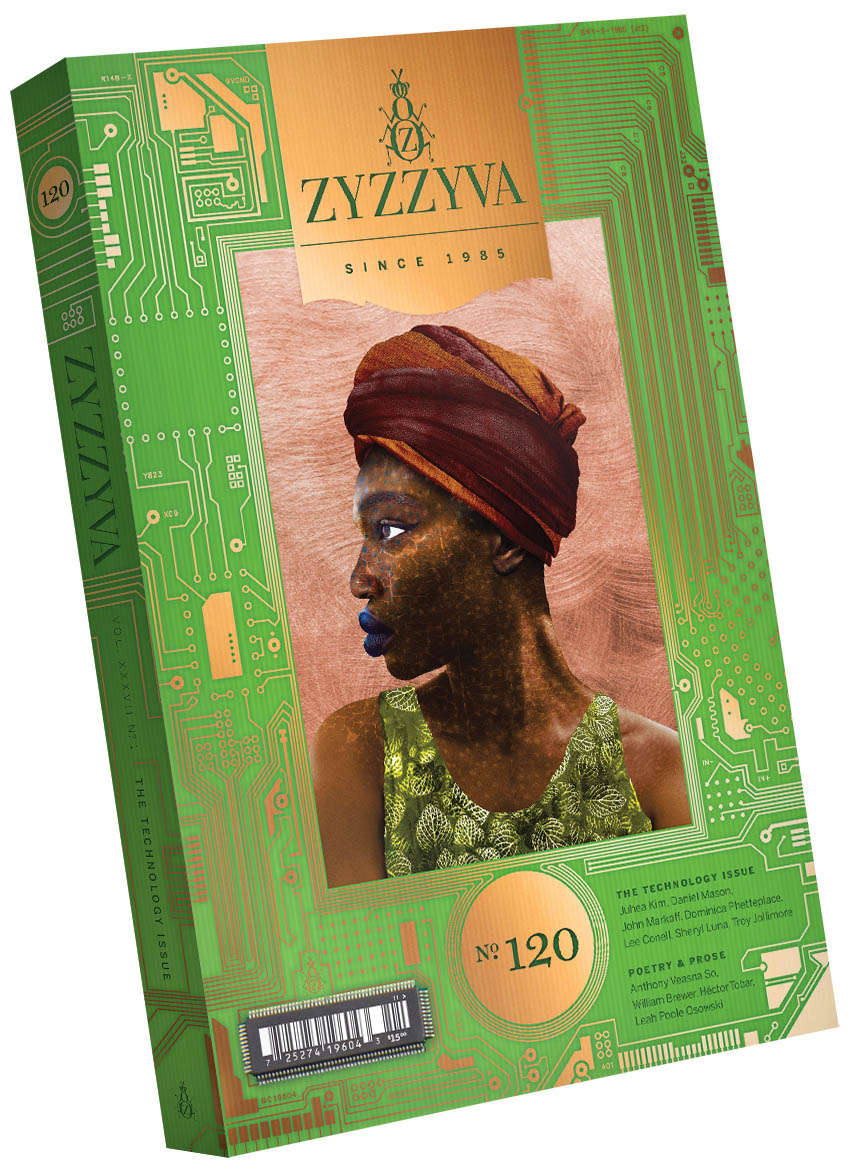
The complete and fully searchable archive of ZYZZYVA’s 26 years of fiction, nonfiction, poetry and art is coming soon. We’re working hard behind the scenes to make the entire archive available right here, free of charge. In the meantime, we hope you’ll enjoy browsing through these selections from our back issues.

Complicity

In Medias Res

After midnight in Lizzie’s Sonoma County studio apartment, a garage converted into a ski loft: beamed ceiling, redwood walls and funnel-shaped fireplace. On the radio, a phone-in psychologist. Lizzie nervously sets down her lemon grass tea, a fluted cup with roses, and calls. “I have this problem, you see, I uh shoplift. Compulsively.”

The radio psychologist tells Lizzie that stealing is a substitute for love.

Things Lizzie Has Stolen for Me

1. Two 100% cotton knit tops, multi-colored nubby boat neck and smooth cream scooped with large buttons down the front. The tiny curtained cubicle, I have tried on four things, the ones I want disappear down Lizzie’s tan pants. Then she switches the four-item tag with a two-item one that happens to be in her purse. Standing in the hall so the clerk is sure to hear, she yells, “Hurry up, I’ll meet you in the car.”

2. One facial mask, with Elastin, crushed almonds and thyme, a woman’s naked shoulder on the label. A health food store, in full view of the clerk, it falls into her pocket.

3. A purple sash, rayon from India. At Cost Plus nobody monitors the dressing rooms. Child’s play.

Lizzie fills her purse with socks and chemises and pepper mills. All she has to do is get some love and then she’ll stop.

4. Romika clogs, tan leather with low rubber heels, my Christmas present. While I ask the sales lady questions about jewelry, Lizzie is to my right stuffing them in her purse. “Those little cuffs there, how do you get them over your ears?”

Outside on Castro, walking swiftly (but not too fast), we make a great team like Robert Redford and Paul Newman. We could dye my hair brown to blend in.

5. One chocolate truffle, Amaretto creme. Lizzie pokes through the cellophane and pops it in my mouth.

The writing flows or gets stuck. Lizzie and 1 have never had sex, not even at the mud baths in Calistoga. We’ve slept together a few times out of necessity—her apartment is cold and there’s only one down comforter, it’s pale rose with tiny white petals or leaves. Once her hand went between my thighs, but she was sleeping.

True friendship is sharing the forbidden.

Each theft allowed Lizzie to breathe for a moment at the surface. The Sweat on her lip, the racing heart provoked a state akin to religious moods.

Five foot six, shoulder length black hair, size eight shoe and dress, Lizzie holds a tortoise-shell compact three inches from her face: brown liner, black lashes, dab of gray shadow. A warm creamy complexion inherited from her Mexican parents. No lipstick, she outlines her mouth with a brown pencil. Lizzie’s clothes: khaki, black, gray, beige, a rare blue or red.

The man I live with is in the shower, I shout through the curtain, “I know you don’t like it but I’ve got to put you in my piece. What name do you want?” “Fire Hose.” “Come on—how about Jorge?” “What’s this Jorge? I want Fire Hose.”

And then there was the time with Fire Hose. He and Lizzie were raised in the same Chicago neighborhood, the same high school, but met out here through me. A Dickens coincidence. Fire Hose calls her Lizard and squeezes her cheeks. She makes fun of his Spanish. “Do you know what Puerto Ricans call a bus? A wawa! For the dog on the side of a Greyhound, like bow wow, a wawa!” Fire Hose was driving his cab that night, Lizzie said, “Let’s get into bed and talk, it’s more comfortable.” Both of us in flannel nightgowns, we continue with the life of Edie Sedgewick. “Winnie, I’m going to sleep here, just ‘til Fire Hose comes home.” At six in the morning I tell her to move over. Three in a king-sized bed, it’s easy, both of them asleep and me in the middle: How far am I willing to share?

6. A can of Pure Maple Spread from Quebec. Safeway’s fisheye mirrors.

When Fire Hose and I got together he had moved back to the old neighborhood, so I spent a couple of months down the street from Lizzie’s birthplace. A year in San Francisco’s Mission District had not prepared me for this level of poverty, men sleeping in restaurant boiler rooms. My memory is full of dust and gravel, “Villa Lobos” scrawled everywhere.

Everything is bound to break wide open.

Lizzie calls her favorite method “exchanging.” Step 1: Buy the cheapest form of clothing available. Step 2: Hide the item on your person and return to the store. Step 3: Take five items into a dressing booth. Switch the item you really want with the hidden one. Step 4: Return five items to the attendant and walk out. Get caught? A race track driver could get killed, does that keep him off the track? A bank robbery at the movies, this masked James Dean holding the room on the tip of his rifle. Can you imagine a Chicana up there pocketing a jar of face cream at Merrill’s?

Bodega Bay, clam chowder and plate glass, we sit at a table watching sea gulls. Lizzie has a problem — she is content to hang around the house not doing anything in particular. Her response to my “What’s wrong with that?”: “You should talk, you with your writing and your intellectual friends.” I butter my sourdough. “Listen, writing alone won’t do it. Some of the unhappiest people I know are writers. And they don’t make that good of friends, not like you and Fire Hose. Did they really film The Birds here?”

Polk Street, a local schizophrenic, the kind you can smell half a block away, leaning over a trash can, shouting into the dark part, “You made a big mistake You make a big mistake You made a big mistake You make a big…”

The Strand, I pay as Lizzie sneaks through the turnstile. The teenage hitchhiker doesn’t have a goal either, a little blonde visiting this movie from Dallas. Then she’s moving to Los Angeles to study with a world-famous sculptor. She sticks her thumb out on the way to receive it all. Finally, the homicidal maniac I’ve been waiting for ever since the previews. She smashes him in the face with a piece of art, it is large and lumpy. The terrified murderer lets her out and screeches down the highway.

I could have stabbed him with my fountain pen.

Lizzie feels all extraordinary calm at the moment of theft. Outside a jeweler’s window, she doesn’t think she will steal. No sooner does she get inside than she’s sure she’ll come out with a jewel: a ring or handcuffs. This certainty is expressed by a long shudder which leaves her motionless.

Breaking her diet with a huge slice of German chocolate cake, Lizzie asks, “Doesn’t the word ‘complicity’ sound like a woman’s name.” I smile and steal a bite.

Catalogue of Ancestors

1969. The summer I graduated from high school. The Calumet Region, affectionately called “Da Region” in gangster movies, Al Capone was its most famous resident, my father’s hero. Officially Northern Indiana but really a blue-collar suburb of Chicago on the Kennedy, you can drive to the Loop in half an hour. 1969, the summer of Ralph.

Ralph had the same strawberry blonde hair, the same green eyes, pale rosy complexion. We were inseparable and everybody thought he was my brother.

I should say Ralph and Nance and I were inseparable. Nance, straight brown hair and wire rims, so skinny, lived down the street. She was my lover in high school and college. Really we’d been doing it since we were eleven, but it had only been a year since we quit pretending to be asleep.

7. The back of a director’s chair, brown. I lost mine when moving. Lizzie walks up to a display chair, wriggles off the back and opens her sweatered armpit.

Summer at home — sheer endurance, hanging around the house, sticky and irritable. Just breathing the air was equivalent to smoking seven cigarettes a day. Ralph and Nance and I together, not love, a matter of sanity.

From the beginning we pooled our resources. Nance and I fried hamburgers at minimum wage, she at Nifty Burgers and I at A&W. Ralph wrote bad checks, supplemented by shoplifting. We worked well together. Nance and I would pay for Ralph’s movie, afterward he’d write a check for pizza. Nance and I would buy a package of buns, Ralph stuck the ground beef down his pants.

Suddenly Kroger’s and Sears became exciting.

Lizzie went to high school on Chicago’s South Side during the Martin Luther King riots. Black girls carried scissors in their purses eager for a lock of blonde hair to show off, like a scalp. Every bathroom was a war zone. Lizzie smiles over her burrito, “That was one time I was glad to be brown.”

His mother was a breeder, Ralph had four sisters and a brother, all red heads. His older sister kept a list of the men she slept with, beside each name was a date and rating. Apparently this catalogue filled several pages. His parents were divorced, the m0ther an alcoholic who cussed in a Southern accent. She had sex on the living room couch, the same one the twins peed on.

Instead of lemonade, Lizzie and her sister sold used Mexican lottery cards for a penny a piece.

A year of college under his belt and therefore world-wise, Ralph was plotting our corruption. He majored in French, so we started with Genet and de Sade. The three of us in cut-offs, sweating like crazy despite the fan. Nance and I sprawled across the floral bedspread, Ralph at my French Provincial desk, Simon and Garfunkel above his head. He reads out loud:

Ah, dear Eugenie, did you but know how delicate is one’s enjoyment when a heavy prick fills the behind, when, driven to the balls, it flutters there, palpitating; and then, withdrawn to the foreskin, it hesitates, and returns, plunges in again, up to the hair! No, no, in the wide world there is no pleasure to rival this one: ‘tis the delight of philosophers, that of heroes, it would be that of the gods were not the parts used in this heavenly conjugation the only gods we on earth should reverence!

Ralph lays the book down and licks his lips, “Well what do you two think of that?” “Wow, Ralph, it’s really neat.”

8. One clear plastic purse studded with rhinestones. Courtesy of the toy department at Thrift Town. I keep my little plastic animals in it.

In grade school Lizzie and her sister would shine a flashlight on the wall, pretending they were at the drive-in. Then they’d put a plastic bag between their mouths and practice making out.

Needing petty cash, Ralph stole a can of Lemon Pledge from the corner Walgreen’s. Then he forged his mother’s signature to a note requesting a refund. Half an hour later his little sister was back with the money.

At the same Walgreen’s they posted a list of all the people who had written bad checks. When Ralph’s name appeared for all the neighbors to see, his mother nearly went insane with rage. Then she found the letter where he admitted being gay, he hadn’t even told his college girl friend yet, and his mother kicked him out. That’s how he started sleeping in Nance’s Hungarian grandmother’s basement for $25 a month.

Nance and I had never talked to a gay person before. Except the high-school teachers, but they were always pretending. I couldn’t deal with the women, the thought of growing up stiff and contained with a short ugly haircut was pure terror. Not for Nance, who fell in love with Judy Garland in kindergarten, she was looking forward to being a middle-aged dyke. She still is, except she teaches graduate school. It was easier with the men, I didn’t have to become one. Especially my senior English teacher, it was rumored that in college he got down on all fours and howled at the full moon. I liked that.

9. A green vinyl footstool, rectangular with four buttons on top. The landlord had stored it in Lizzie’s garage for a yard sale.

Ralph told us homosexuals wore mascara and picked each other up in cars. Then he described various sexual acts, using as many Latin names as possible. Nance and I had already tried a couple.

The further I progress, reducing to order what my past life suggests, and the more I persist in the rigor of composition the more do I feel myself hardening in my will to utilize, for virtuous ends, my former hardships. I feel their power.

When Lizzie was in the hospital, her sister slept with Lizzie’s boyfriend. Not buying, not receiving. Taking.

Sitting on the front porch petting the dachshund, Ralph said, “You’ve got to go to college, it’s your only way out.” He made it sound great — drugs and parties and cutting classes.

And it was great. For all those reasons. But what a waste, after four years I graduated with honors and no idea how to support myself. My mother paid for it with kitchen work, mopping floors.

Really it was no big deal. Nance and I had been having sex for seven years but technically we were virgins. Ralph was available. The day Nance’s parents left on vacation we got drunk on sloe gin, spilling it all over the new kitchen cabinets. Whenever I hear the Beatles’ White Album it all comes back. It was sickly sweet and red and sticky.

Climbing into Nance’s bed, Ralph gave a brief lecture on penis size, then demonstrated. What I remember most is laughter: we knew this was a ridiculous situation.

We never did it again, and communal living continued as usual.

Sears will replace your paint if it doesn’t cover. Lizzie and her sister want to do their bedroom, they buy half the amount needed, then take back the empty cans and complain about the pink showing through.

Ralph had been writing bad checks for two years, on three different accounts. He kept detailed records, could tell you to the penny how many thousands he owed. He seemed to actually enjoy reading all the threatening mail.

I stupidly told my mother about our financial arrangement. “How can you eat that pizza, knowing it was paid for with a bad check?” My mouth full of mushroom and pepperoni.

We knew we were perverts so we wallowed in it.

Ralph didn’t give us any warning. One day he gave the grandmother a rent check and disappeared. Nance and I were pissed. When it bounced, we received the full brunt of her Eastern European Immigrant fury.

The last I heard of Ralph he was living in Indianapolis and had changed his name to Lee.

Legendary Materials

My personal weakness is sales. That’s why I love Macys — you can live your whole life through sales. All it takes is patience and the Sunday paper. You can buy it or visit one of San Francisco’s many coffee houses Sunday afternoon. There is always a copy of Macys California lying around.

50% OFF CUBIC ZIRCONIUM — SWIVEL INTO G.E.’S 25” REMOTE COLOR CONSOLE AND SAVE — COSMIC HEART WITH PEARL, REG. 100.00, SALE 67.00 — YOUR CHOICE $12-25% OFF SELECTED LEOTARDS IN COMFY COTTON / SPANDEX BLEND

I had to wait three months for my red leather gloves, but it was worth it.

Every teak item is half price except the wine rack Lizzie wants, so she peels a $20 pink sticker off a cheese saver and puts it on a wine rack. After paying, she uses the same sticker to buy another. Later both are returned to the Macys in Sonoma at a $40 profit.

Fire Hose is sitting at the kitchen table when we get home, he doesn’t know about any of this. I say, “You should see the wine rack Lizzie just got, it was a real steal.” She squints her eyes and hits me.

I take Lizzie to Old Wives Tales, figuring feminist books can only do her good. She whispers, “Let’s get out of here, I can’t stand all these words.” “Lizzie, these books were written for you.” “No they weren’t, they make me feel stupid.” So we drive to Thrift Town instead.

10. One full slip, non-cling apricot with minimal lace. A pink $4.99 sticker superimposed over the $22 tag.

Adrian, a friend of mine from work, tall, blonde, well mannered, his father the vice president of a bank, far too antiseptic for my taste. Lizzie sees him at my kitchen table and is so attracted she runs into the bedroom. I follow. “What’s the matter?” “He’s so clean I feel like a cockroach.”

It’s the same with stealing — a touch of the magic wand and bam! she’s a cockroach from 18th and Blue Island.

Lizzie has never slept with a Latino man.

11. One blue rolling ball pen. When I find mine in her purse, she pockets me a new one.

SAVE $10 ON THE ROYAL WITH FAST ONE-STEP ERROR CORRECTION

Church Street Station, Dos Equis in the food section, Dan in his pale skin and weathered leather jacket that once was brown. He used to steal food and books. I ask, “Did you need those things?” “Of course.” “I mean, could you have gotten them otherwise?” “No.” I lean back, shake my head, “That’s not the same as doing it for sport.”

Dan won’t be that easily defeated. He pushes aside his glass and takes a drink from the bottle. He once knew a man who only wore white T-shirts. Whenever they got dirty, the man’d just go out and steal some more. That reminds me of Jerome, he does the same thing with thrift stores. Whenever his shirts get dirty, Jerome says, “It’s time to do the laundry,” and heads for the Salvation Army to buy a couple clean ones.

Dan is surprised, says he’s seen Jerome in some pretty nice shirts. But he’s holding his mouth that funny way, staring intently. This means Dan is thinking “Another Superficial Conversation.” Soon he’ll try to change the subject to something like structuralist literary theory. So I hold on to Jerome’s clothes, innocently ask, “Don’t you think that sometimes he could be a bit more choosey?”

A cockroach from 18th and Blue Island crawled out of Macys with a $20 pepper mill on her back.

Writing about his job as a sheet metal worker, Dan uses “synchronicity,” “semiotic,” “metaphorical level of exchange.” I say, “Why the big words? You trying to sound smart or something?” He looks down the subway stairs then back at me. “I want to use a vocabulary I’m not even supposed to own.”

PRO-MAGNALITE 11-pc. SET SALE $190 WITH BONUS

Taking out my Fast Pass I said, “ Dan, that’s a good story, I think I’ll put it in my piece.” He smiled, so I guess it’s okay. I wouldn’t want to be accused of stealing his life.

To me a friend is someone who raids my refrigerator without asking.

Imagine a roommate who marks an X on every egg.

Any tag with a green slash through it is half off. Lizzie immediately goes out and gets a matching green marker.

She finds a copy of Kafka’s Metamorphosis in my study, the light is on all night. Over coffee and scrambled eggs, a T-shirted Lizzie, no make-up: “Winnie, I am Gregor Samsa.”

Three of the men I know are reading Derrida but none of them understand him. They admit this to me, not one another. Each time I hear the story my response is the same, “Don’t you think that’s part of his appeal, that he’s incomprehensible?” Dan’s the only one who sees my point.

Knowledge — something to be locked up? The only way to get it is like Dan, to steal.

Gregor Samsa crawled out of Thrift Town with a clear plastic purse on his back, it was studded with rhinestones and sparkled.

Lizzie wants to write a piece on shoplifting, to get it out of her system. I volunteer to help, suggesting scattered paragraphs, each one small enough to fit in your pocket, and nobody sure where anything comes from:

If I am accused of using theatrical props as fun fairs, prisons, flowers, sacrilegious pickings, stations, frontiers, opium, sailors, harbors, urinals, funerals, cheap hotel rooms, of creating mediocre melodramas and confusing poetry with cheap local color, what can I answer?

How much are you willing to put out for this?

$22.50 RAVIOLI HEAD

Lizzie has never talked to Dan, but she saw him once at my reading last summer. Afterward, driving down Valencia, she exclaims, “How can you control yourself around him, he’s so attractive.” “You don’t know him, it’s easy.” Then I add, “He lived with a Mexican woman for eight years.” Lizzie switches on the turn signal and for a moment looks hopeful.

No work for over a month, I think twice about buying a burrito. Lizzie has gone back to Sonoma. After two days with her I could own anything. Old Wives Tales, a new book on female psychology, $16.95. They are so trusting here, so easy to slip it in my bag. How did this thought slip past my censor? Ripping off a feminist book store and me a woman writer, there could be nothing worse. I leave immediately, not trusting my hands, my mind.

FREE KNIFE SHARPENING

The atmosphere of the planet Uranus appears to be so heavy that the ferns there are creepers; the animals drag along, crushed by the weight of the gases. I want to mingle with these humiliated creatures which are always on their bellies. If metempsychosis should grant me a new dwelling place, I choose that forlorn plane, I inhabit it with the convicts of my race.

When I pay full price for something I feel defeated.

Lizzie gives her homeopath $80 for a kleptomania remedy. She just takes this white powder and avoids coffee and sugar for the next three months.

12. One Chemex coffee maker, four-cup capacity. This one’s disputable. A month ago in Cost Plus she remarked how easily it would fit into her purse. When I get it for my birthday I ask if she bought it. Lizzie turns her back to me and chops onions, “Yes.” “Come on, don’t lie to me.” “Winnie, leave me alone.”

Posted in Archive | Tagged , , | Leave a comment

A New Ocean

At five in the afternoon one day in the fall of 1963 my “guide” took the sleep mask from my eyes and helped me to sit up on the deep couch on which I’d been lying since eight that morning. He told me that the mixture of LSD and mescaline that I’d been given had now passed through my system. How did I feel?

I could not answer him. The drugs had tilted my brain and breached a barrier, and visions from my subconscious had been pouring unstoppably into my conscious mind. Some had been literal, or had made me laugh — the desk I’d worked at in the Ivory Coast, a snapshot of a friend’s expanded waistline — but most had been so heavy with significance and reproach that they had squeezed my heart to groaning. My father’s wide eyes and yearning, boyish smile, shadowed by the brim of his fedora, had fixed me. At his death several years before, our difficulties had been unresolved.

A Chanel suit belonging to my separated wife hung flatly in a dim and empty closet. My four-year-old daughter’s thin legs and pretty shoes had skipped back and forth, back and forth. My hair behind the temples, and the cushion that had been under my head, were soaked with tears.

My guide led me to a chair before a window and drew its curtain wide. “How does it look to you?”

“Awful.” An asphalt parking lot stretched to a tree-lined street down which cars appeared to be moving at violent speed. Solitary people were squinting against the slanted autumn sunshine.

“Do you want to go out there?”

“No, I don’t.”

He wrapped a blanket around me, for I was shivering, and left the room. Beyond the closed door I heard the murmur of a consultation, and I could picture him with the blonde woman doctor who had checked me physically and had replaced him at my side when he needed relief, and with the wiry psychoanalyst who was the program’s Director. There were others of the staff, but I could not identify the voices.

Some of these others had medical or therapeutic credentials, some did not, but titles and qualifications seemed unimportant to them. They were of all ages and complexions. Something they believed could change the world had been discovered, and anyone of useful intelligence would probably have been welcomed by them. Not long before, John Kennedy had spoken about Space as “the new ocean,” saying that we must sail on it simply for that reason, because it was a new ocean, and this group shared that spirit. So far, they had every reason to be optimistic about these inner-space voyages.

The friend of mine who had proposed insistently that I take the drugs, who knew the extent of my depression since my separation from wife and child nearly a year before, had worn a most unexpected, beatific smile from the day of his session onward, and he was not exceptional. The short-term benefits to troubled lives had been excellent, and no one had broken down.

My guide came back into the room and said, “We’re going to give you something more. O.K.?” He was pale, and his dark stubble looked days old.

“Good.”

A vertical canister of C02 was wheeled in and a breathing mask attached over my face. A valve was turned and the sound of rushing air filled my mind. I breathed deeply and was suddenly weightless and flying, relieved of my body. Without friction, without any sense of speed, I shot straight up into the constellations, and there, in the star-dotted blackness, I arrived at peace. My heart was freed, and in a silence in which there was no temperature, no gravity, no wish or will or conflict, no need, I felt an overwhelming, blissful gratitude.

I rested there a while and then I started down. The Earth was far away, a speck and then a dime against the blackness, but it quickly grew. The continents and the oceans became distinct, the tan deserts, the ice at the poles, and the dark forests of Canada, Russia, and Africa. I began to see the conglomerations of towns and cities, and to sense the variety of people, especially those where I’d lived — New York, Paris, Abidjan, and San Francisco. Nearing the ground I recognized with starts of joy some faces in the crowds, and I saw with the force of revelation that my father and my wife, and others whose specters had distressed me, were the same size as the rest, as robust and as frail.

As I slipped into my body and the floor became real under my feet, I felt my essential sameness with all these thousands of beings around me who were speaking in hundreds of tongues. Their warmth invaded me, and when I opened my eyes I was shouting with excitement at joining the world of humans.

My guide greeted my arrival and others came into the room to pat my back. After a time, one of them took me out into an evening of commonplace miracles.

I watched the ash-yellow oatfields rippling in a windless sunset and found that I could see the sap moving in the branches of the liveoak trees, even in the capillaries of the leaves. After dark, the lighted bridges crossing San Francisco were bemusing, as were those wonders of human order, traffic lights. In many of the people we encountered I saw beauty of body or spirit, and everyone of them seemed a miracle of gathered energy. Now so would I be.

My friend of the beatific smile had talked about “psychoanalysis in a day,” but this was something much better, I thought. There was no need for “analysis.” I was free.

Next morning I learned from a waitress at the counter of a strangely quiet, twenty-four-hours-a-day restaurant that John Kennedy had been shot in Dallas. He had been taken to a hospital. That was what was known.

I had never seen such things as the scrambled eggs on the faintly patterned, brownish plate, or the nicks in the tines of the fork. Yet I ate. My mind attempted sporadically to interpret the news, and, at other moments, images from the day before took over. A man standing beside me spoke up in a loud voice, proposing a date to the waitress, and she turned pink and hurried away to the kitchen. This episode seemed no stranger than the food or the coffee.

The follow-up appointment with my guide was for eleven o’clock, still an hour away. I started walking without purpose and stopped outside a barber shop, for in it I could see a TV set turned on.

Both of the barbers were idle, one sitting in his chair, the other leaning against the back of his. Closest to the set was a black shoeshine man, an older man, sitting. Their concentration was such that I momentarily felt I should not disturb them, but I went in and was motioned to sit down.

The TV camera was at the hospital. Just after the barber had begun to snip my hair the announcement came that Kennedy had died.

The shine man pointed at my shoes, but I shook my head. He said, “They couldn’t let him live. Not after Bay of Pigs. Couldn’t let him live his life.

The broadcast went back in time to Kennedy’s arrival at the Dallas airport with Jackie. Smiling officials greeted them. He was handsome and jaunty. Everyone was full of daylight.

“See him there?” the shine man said. “He’s too much for them. Too much. They can’t abide it.”

The broadcast showed pictures of the motorcade, of the cars coming into Dealey Plaza. Then it was broken into and a voice told us that a suspect had been arrested, and that his name was Lee Harvey Oswald.

“They get someone. Oh, yes.”

The images shifted to the hospital again, to Washington about the governmental consequences.

The shine man said, “He let them look real bad. CIA. Military, too.” He wiped his eyes with his knuckle. “Lee Harry Oswald, indeed.”

I paid the barber and walked to my appointment.

My guide had not yet come in and when he did, brisk and clean-shaven, he seemed too glad to see me. We sat at his desk and he asked some clinical questions. Had I slept? Had I dreamed? Was I experiencing flashbacks?

Then he dropped that manner. “Arc you really O.K.? I thought of you first thing after I took in the shock, whether or not you’d be all right.”

“I’m O.K.”

“I was afraid you might lose it, the good stuff you finally got yesterday. “

“I’ve got it still,” I told him.

“You were tough,” he said. “You wouldn’t let go. I tried what I could to help you though … Then the news. It’s your universe. And then.” His face showed pain, but a more superficial frustration as well. His treatment had been interfered with. He said, “Maybe you’ll want to take it again. Do some more exploring.” I was embarrassed to be talking about myself, my case. “Not tomorrow,” I said.

“Oh, no. Maybe months from now, certainly not tomorrow.” It was a strange handshake. The muscles of his hand and his skin were extraordinary vivid, although there was nothing unusual about them.

I spent most of the next few days alone in my San Francisco apartment, the TV showing me the aftermath, the official events, the caisson crossing the Potomac Bridge. Sometimes I felt I knew where he had gone, out there in the cosmos. I could feel its weightless silence. For me it had been paradisiacal, but for him the timing was all wrong.

My apartment off Buena Vista Park had a small balcony which looked out on a sweep of the city’s south side that included Twin Peaks, Diamond and Dolores Heights, and the bay toward San Leandro. Some of the Victorian houses facing me had been whimsically trimmed with bright paint. Wind chimes and bicycles hung on back stairway landings. I brooded on these clues to their inhabitants and on the backyard gardens below me, some neatly planted, others beaten down around a children’s swing, a kiln, a trampoline. Mad and dangerous though some of my neighbors no doubt were, I admired their putting the next meal on the table, doing what they had to, and getting on with it. I was of them as I had not been before.

Fifteen years afterward I decided to find out what I could about the people who had run the program and those who had passed through it. I knew it had been shut down when LSD had been declared an illegal drug not long after my session.

I called the woman doctor who had sat with me part of the day. She had become a psychiatrist with a practice in Menlo Park.

On the phone she sounded professional and guarded, but said she would be glad to talk. I asked her if she’d like to meet for lunch, or any other time that suited, but she said, “You can make an appointment, if you like. I’ll have to charge my fee.” I was mildly shocked, but accepted her terms.

Her office was near where the “Center” had been, and it seemed a standard therapist’s environment with comfortable dark chairs and a couch, and the curtains half-drawn. She was very much as I remembered her, a blonde woman, somewhat overweight, with a smile that at moments looked tentative, at others a touch cynical.

She told me that when they had had to stop the program there had been no money to follow up on those like me. She could not tell me anything about long-term results, except in isolated cases. “Now you’ll be one,” she said. “What’s happened to you?”

I told her that I’d remarried and had two younger children, and that I’d continued to teach and write. I’d published a novel and shorter pieces, and with another writer I’d started an annual writers’ conference. On the other hand, I felt I hadn’t been productive enough. I had had a drinking problem, but I had quit five or six years before. “What about you?” I asked.

“You can see,” she said, without much enthusiasm. She added wryly, “I still haven’t lost weight.”

There was not much news she could give me of the others who had been on the staff. So-and-so was still working at Syntex, another had taken a job in Los Angeles. In her responses there was a shade of tedium, but also sympathy.

I asked about the psychoanalyst-director.

“He’s at a Vets Administration hospital in Maryland. I have the feeling that he’s serving out his time.”

Did she remember that Kennedy had been killed the day after my session?

“Oh, yes. Yes. That day changed a lot of things for us. For everyone.”

“What changed?”

“You know as well as I do. Many things.”

“Things always change.”

Her mouth twitched impatiently, but she replied, “The mood. The feeling of the possible.”

We said goodbye and wished each other luck.

Outside the building’s sunny entrance I stopped to look at a liveoak tree, an old one with a great reach of gnarled branches and glistening dark leaves, which stood protected in the middle of a traffic island. I concentrated on it, and, after a bit, I saw the sap moving in its new, lighter limbs. The vision soon vanished and I could not revive it, although I was patient, blinking and staring intensely.

Then I let the effort go. Rather, it was swept aside by a rush of gratitude, part warm from memory, part fresh, a buoyant wave that lifted me from what had seemed a flat sea.

Posted in Archive, Back Issue Excerpts | Tagged , | Leave a comment

Heroin

Do you like it? Like a crooner, don’t you think? That’s where I got my last name. “The Sands.’” A casino in Las Vegas. This old drunk fuck was telling me about it. “HEY, little pretty black boy, goddamn … I ain’t seen nothin’ like you since I left Detroit … ”

He couldn’t get over it, touched me when he got the chance. Did I have a daddy??? Shit, I laughed back at him, imitating his drawl: SHEEE-IT, man, I said. Mocking him. You must be kidding! Man, I don’t even have a mother. Laying it on real thick, so he’d feel sorry for me.

He started coming around “CocoRico” regularly. I’d be at the bar up front, checking things out. Actually, he wasn’t bad-looking. When he wasn’t drunk his face and eyes didn’t droop as much, and you’d notice his big body and muscular arms, pretty strong and firm for a man his age. I’d always act surprised to see him.

That was before disco, before I talked Andres into hiring me as a DJ for the back room. “What do I need you for?” Andres used to say, pointing to the jukebox. It seemed like forever until Andres let me give it a shot, and look at him now: he’s making money, the place is jammed until all hours of the night — even girls want to come here and dance, the music’s so good.

“You’re kind of young, aren’t you?” the American once said. But I could tell he was fascinated, just like all the rest of them. My head of tight, kinky curls, my pretty hazel eyes, my sleek brown skin. “Where’s the little G.I. baby?” he’d ask Andres. Andres would shrug, in that bored way of his. “He’ll be here any moment now, I’m sure.” The American would buy more drinks, sitting close by the door. Sometimes I’d get there, let him buy me dinner. Sometimes I’d just stay away.

“Call me Neil,” he said, his eyes fixed on me in that sad, funny way of his. It was one of his sober days. NEIL … What kind of name is that? I loved making fun of him. “Good sport,” he’d laugh with me, jabbing at his own chest with one of his large, rough hands. I spit on the floor in contempt. “Man, you don’t have to talk to me like I don’t know anything. Good sport,” I mimicked, rolling my eyes. “What do you think this is? The Lone Ranger & Tonto?” I sulk, look away from him. Scan the room for a pretty face. Make him feel real bad.

Embarrassed, he looks lost. “Joey, I’m sorry.” He means it. I like that best. I could make him do anything then.

I keep at it for just a little while longer. “Man, I’m no savage.” When he looks like he’s going to cry, I stop. Touch his leg under the table. Soothe him with my voice. “NEIL,” I tease, gently now. “Neil Sedaka — ahhh …” I knew how to make him laugh.

One time he asks me a favor. “For my homeboy …” Some younger guy named Phil. I didn’t like Phil as soon as I met him. “Phil wants to see a live show …” Phil is standing there, next to Neil. Staring at me and not saying anything.

“You mean a sex show?” I take my time drinking my beer, ignoring Phil’s anxious, piercing gaze.

“Yeah, that’s right. One of those …” Neil is uncomfortable. Andres stands behind the bar, within earshot. He seems absorbed by the magazine he’s reading, an article about his rich cousin Isabel, who’s married to Alacran. But I know Andres — one car’s cocked in our direction.

“You want boys, girls, or both?”

“How much?” It’s the first and only time Phil opens his mouth.

“Depends,” I say. I’ll negotiate with Uncle privately, take my cut.

“We have a car,” Neil says.

We drive down the boulevard slowly, looking for the street. It’s early, around eleven at night. I sit in the front seat with Neil, giving directions. Across the wide boulevard I can see the ocean, black and still. “Is that your ship?” I point to the carrier floating, not far away. The men don’t respond.

Uncle’s place is behind the abandoned “Lido Supper Club.” He’s the night watchman, hired by Congressman Abad to guard his property from looters and thieves. The club is a white building with fake marble columns on the outside. Statues of half-naked nymphs and satyrs hold unlit torches. Uncle ushers us in through the back door. It’s enormous inside, and eerie. Everything’s been left as it was. Dozens of little tables and chairs, some with stained white tablecloths still on them. Ashtrays filled with cigarette butts. Empty bottles of San Miguel beer. A dance floor tiled with blue and white mosaics. There is a thick coat of dust on everything we touch.

Uncle is looking for the main switch, stumbling and pointing his flashlight at the cobwebs on the walls. Finally he turns on the dim chandelier that hangs in the room. He motions to a table in the front row, facing a large stage. Not too long ago, Johnny Buenaventura and his Orchestra used to play “The Girl From Ipanema” here. Now a bare mattress lies dead center.

I leave the two Americans at the table, take Uncle aside and tell him what they want. He is gone approximately ten minutes. A skinny young girl enters, followed by a well-built young man, close to my age. She wears a flimsy, loose-fitting dress, her eyes lowered. She is barefoot, and I notice her meticulously manicured toenails, the black nail polish dotted with tiny crescent moons. The young man is also barefoot. He wears worn khaki pants, and his chest is bare. There are intricate tattoos of spiders and cobwebs up and down his lean, muscular arms. He is beautiful, in his way. The two Americans sit up in their chairs, attentive now. I stay in the back of the cavernous room, smoking my cigarettes in the shadows. This way, I can watch them all.


We were in a room at the Hilton. “You ought to sing,” Neil was saying. “You have an exquisite voice. Good way to make some money, even here in Manila.” I grunt in response. What does he know, I’ve heard all this before. I turn on the giant color TV.

I had just taken a bath and a shower. If the water stayed hot, I’d be in there all day. Afterward I stuff the plastic shower cap and slippers with the Manila Hilton insignia, complimentary robe and two bars of Cashmere Bouquet soap in one of Neil’s Sportex shopping bags. He hated when I did that. “You don’t have to take that cheap shit. I’ll buy you what you need …” He just didn’t understand. I love the newness and cleanness of my little souvenirs, the smell and touch of the glossy plastic. I would live in a hotel room forever, if I could.

“I’m hungry,” I say to him. “Call room service.” We are sprawled on the bed. It’s two in the afternoon. “Tawag Ng Tanghalan” is on. A young girl singing “Evergreen.” She is earnest and terrified, but her voice booms out in spite of her, from somewhere inside that frail body. Neil shakes his head slowly, in admiration. “Not bad. She’s not bad at all …”

The TV audience claps and whistles enthusiastically when she finishes the song. She blinks into the camera, startled. She is last week’s winner, and an audience favorite. She stands in front of the cheering crowd, fidgeting with her hands. I can’t bear to watch her, it’s too painful. Her awkwardness makes me angry. “Look at her — how stupid!”

“Poor thing,” Neil sighs. “She needs to be rescued, quick.” Impatient, I make a face. There he goes again, upset. He identifies with everyone and everything. I can’t be like that. If I were on TV, I’d be the coolest guy. Mr. Heartbreak, the one that got away. Cool, calm, collected.

Lopito appears on the TV screen, waving to the noisy audience. Before he can even thank her, the young girl rushes off the stage. He gestures towards her departing back. “OUR REIGNING CHAMPION! A BIG HAND FOR CONNIE LIM, THE BARBRA STREISAND OF THE PHILIPPINES!!!” He is making fun of her, sneering in front of the audience. They pick up on his cruelty, start tittering.

Before announcing the next contestant, Lopito rattles off the different prizes: a twelve-inch Motorola color television, a clock, a year’s supply of Magnolia Ice Cream. The big prize is a screen test and a chance to appear in Mabuhay Studios’ next musical, starring everyone’s favorite sweethearts, Nestor Noralez and Barbara Villanueva. Lopito reminds us, once again, that Nestor and Barbara were discovered on his show. “Why don’t you audition for this? You’d be great …” Neil says. He can’t be serious, so I give him one of my withering looks.

“Come on, Neil. Call room service. I’m starving to death …” The next contestant is a young guy named Romeo something. Pretty cute, but corny. “Not bad, huh, Neil?” I poke Neil in the ribs, playfully. “Look at those thighs, and those lips …” Neil ignores me. “What a hairdo!” I say.

“What do you want to eat?” Neil asks, getting up from the bed.

Romeo whoever-he-is starts belting out “Feelings,” except he sounds like he’s saying “Peelings.” He’s trying very hard, and he’s making me sick. No charisma, as Andres would say. I switch the channel. There’s an old black-and-white movie, with Leopoldo Salcedo fighting the Japanese.

I lean back against the pillows, my arms behind my head. My tight black curls are still wet, framing my face. Neil is looking at me, ready to dial room service. “WELL?” he says. I am still naked. We both pretend not to notice how hard I’m getting. “Cheeseburger de luxe,” I say, dreamily. “French fries with ketchup. Mango ice cream…and a Coke.”


When Neil got stationed back in the States, he sent me a postcard:

Joey Sands
c/ o Andres Amaya
CocoRico
4461 Balimbing Street
Mabini, Manila
Philippines

Joey:
I thought you’d appreciate this.
Wish you were here …

The postcard was from Las Vegas, a color photo of The Sands Casino, with Sammy Davis Jr.’s name in lights. NOW APPEARING.

“You got mail,” Andres said, handing me the postcard. “You’re lucky I didn’t throw it away — haven’t seen you in weeks.”

With that buddha face of his, Andres watched as I held the card in my hands, pretending I could read. “Let me,” he finally said, snatching the card out of my hands. When he finished reading aloud to me, I smiled. Put the card back in my jeans pocket. Carried it around for days after that, maybe months … I don’t remember now.


I ask Andres if he’d write a letter on my behalf, someday. I have Neil’s APO box number, whatever that means. I have to figure out what it is I want, before I can dictate my letter. It’s gonna be good. I know how to get to Neil. He’ll send for me: we can live in Vegas or L.A.

“Sure … why not?” Andres says, in that easy way of his. He looks past me at the door. A couple of Americans have walked in. Middle-aged, okay bodies. They’ve never been here before. They’re hesitant, they could turn around and leave and never come back. Andres can tell. They aren’t servicemen. They look classy, yet casual. What Andres calls “old money.” His favorite kind.

It’s early, “CocoRico” empty — except for me and a couple of other young guys. There won’t be a rush for another hour. “Good afternoon,” Andres says, his shrewd eyes on the Americans. I perk up. This is going to be interesting. I am tingling, the dope in my veins has run its course and settled peacefully.

The Americans are relieved. They smile and sit down at the bar, not far from me. Andres stands under a poster of a matador and a bull, brought to him all the way from Barcelona by one of his rich lovers. He is chatting amiably with the Americans, asking innocent little questions. Where are you from? Really? And how do you like Manila?

The Americans loosen up. One of them, the older one, eyes me boldly. I ignore him, smiling to myself. Listen to Andres go on and on, prying information out of them. Andres can be so cordial when he wants.

That’s what I like about him. He’s so slick.

Posted in Archive | Tagged , , | 1 Comment

Piropo

They say that change in your life happens quickly, and maybe it’s true, because my life with Vicente and Joaquín changed in just days. I guess I’d had enough of watching over Joaquín like a child. You just can’t baby-sit a grown man. Sometimes at night he’d go out for a walk. I always wanted to go with him, but he told me he needed to be alone. Who knows what he was doing. Sometimes he’d be gone for hours. I never once followed him, but I could have. Maybe I was afraid of what I’d find. I felt him stray from me in every way. He wanted to blame it on my hair, on our not having relations.

All my life, I’ve fought like an animal to take care of my own—my child, my parents, my brothers, and now Joaquín. I’m tired. I think I lost that urge to fight. My father sometimes used to call me una fiera, una loba, words you shouldn’t use for your daughter. Yet I could tell he was proud of my fury. Other men think it’s bad. No one wants a wolf in his home. Only in the forest do men dare shape-shift and let their nahuales battle it out. Attacked beneath the trees, a man either roars or whimpers as he feels his life leaving him, his blood let. Does he love life enough?

But we are not in the wilds where a man might have to bare his teeth and give his life over to a nahual. We’re at the corner of Haste and Tehama.


So this one day, a green Expedition pulls up in front of us. Vicente was so tired of waiting for work he said we should take whatever the driver was offering. The man in the Expedition was playing the Carlos Santana CD all the teenagers liked, the one with a song from Maná. He lowered the volume.

“Buenos días. Necesito unos albañiles. Tengo un patio de ladrillo que necesito terminar.”

He wore a denim shirt that looked freshly ironed. Whatever patio he wanted fixing wasn’t one he’d started. His face didn’t show any wrinkles from outdoors work. He looked like an abogado or a professor with his round rim glasses, like the kind of man who takes hours to read his newspaper.

Vicente appreciated the man’s attempt in Spanish and took over where I usually ask some more questions. How many days of work? The man said, Two or three, max.


Vicente went to the driver’s window, got a figure for payment, and then motioned for us to get in. With three of us the job would be quick. I hoped it would be clean. I usually like laying brick.

In the car the man’s voice relaxed as we headed toward north Berkeley.

“Me llamo Connor Dougherty y aquí vivo cerca.”

“We understand English pretty good,” I told him, sitting between Joaquin and Vicente. “It’s just sometimes when reading contracts or signing for deliveries, I’m the one who takes care of it.” We were driving to a house on Santa Fe Street, off of Marin Avenue. “If there’s something complicated you can tell me, but we pretty much follow instructions, not a problem.”

“Oh, I see,” he said. “It’s a pleasure for me to speak Spanish, though. I worked at the Universidad Autónoma for two years. I’ve tried to keep it up since then.” They all try to keep it up. I let him talk about his work in Mexico.

As soon as we park in front of the cream-colored house with brown tejas, I know he’s one of those Hispano lovers. The entryway had blue and white Talavera tiles on the front part of the stairs. Big clay planters lined the walkway through the yard, and the bougainvillea climbed the pillars of the front porch. I was maybe even expecting his wife was a pocha, but no, his wrinkly thin señora came running out to meet us.

“Buenos días a todos. Bienvenidos.”

I moved behind Vicente and pulled my cap down. Sometimes other women could pick me out.

They led us around the side of the house and pointed out the half-finished patio job. I wasn’t sure about the two or three days. The patio seemed to connect to some forms where a foundation was waiting to be poured.

“And that?”

“That’d be great if you could handle the foundation work, too.”

“That depends. Are you working with an engineer?” This was a job to be inspected by the city.

“The design and calculations are already set. I just need to order a large quantity of concrete.”

That was my cue to not ask any more questions.

“I was really hoping to get it done soon, since we’re planning a party. My daughter graduates in a few weeks.”

“Well, it will take us a bit longer, even though you have already done the hardest part.”

Vicente picked up a level that was tossed with some of the other tools in a wheelbarrow. He placed it on the three meters or so of patio they’d already started. Vicente checked how they’d handled the first part. The remaining ground had been leveled off and prepared, so we just had to follow the pattern and set the brick. Mr. Dougherty spread out the plans and explained the design to Vicente. They had purchased some nice Moro and White Antique flats to make a pretty contrast. He wanted some sort of Mayan border to show in a pattern through the darker brick. It surprised me they would build that into their backyard. Some people with money have crazy ideas, but at least this was pretty nice.

Joaquín got started mixing cement in a corner of the yard, and I gathered the tools we’d need to get started. At around eleven, Mr. Dougherty left, but said his wife would bring us lunch. He was going out to order the cement delivery for the foundation.


What I love about laying brick is the balance of shapes, like a dance. I even dream of dancing and hear music in my head, no matter if the guys are loud and playing el Cucuy, who is so obnoxious, on their radio. I think of Manzanillo and working on my grandparents’ home when I was so young I could barely lift a brick. Even then my father let me drag the trowel across the bricks sandwiching wet concrete. The fonda across the street played danzones from morning until night. The old people sat and fanned themselves, drinking glasses of jamaica. Father would place the bricks, and I’d flatten and scrape. We’d trace over the lines with a little metal strip and shape any messy edges. The ends of the bricks always met exactly in the middle of the brick placed below them. The lines of gray cement stood out like squatting guerreros—a short body in the middle with arms stretched out, forearms raised at the elbow skyward. The perfect balance reminded me, too, of lovers dancing. The sharp lines were their arms in the hold of a danzon, stilled in a frame separate from their bodies, recto pero dulce. The trowel scrapes across the brick in just the time it takes for a woman to be spun and dipped.

“¿Te gusta un pan dulce o un café?” Mrs. Dougherty held out a tray of pastries.

“No thank you, señora.” I didn’t want to slow down to eat.

Joaquín took off his gloves and sat in a white, big-cushioned patio chair. He accepted some pastries and even had the nerve to ask for coffee. The lady came out with a second tray, one with coffee, cream, and a large glass of orange juice. Maybe I should’ve taken a break, after all.

Joaquín smacked his lips over the juice. Hey, I think this is fresh-squeezed. This juice tastes like honey.

Vicente shot me a look like Joaquín was crazy. Only he could spend fifteen minutes savoring orange juice and pan dulce while we worked like dogs to finish the damn patio. We were nowhere near done and still had to negociar details on that foundation. Vicente whistled at Joaquín. Joaquín got the hint and put the lady’s little cup and plates on the tray, then walked it over to the house. I watched him stare into the patio screen for a little minute, then slide it open without even knocking. He entered that lady’s kitchen like a thief.

Posted in Archive | Tagged , , | 1 Comment

Everything That Happens Can Be Called Aging

I have more love than ever.
Our kids have kids soon to have kids.
I need them. I need everyone
to come over to the house,
sleep on the floor, the couch
in the front room. I need noise,
love, the noise of love,
too many people in too small a place.
I need dancing, the spilling
of drinks, loud pronouncements
over music, verbal sparring,
broken dishes and wealth.
I need it all flying apart.
My friends to slam against me,
to hold me, to say they love me.
I need mornings to ask for favors
and forgiveness. I need to give,
have all my emotions rattled,
my family to be greedy,
to keep coming, to keep asking
and taking. I need no resolution,
just the constant turmoil of living.
Give me the bottom of the river,
all the unadorned, unfinished,
unpraised moments, one
good turn on the luxuriant wheel.

Posted in Archive | Tagged , | 1 Comment

Son of the General

Below the hotel veranda, neighbor boys shoot down mangoes with slingshots. Sometimes they miss and startle roosting fruit bats. A belt stretches across the restaurant table. “Eso no es nada,” son of The General says, referring to the cloth belt that he uses on his child. “Once, when I was around sixteen years old, I walk into the army station and the soldiers ask me, ‘Are you afraid of your father, El General, or do you respect him?’ ‘Claro—of course, I’m afraid of him,’ I answer. My dad overhears and rages into the room. ‘Miedo? Fear? I’ll teach you what fear is.’ He turns to the soldiers. ‘Prepárense el agua.’ He yells at me, ‘Strip down to your underwear.’ I do what he says. The soldiers drop ice water on me from an overhead tub. Out of nowhere, my dad slams his pistol on the side of my face and then my shoulder. I fall to the ground and my dad comes after me again. For sure, I think my shoulder’s broken. Then I get up, limp home in my underwear, pack my bags, and leave for an artist community in the mountains.” After a peasant massacre, El General earns the nickname “El Loco.” Green Berets send counterinsurgency experts to train him in how to clean up Communism. El General forms “La Mano Blanco” — “The White Hand” — the first Death Squads in Central America. Surveillance files are established with tabs: union, student, antigovernment, religion. Murdered victims are thrown in ditches with signs, “La Mano Blanco.” Bankrolled by the CIA, El General buys land and a fleet of luxury cars. President LBJ presents El General with a medal for his “Exceptional Meritorious Service.” Studying abroad, the son of El General and my husband become roommates. In college, the son receives a phone call. His brother was murdered leaving church. The army advises him not to return for the funeral. A year later, another phone call. This time, El General was murdered. Again, he is advised not to return. “We know who killed El General,” says a high ranking military official. “If you give us the word we will avenge your father’s death.” The son does not give the word. Both he and my husband graduate, relocate, then lose contact as they wait out the war in different countries. Granted political asylum, the son of El General and his first wife settle near pacific waters, which at first they find comforting. But when warm currents from home never arrive, they shake their heads at the chilly waters, as if an old friend has changed; his wife says the ocean knows only one season: winter. Once, holding his firstborn, the son walks against a seawall. A surging tide sideswipes him, knocks his baby out of his arms, and pulls his boy out to sea. He lunges after him, reaching for hand, heel, or leg. The next wave returns his son back into his arms, unharmed, as if the sea grants second chances. Now, he has a recurring nightmare, even though his firstborn has grown, lives abroad, and plays in a rock band. Enshrouded in waves, dark seal shapes rise, then crash to shore. They are babies. Babies crawling to land. Before the next wave breaks, he gathers as many as he can, but still, he can’t find his firstborn. He wakes on all fours, pillows and covers in hand. By chance, twenty years after college, my husband runs into his old roommate at our vacation hotel. Remarried, he has a child our son’s age. When I meet him, I am standing waist deep in the pool and he almost falls in as he reaches across the water, trying to shake my hand. Late afternoon, we share foil-wrapped roasted fish with him and his new wife. Our caramel-colored sons look like twins. My one-eyed fish stares up at me. Long-tailed roosters strut by our palapa as if they own the pool deck. Below the veranda, neighbor boys shoot down mangoes with slingshots. Sometimes they miss and hit fruit bats. A soft belt stretches over the table. Our server delivers another round of Pilzners topped with limes and hands the boys their Cola Champagne. Seeing a shadow in the deep end, my husband dives into the pool and pulls up a boy. Bloated, face purple, hands blanched, he isn’t breathing. On the other side of the pool, his mother screams. Distracted by shell necklaces for sale, his parents didn’t see their son jump into the pool. The boy spews a fountain of water when his uncle administers CPR. He starts to breathe. They rush him to the hospital and later he is released in good health. Sons in hand, we walk out to the beach and await the sunset. Sitting in the sand, we watch the sun glow iron red. Farther down the beach, the father of the drowned boy also watches. The father never thanks my husband. The son of El General shrugs. “What’s a father going to admit?” With his palms face up, the setting sun rests in his hands then slides through his fingers. Like molten lava, the sun burns into the horizon.

Posted in Archive | Tagged , | Leave a comment

On Entering 2nd Grade

Here. Take red clover in the mail box
take Tigey take soft and old
and barbed wire
take care take yourself.
Or take karaoke for example

your glasses a souvenir the Ferris wheel
or ferret.
Take Mr. Hoppy Junior
and his penchant for light
take insomnia laugh tracks trucks balance
beams and global warming take
lemon drops.

Take the enamel off the paint
and the springs from the trampoline.
Take manes and tails
and the large eye-fruits of the named but invisible
horses that follow you to school.
The dock is rising to where sky reclaims the water —

So take your stories
and throw them in.
Take stepping off cliffs
into lakes rope swings that sway in the air
your mother’s hair clip
and stockings the seam —
take no more streets without trees

no glitter no secret gardens no books
about baby-sitting clubs
no more afternoons
speedboating away from rage.

Posted in Archive | Tagged , | Leave a comment

In a Car, Far Away From Here

I should be suspicious a few weeks later when my sister asks right after dinner if I’d like to go get ice cream. She never asks me to go anywhere, never even comes out of her room. Despite the statewide manhunt for Cooper, our parents have allowed her back in her own bed at night. It’s not like she’s busy on the phone talking boys with friends. She doesn’t have any. Ever since we moved to Chino, she keeps more and more to herself. She misses too much school because she’s tired. And the few friends she did make have all but given up calling to find out what’s wrong. My parents now pay a shrink in L.A. to figure out what they can’t.

As I reach the car I call shotgun, forgetting in my excitement that I’m to be the only passenger.

We ride in her 280-Z, my father’s old sports car. It was a gift for having aced her driver’s test. The car is intended to be an incentive for her to drive to school, providing her with another kind of license—to show off. Before accepting it, she insisted that the maroon car be painted white like the Z the cool photographer drives in Madonna’s “Borderline” video.

My sister takes me to Baskin-Robbins and buys me a double scoop of chocolate chip. For some reason she doesn’t give me time to eat it there. Never before has she let me eat or drink in her beloved car.

I hang behind in the store, convinced this is some sort of trap.

“Are you sure?”

Rhea has the lightest-colored eyes in the family. They’re hazel, and they change colors depending upon the light in them. Something dark is in them now, something deliberate and dead set that’s doing more than clouding her judgment.

“C’mon, Paula,” she says. “Let’s just go.”

On the way out, I grab a wad of napkins.

Instead of returning home, she speeds south down Central Avenue, toward the outskirts of the city. We pass Chino Grain and Feed, built like a gigantic aluminum shed, where my parents pick up bales of hay and straw for the horses. We pass the grass field and wooden bleachers that is the Chino Fairgrounds. I don’t like where we’re headed. The prison is less than a block away.

“Where are we going?”

“I told you. We’re going on a drive.” She looks over at me in disgust. “It’s dripping.” My sister no longer likes food. She used to be overweight, so overweight that our grandmother, our yia yia, would sew her polyester pants with an elastic waist. In the last six months, she’s dropped more than fifty pounds. Now too thin, her weight still eats at her in other ways and she subsists on nothing but Tab and Cup o’ Noodles.

Quickly, I lick around the sides of the cone and stare out the window. The prison is surrounded by chain link, which is how it got its nickname “the prison with no walls.” Barbed wire is coiled across the top, though Cooper didn’t risk climbing over it and cutting up his hands. He didn’t have to. According to my father, he walked right out through a hole in the fence. “Either he cut it himself or somebody else had before him,” my father explained. “Naturally, they’re trying to keep that part out of the papers.”

All of the front towers are unlit, except for one where a man in a dark gray baseball cap is visible. Even at this distance, I can tell he isn’t looking where he should be. He’s focused on something inside the tower, maybe watching a baseball game or a game show on one of those portable TV’s.

I lean toward the dash and point at the guard.

“How come he isn’t on the lookout? He’s watching TV, I can tell. Don’t you see him?”

My sister bats my arm out of her line of sight.

“He’s probably watching the monitors, Paula.”

At the stoplight, she turns right, in the direction of the hills and there is now no denying where she is taking us. I roll down the window. The night air blows hard and fast in my face, and I can’t catch my breath. Ice cream melts cold down my fingers. I toss out the cone, hoping a cop will see it and cite her a thousand bucks for littering. Anything to make her stop.

The 280-Z doesn’t have power steering and she needs both hands to make this next sharp turn. There are no street lights so I’m not sure how she knows this is the right road. It’s made of dirt and gravel and at the sound of the spoiler scraping the ground, I’m convinced she’ll change her mind and back right down. Instead she downshifts into first gear and steps harder on the gas.

Hurriedly, I roll up the window as if being separated by glass is an actual form of protection.

“Turn around,” I say. “Please, Rhea.”

“You need to confront your fears.” Her tone is polished, adult sounding, possibly like her new L.A. shrink.

The house is just a dark bulky shape and I tell myself my sister might’ve gotten the addresses mixed up. This house could belong to a family that is off on vacation or simply out to the movies. The front yard is in need of trimming.

She stops the car in the circular driveway and outstretches her arm as if she’s performed a magic trick.

“You see? Nobody’s here.”

If this isn’t the spot where the worst mass murder in San Bernardino County took place, others have apparently made the same mistake as my sister. Beer bottles and fast food wrappers litter the front yard. In less than a couple of months, the house has become a creepy hangout spot for teenagers. It seems too soon. The cops should’ve secured it longer, but there’s no trace they were even here. No yellow police tape sealing shut the front door or fingerprint dust around the windows and doorknobs. No obvious signs of the bloody slaughter that occurred inside.

Cooper attacked the father first because he was the strongest, an ex-Marine who would’ve fought back on instinct. He stabbed and struck the father’s head and chest so many times that one of the man’s fingers was later found inside the closet. Next, Cooper turned the knife and hatchet on the wife who only got as far as the foot of the bed. The children, awakening to her screams, must’ve run toward the bedroom where Cooper hid like a shadow in the dark.

“I want to go home now,” I say.

“Or else what?”

My sister is taunting me by bringing me here. It has nothing to do with overcoming my fears. All she wants is to scare me.

Maybe it’s my anger that forces me out of the car and makes me grab an empty beer can. Although the lip of it is too smooth to do any real damage, I have a plan. The tab twists off easily and there it is, a tiny, jagged stump. I hold it against the car door, the custom paint job that my father jokingly said cost him an early appearance in L.A. Superior Court with a perverted high school gym teacher. The man was caught, his silk running shorts around his ankles, in the back seat of his Prelude during lunch period with a seventeen-year-old girl. Luckily for him, the student thought she was in love and clammed up. My father got the charges dropped, arguing that although he exercised poor judgment, the gym teacher did nothing criminally wrong by showing this girl how to avoid a groin pull.

I rattle my threat for effect.

“A long curly swirl would look cool,” I say. “Or maybe my name in cursive.”

Even in the dark, I think I see her eyes change color.

“You little skatofatsa.”

Cursing me in Greek, calling me a shitface, is just a start. Part of me is scared because I could be in for a serious beating. Sometimes she play fights with me, almost always getting too rough, and I wind up locking myself in my room, hating her, with a reddened cheek or a welt on my forearm. It occurs to me that my sister might even ditch me here on Cooper’s murdering ground.

“Don’t think I won’t do it,” I warn, thinking up my own Greek curse word I’ve heard my father use. “From taillight to headlight, palio hondree.”

I’m not sure what I’ve called her. My father shouted those two words once on our way back from an Angels game when we were cut off on the freeway by a female driver. They are successful in getting a reaction out of my sister. She reaches into the glove compartment, pops a pill from a prescription bottle, and downs it with a gulp of Diet Coke. I’ve only seen her take medication if she has a cold. This is different, and I worry if what she’s just swallowed is going to make her sleepy. Already, she looks worn out.

“Christ,” she says. “Just get in.”

I wait until we’re safely back on Central before I dare ask what I called her.

My sister smiles, though it’s an uneasy one. The pill has relaxed her some.

“You called me a fat ass.”

The worst I’ve ever yelled at her is vlaka. Moron is nothing compared to what I just said.

“Sorry,” I say. “You’re not fat.” And although I mean it, my apology comes too late.


Posted in Archive | Tagged , | 1 Comment

The Giraffe

When we were angry with each other,
we spoke only to the giraffe.

He bent down as if to drink,
while I rose up to the tree line

where the acacia waited to be stripped
by my tongue. A compromise, then:

admission of redress. In spite
of thirst and thorns, we ate.

Oh the exquisite distances
between mouth and tail!

Posted in Archive | Tagged , | Leave a comment

The Third Daughter

The Chairman is dead. Outside, the people of Chinatown are cheering. They light firecrackers and beat pots and pans, chanting as they march three floors below the window of my apartment. Their signs say, “Smash the Emperor!” Drips of paint spoil the sweep and curve of the calligraphy, the characters bleeding as if shot.

Shouts and curses echo over the cobbled San Francisco street. The Chairman’s supporters, wearing black armbands, march from the opposite direction. A standoff, a scuffle, and two men roll in the street until one reaches under his opponent’s leg to pinch his testicles like a ripe tomato. The man howls, the other shouts, “Fuck you and ten generations of your ancestors!” This is how the civil war continues, half a world away and a quarter-century too late. Without dignity.

The cheering swells, the revelers giddy with rice wine and easy victory. Sincerity shines in their faces. No longer will they whisper the Chairman’s name, afraid of his reach across the ocean. No longer will they invoke him to scare their children, or as a curse against their enemies. No longer will the people I betrayed live under his threat. With the Chairman dead, the people here will be able to reach family trapped on the other side. They can return to the homeland they thought closed forever, kneel and press their foreheads to the soil. If only I could hunger like them, for a dream, for anything larger than myself. What I want is to want, once again.

I tear myself away from the window, unable to watch any longer, and comb my wet hair with my fingers. After a busboy at the Pearl Pavilion collided with me, spilling sauce down my back, I returned to shower between my shifts and heard the news on the radio. I undo the towel wrapped around me. At twenty-seven, I am plain and strong, hard lines everywhere but my chest. I trace a finger across a thin scar on my right kneecap, where I fell in the fields as a child, and the burn scar on my wrist, a souvenir of the Chairman’s revolution. I smooth my callused palms on the red satin shirt, the stain rinsed out and blotted dry. The dampness makes me shiver as I fasten the frog closures, feeling the pinch at my neck. The uniform is slightly too small, tight across my shoulders. I slip on black trousers, and as a final touch, a necklace of a prancing jade ox. A gift from the Cook, on the third anniversary of my time at the Pavilion. I reach my arms up to clasp the thin gold chain, feeling my chest muscles pull tight, and my breasts push against my shirt. Here my awkward younger self emerges, exposed and on display. Although I might appear strong and sure-footed, versions of me compete within. A clumsy peasant. A nimble dancer. A straight-backed revolutionary. A doubting missionary.

Old Wu knocks at the door, three hard raps his signal. I tell him to come in.

He shuffles inside, his back bent, but his eyes strong. He never married, like many of the bachelors who came here as teenagers in the 1930s to work in laundries or as houseboys. While my parents grew up toiling in the fields, he set sail for Gold Mountain.

“The old bastard is dead!” he crows.

The Chairman and I met the year I turned sixteen. I look away so that Old Wu cannot see my grimace. I pour us tea, ever the dutiful daughter. Even though the tea scalds my tongue, I drink, trying to ease the heaviness in my chest, and the taste is smoky, lingering and pervasive. I roll the empty teacup in my hand, absorbing the traces of warmth from the ceramic, solid and heavy, hard as bone.

“Guneung, you’re so quiet,” Old Wu says, addressing me as “young maiden.” He sits on my folding stool, the only piece of furniture that I possess, other than my bunk bed and a cardboard box that serves as my dresser and night stand. He coughs, a deep, wet hacking that has plagued him this autumn. He catches his breath and sets down his teacup on a stack of newspapers. “You should be happy! Let’s have a real drink. I have a bottle of plum wine I’ve been saving for the right occasion.”

He grins and mimes clinking glasses. Not for the first time, he is trying to romance me. I put on my coat and usher Old Wu into the dark hallway that smells of grease and stir-fried vegetables. “I’m late for work.”

“Be careful.” He wants to protect me, but he doesn’t know that I have faced down dangers he could never imagine.

“Don’t get mixed up in their fights,” Old Wu adds, his face anxious, and suddenly I am ashamed of my resentment. Why should my past visit his present?

Old Wu has never inquired about my history and I have never volunteered. Perhaps he wants to believe, for my sake, that I never suffered. I walk down the narrow, steep stairs, where the overhead light has burned out again. Outside, firecrackers sputter and pop. My foot slips and I pitch forward before I catch myself, bracing my hand on the peeling wallpaper. I hesitate, not yet ready to face the crowds.

The Chairman tried to obliterate our past, but the Chinese still revere our dead. Against his wishes, in secret, we prayed to our ancestors and asked for their blessings and protections. Now we will sweep the tombs of our ancient heroes and sing the stories of their great deeds.

Consider the hero’s tales of piety and courage, of coincidence and reversals of fortune, of virtue and corruption. To become a hero, your details will be worn away, worn smooth, until you are blank, the barest of outlines. Only then can you become a light leading the people of this generation, the next and the next.

* * *

I was born in 1949, the year of our country’s Liberation, when a peasant became leader of our country, when the Chairman’s rule promised to end hunger and superstition, to end all that made us weak. Even in this new era in which women could be heroes too, my father must have been disappointed when I was born. He wanted a son so much that I became one for him.

Sixteen years had passed since Liberation and my birth—a blink, a breath in a country with a history thousands of years old— and I was impatient for change. Only recently had my village begun to recover from three years of famine. I did not know then that my homeland was poised between periods of chaos. That we were less than a year away from the Cultural Revolution, that  schools would close and teenagers — model students one day, thugs the next — would form gangs and turn on their neighbors, their teachers, and their parents. They would destroy the old world, so a new one could be born.

The Party official was its harbinger. He arrived on an early autumn day, just before the harvest. The rumble of his Jeep echoed through the valley and along the rutted road that led to our village. We dropped our hoes and ran in from the cornfields. He was new to us, short and compact, his steps slow and precise, and his expression steady. He ordered the girls aged fourteen to twenty to line up in the plaza, and told us to remove our hats. I took my place at the end, hunching my shoulders. It did no good. I was still the tallest, broad-shouldered and knock-kneed, awkward as a baby calf.

Ba, sitting beneath an acacia tree, tipped the brim of his straw hat, and I straightened. He was reminding me that as tall as I was, he was taller. As dark as I was, he was darker. Until last year, I joined him and the other men in the plaza in the evenings, listening to their riddles and stories, rowdy and rousing. Then my body began to curve and swell, and I was no longer welcome.

Everyone in my village shared the same surname, Song. Our neighbors knew my parents and my grandparents. They recognized the inherited shape of my ears, my temper, and my fate. They had me determined before I was born. My sisters and I shared our middle name—Mei, plum tree of integrity—that indicated we lived through the same generation of civil wars, bandits, and famine. The winter blossoms open in snow. Pure, strong, and reckless. I like to think that at first I was a doll to my two sisters, new and precious in a home with no toys and no time to play. Later, I became Third Daughter, another task in a long day. To carry, to feed, to bathe, to silence. I became competition, the meager portion of porridge divided once more.

The official began to walk along the line. I straightened my wrinkled gray tunic and sagging pants. He paused before each girl: the scrawny ones, the short ones, the village beauty renown for her dimples and petal soft skin. At last, he stopped at me. I shifted on my feet, wondering if the visitor found me wanting. I resisted looking down—resisted what was expected of me. I studied his high cheekbones, his deep-set eyes, and he drew back from my scrutiny. The official turned around and examined each candidate for a second time.

The wet heat was starting to break, and our shuffling feet had kicked up the scent of chickens, dust, and straw. I flexed my hands, sticky with sweat. My knees ached, and my shoulders were sore from weeding since dawn. Cicadas droned, their song monotonous yet haunting, punctuated by the flick of their wings. Such tiny creatures, but together, deafening. To my left, my neighbor sucked nervously on the end of her braid. To my right, another tugged on her tunic. The official paused not before the village beauty, but the oldest candidate, her squashed nose covered by a glistening mole.

I wanted him to pick me for this duty and to separate me from the rest. I prayed to the Chairman, asking him to grant me the opportunity. I imagined him beaming, his hand outstretched. Mine, reaching. I wanted to live like a hero: courageous, admired, eternal. Rebellious, too, for giving up a typical life. My parents told us stories bursting with heroes who sacrificed for the people. Female heroes were few but vivid: a teenage spy, beheaded after she rallied peasants against enemy soldiers. A factory worker burned to death after she stopped a huge fire. A peasant killed when she held together a collapsing kiln.

When I was eight, I wanted to be Sister Yu, who herded her commune’s escaped sheep during a blizzard. She crouched against the wind, straining to hear their frightened bleats. Pretending, I wrapped a rag around my ears and eyes, trying to feel my way home from the edge of the village. I dipped my hands into the icy river until they went numb.

When I was twelve, I wanted to be Iron Girl, who grabbed the reins of a stampeding ox to save three terrified elders. She died when the cart ran over her. I flicked stones at our exhausted ox, willing it to run and rage, but it did not raise its head. My exploits earned the scorn of my neighbors, who called me muddle-headed, a stupid egg. I never explained what I was doing. Heroes died, but they lived forever in me.

If the official did not pick me, in a year I might be married. Later, I would have a baby, then another. Even if my marriage were delayed three, five years, even if it had nothing in common with the disappointment of my parents, I would rise at dawn, toil, hunger, and ache, every day repeated until I died.

My neighbor, Fatty Song, whose strong arms and broad back I admired, pushed to the front. At the spring festival, Fatty, a brigade leader, had apologized for bumping against me, never knowing that I had brushed against him. He played the bamboo flute, sweet yet sinuous melodies that I wanted for myself. Behind him stood my sisters, too old to participate. First Daughter nudged Second Daughter, and they began to whisper. I knew they hoped that the official would pass over me. My sisters, born less than a year apart, were always together, crows perched on a roof—forever watching, cawing in a language not meant for me.

My mother leaned on the arm of First Daughter. Ma was tiny, slender with delicate features—plump mouth, brushstroke brows, and long-lashed eyes. People snickered that my mother was like a flower planted in dung because she was married to my father. The beautiful invited such ridicule. My two sisters inherited my mother’s looks and consequently absorbed most of her attentions. She braided their long, shiny hair, but ran a comb through my thin locks. Her hand rested easily on their shoulders, never mine. My sisters were the first to survive infancy, arriving after a stillborn son and a toddler fallen to a fever, and my mother loved them with an intensity forged from loss. I inherited Ba’s broad nose and high cheekbones—crude if handsome in a man, but plain on a woman. It pleased me that we looked alike, sharing what no one else did.

Ba rose to his feet. As a teenager, soon after he married my mother, he left for the provincial capital to make his fortune. He had quick hands and thought he could work in a factory. He returned a year later, missing the pinky finger of his right hand. He had attempted what others in his generation wanted, and his failure earned their contempt. I turned my head to the breeze, soft and warm. Low, slanting light transformed the crumbling bricks and splintering wood of our homes into something inviting and beautiful. I was proud that the official had arrived when our fields were lush and the persimmon trees heavy with heart-shaped fruit. We must have seemed like a model village, a socialist paradise.

The official didn’t know about the village’s squabbling during the long mandatory political meetings. A few, like my father, challenged the directives from the Party. Dig up the graveyard and change the course of a flooding river? The land where our families had lived for generations was beyond change, Ba had argued. He was too fond of the past, a nostalgia that spat at the promise of the future. That was when I first began to question my father, for how could he deny the Chairman’s wisdom? The headman triumphed, Ba lost, and the river straightened where it once curved.

I cocked my hip and stared at Headman Song, trying to attract his attention. Two years ago, a musician on his way to the capital had sought shelter in our village. Although he wore the same rough clothes as the rest of us, his eyebrows arched like willow leaves and his skin glowed. His high haunting voice silenced us. He sang of heroes, of a mischievous monkey king who rebelled against the heavens. He plucked at a zither over his lap, the melody roiling from his fingers. Every family volunteered to house the musician that night, for the village never had such remarkable visitors. Headman Song prevailed, and he moved his wife and four children to his brother’s home to provide quiet for the musician. At midnight, I crept to his house in the hopes of listening to another song. Instead I heard grunts and moans. Through a crack in the front door, I saw their shadows on the wall come together and apart. I recoiled, but part of me wanted to be inside, too, pushing and clinging. Shudders ran through both men. I leaned closer and knocked over a stack of baskets, falling to my knees and skinning my hands in the dirt. I tried to untangle my feet from the baskets and as I rose, the headman burst through the door, naked. His nipples were startling, large and flat. He gripped my wrists, and I kept my eyes on his face. He scowled beneath his knit brows, his body heavy with the thick soapy smell of chestnut trees in bloom. I did not scream, and he knew I would keep his secret.

Now I waited until the headman’s gaze settled on me. I floated my hands as the traveling musician once did over his zither. Over the headman. His eyes widened. I swiveled my head over the length of the crowd, as if to say, I will tell everyone. Headmen elsewhere in the province had been beaten for lesser offenses, for the people hungered to humble the powerful. The people listened to their confessions, stripped their authority, and forced them to tote night soil and catch flies in a jar. Even if few believed me, the headman’s reputation would suffer, for such was the strength of accusation in those days.

The cicadas rose in pitch, droning and deafening. Headman Song took the pipe from his mouth, and turned to the official. They spoke with their heads bowed and expression hidden. The official returned before me and rested his hand on my shoulder. He was testing me, and I did not wince or draw back.

Posted in Archive | Tagged , | Leave a comment

How to Fall

I rode up to the snow-blessed hills of Vermont on a ski trip for singles. I did. Two overheated buses full of women and men between the ages of twenty-two and thirty drinking flavored vodka from plastic martini glasses, and trying to mask their awkwardness. My college roommate Amanda dragged me along, in part for company, but mostly to extract me from the ditch I’d dropped into since things ended with Mitchell. I was permitted to mention Mitchell once — for under ten minutes — Amanda said. The subject was otherwise off limits.

“Deal,” I said.

“Let’s see,” Amanda said.

There were a few more women on the trip than men, not by design, but two of the men had called in sick at the last moment and another — the one I decided I would have hooked up with — was in Florida arranging his grandfather’s funeral.

A broadsheet was circulating with mini-profiles of all of us, and pictures of everyone but me (I’d signed on too late). Amanda quickly sized up the talent — dentist, doctor, actor, shrink … software engineer, sports agent, magazine editor — and she picked out two lawyers, Kevin and Roland, who worked for the same public interest firm, and were sitting two rows back from us. Kevin’s hair was thinning and his gray eyes were slightly amused. Roland, who wore a pale blue ski cap, had a wide smile, the patchy beginnings of a beard, and attractive lines around his mouth. They seemed charming enough in our initial conversation and if I pretended I was someone else I could get through this, I thought.


We were booked into a fairly large bed and breakfast — eight rooms, and Amanda arranged it so our room was next to the lawyers. It was around nine when we arrived. Killington, Vermont. We went straight to dinner. There were other singles at our table, all perfectly harmless, but after they cleared the salads we confined our conversation to the four of us. The lawyers were telling stories of spectacular ski accidents from their childhoods. Roland used to race. He’d had a nearly fatal collision with a tree when he was seventeen and lay in a coma for a week. They were certain he would die or end up a vegetable. “I think my brother had already made plans to move into my room.”

He closed and opened his eyes as though reenacting it for us.

“Then one day I just woke up.”

“He transmogrified,” Kevin said.

We waited for an explanation.

For around half a year — while Roland convalesced from his broken leg and two broken ribs — all the murkiness and “fuckedupness” in his adolescent life disappeared, he said. His grades improved. He wrote a play (loosely based on his hospital stay) that earned him raves in the school newspaper, and he learned how to play the French horn. He read War and Peace.

“It was as though I’d cleared out all the clutter in my brain and I suddenly had room for everything I’d wanted to do. It lasted until the summer after graduation.”

Kevin refilled everyone’s wine glasses. We looked at Roland now, who seemed uncomfortable with the attention he’d drawn.

“Then I went back to ripping off convenience stores,” he said. I believed him until the corner of his mouth turned up in a smile.

“He was a god as a racer,” Kevin said.

“I’m far more restrained these days,” he said.

“His restraint would make your hair stand on end,” Kevin said. “I’m mister leisure out there. I snowboard with the high school dudes.”

“How old are you?” Amanda asked him.

“Thirty.”

“Have you ever been married?”

Amanda was a financial analyst, and accustomed to gathering information before committing her clients’ resources. I shot her a look.

“Yes,” he said.

“Somehow I knew it,” Amanda said.

“She died,” Kevin said. “Not from skiing.”

“I’m so sorry. How did she die?” Amanda asked.

“She had an aneurysm,” he said. “Listen, I don’t want to depress everyone. It was a while ago.”

“Two years,” Roland said.

“You poor, poor thing.” Amanda leaned toward Kevin with increased interest. “My uncle had a stroke. He’s better now. They got to him early I guess. How old was she?”

“Twenty-six.”

“My god, that’s so young.”

“It is.” He fidgeted with the clasp on his leather watchband. “Anyway, how long have you guys lived in the city?”

“My whole life,” I said.

“Five years,” Amanda said, about herself. Then she told them about my childhood. It was a sweet gesture I suppose, though she mangled several details and made me sound fairly disturbed (and my father sound like a polygamist). While she was talking, I started to picture Kevin’s young wife a day before her death, booking a vacation she’d never take, or buying groceries she’d never eat, and then I remembered Mitchell and I realized he was at a secure distance now, and I felt calm, because when you got right down to it, what had happened to me? Nothing life-threatening. No coma, no aneurysm.

Not yet anyhow.

I poured myself another glass of wine. Then two more, and we had shots of vodka after that, which Amanda said should be our last.

We started telling jokes. Or maybe I just did. I told them the one about the city boy moving upstate. He gets invited to a party by his downstairs neighbor.

“What’ll it be like?” he asks.

“Oh it’s going to be wild,” the guy says. “There’s going to be some drinking, there’s gonna be some fuckin; there’ll be some fightin, and maybe a little dancing.”

“Who all’s coming?” the city boy asks.

“Oh, it’s just going to be you and me.”

I’m not sure why I told that one, or why I thought it was so funny. But the men laughed and Amanda didn’t.

“So the first guy gets raped,” she said.

“No,” I said. “That’s not it at all.”

“So then what is it?”

“It’s about false advertising,” I said.

Roland raised his glass, “And that underneath it all we just want to drink, fuck, fight, and dance.”


The night he broke up with me, Mitchell and I decided to sleep together one final time, and when he slipped out the front door in the morning, I felt surprisingly intact. I had the typical what-did-you-do-over-the-weekend conversations at the media distribution company where I work, accomplished a few basic tasks, and I thought: maybe this’ll be easy. And then I thought, what does it mean if it’s easy? And then I started to call Mitchell to ask him what it meant. But I remembered the rule we made about not calling and so I hung up.

After work I went to the Museum of Natural History, and I coursed around my favorite spots, the whale and the dinosaurs, and the Pygmies. I tried to make it fun, so that it would be a story I’d tell my friends—you know what I did? I went to a museum by myself and you know what? I had a blast. And they’d think— she’s going to be just fine. I’ve always liked seeing people alone in museums, jotting down notes, lingering at a painting or a piece of Mayan pottery. I liked the idea that I could be like that. But I began to feel very self-conscious, and I wanted to get to a phone so I could call Mitchell. I had left my cell phone at home so I wouldn’t be tempted.


I hightailed it through the park. It was November and fairly cold, and you could see the breath emerging from the mouths of the bundled-up joggers and shoppers who passed by. I began to think that going out without a phone had been a mistake. I wondered, What if he calls?

He called, I thought. Or stopped by to make up and I wasn’t there. Convinced that this would happen, I stayed in the next few nights watching DVDs. I chose ones I thought would distract me, like The Matrix, which with my diminished concentration I couldn’t really follow—people in pods, and a world that might or might not exist, and Keanu Reeves in a black coat taking pills and shooting people in what looked like the entrance to a bank.

At eleven the following Sunday night, I called Mitchell and told him that if he came over and we slept together it didn’t have to mean anything.

Brilliant move.

It was two weeks before I heard from him. And over those nights it was like I imagine life must be in a methadone clinic — cold sweats and a soul-shriveling restlessness — but this is nothing new. Everyone in every country of the world has bushwhacked through this. It probably didn’t help that we slept together twice more. I have no explanation other than that both times I believed we were back together, though he explicitly told me (“Are we clear on this, Jen?”) we weren’t. When I left at three and searched for a cab I did this thing where I dug my fingernails, and one time a pencil, into my arms, the way I would as a little girl when the doctor gave me a shot and I wanted to divert the pain. I saw my reflection once in the wide-angle mirror of my apartment building’s lobby. My hair was squashed and matted and my arms were blotched with little red cuts. I looked like a junkie with shitty aim.


Under the silky light of a storybook moon, the four of us walked back through the cold to the B and B. The proprietress was at her desk when we arrived and she asked us for our breakfast preferences. She handed us sheets of pale green paper with an impressive list of food and beverage selections. I circled grapefruit juice and pancakes, and bacon, and then thought better of it and crossed out the bacon, and then wrote out the word bacon, and then wrote the word Yes next to bacon, so they would know I wanted it. What the fuck. I asked for a pot of coffee — it said a cup or a pot, and I liked the idea of someone brewing a whole pot just for me.

We turned in our lists and then we lingered in front of our room. A dog barked from downstairs. I thought Amanda might ask the guys in and I would have gone along with it, but it was better we went our separate ways. The rooms were small and one of us might have felt trapped. We could hear their voices through the walls though we couldn’t make out what they were saying, even when we listened through the water glasses.

Posted in Archive | Tagged , | Leave a comment

Mistakes Were Made, Errors Happened

I came to Tokyo summers, when I was a boy, with my mother, hot August weeks, shimmer rising with cicada buzz. We stayed with her brothers and sisters in the suburbs on the Den-en-toshi-line.

I caught frogs and kept them in the clear plastic bubbles that encased toy cars bought from vending machines till they suffocated. My cousins and I set off hanabe. We ate dango ice creams. We raced little sailboats in the man-made stream at Sendagaya Park.
For me, the exotic freedom was intoxicating, though I now realize my mother was running from something, from my American father, from her life in San Diego. She was hoping, probably, that her family in Japan would say, Come back, come home. But Tokyo wasn’t her home anymore. And I loved it because it wasn’t home.

I learned my rudimentary Japanese. I slurped up soba and onigiri. I felt Japanese, at least during those summers.

When I returned a year after I graduated from high school, I didn’t feel Japanese or American, just stuck in the middle.

2.
I arrived with $800, which I put down as key money for an apartment in Nishi Azabu. I was looking for a soft future and didn’t see any reason why a good-looking kid like me wouldn’t find his way in another Tokyo summer.

There were girls—foreign girls, Japanese girls—and I was hot-blooded and eager, but I couldn’t get my words out—in English or Japanese. I hung out in gaijin bars with the other foreigners. My sweaty shirt stuck to my chest. I played dumb, and sometimes, amazingly, it worked, and a girl would warm to me or take pity on me, and bring me home. My tongue-tiedness soon disappointed each of them, however. I never knew what to say in English or in Japanese. They quickly tired of me.

I joined a pickup soccer game in Yoyogi Park most afternoons. I had played for Mission High, where, sometimes, I was mistaken for Mexican, because of my black hair and usefulness as a midfielder. Here, they had trouble even making a guess.

And I was soon broke.

3.
I got a job as a messenger for a company that designed brochures. I didn’t know my way around Tokyo outside of Minato-ku and had to rely on Masa, another messenger, who struck me as diabolically brilliant. He usually steered me right. He had good ideas, most of them criminal.

One of his best ideas was to steal computers from the office and sell them to a fence who ran a used machine shop just a few blocks away.

This would have been a great heist, but our boss walked by the storefront one day and recognized his Macs in the window because they still had our company logo.

Masa, who had found the fence, had taken less than a tenth of what they were worth.

4.
We were both fired.

5.
A short, middle-aged Japanese man in a bomber jacket had recognized me in a little pub shaped like a railroad car. He was an associate of my former employer. As this bomber-jacket fellow went on about my immorality, I stayed quiet and unresponsive. We were standing side by side, as if we were staging our little conversation as a play for fellow drinkers.

He poked a finger at my shoulder and called me scum. When I ignored him, he shoved me.

This escalation caught me by surprise. I was left with two courses: retreat or hand-to-hand combat. Neither appealed.

Then, an almost miraculous intervention: a woman with short blonde hair that was swept up and away from her freckled face by a headband approached me, smiled, kissed me on both cheeks, and said, in a French accent, that she was so happy to see me.
I told her I was likewise delighted.

The angry man attempted to intervene: “You’re a dirty half-breed.”

I ignored him, turning my full attention to this blonde French woman. Her presence—her interest in me—caused the angry man to break off his challenge.

She played with the buttons on my shirt. “You missed me?”

“Of course,” I told her.

I had never seen her before.

6.
Delphine said she had mistaken me for someone else, for another half-Japanese, half-American guy with long hair. I was grateful for her rescuing me and for her acquaintance. I bought her a drink. It turned out that she lived nearby, just on the other side of Gaien Nishi Dori, the main street in my neighborhood.

The next day, she faxed me a map, and I rode my bicycle over to her apartment.

She lived on the third floor, in a Western-style apartment with carpeted living room. By day, the glamour of her nocturnal appearance was wiped away, and her features now appeared more flattened—as if someone had changed the aspect ratio on her face. Her round eyes, flat nose, and full cheeks put me in mind of a koala bear, but a sexy koala bear. She wore a tank top revealing fleshy, freckled arms and sweat pants that rode up between her haunches.

When she lay down on the floor beside her sofa and stretched, lifting those arms over her head so that I could see her short, curly, sand-colored armpit hair and then arched her stomach and hips upward, I couldn’t resist: I got down next to her and began to give her a massage—this was my standard move, a little shoulder and neck rub, and then a repositioning of the hands, and then lips on neck. She closed her eyes, seemed to enjoy my touch, but when I tried to kiss her, turned away.

“I’m a call girl,” Delphine explained.

“So what?”

“So I’m not for free.”

7.
Masa telephoned and asked what I was doing. He was with Mr. Saito, and they were downstairs. When I got in the car, Masa was smiling through his fake tortoise shell glasses, obviously pleased that he was riding around in a Mercedes Benz 500. Mr. Saito nodded when I greeted him.

We rode north, past Nishi Azabu, through the tunnel, and then along the park to Yotsuya, where we idled next to a Lawson’s convenience store. Masa looked at me and nodded.

Mr. Saito led us down some stairs and into a darkened apartment with an open kitchen opposite a red upholstered booth in which four women in towels sat drinking cold oolong tea, while two men in headphones ate soba. In the middle of the table, a video camera lay on its side.

Mr. Saito and a large man with sweaty forehead and a beer company towel wrapped around his neck had a conversation that went like this:

“On or behind?” Saito asked.

“We’re late.”

“Why?”

“Late girl.”

“Catch up?”

“Yes.”

“Today?”

“—”

“Tonight?”

“Yes.”

“Is he here?”

“No.”

“Him?” Saito pointed at me.

The sweaty man looked at me. “Show us your penis.”

I pulled down my jeans and my underwear.

Both Mr. Saito and the sweaty man made disappointed grunts.

“You said you were half foreign.”

Mr. Saito didn’t give us a ride back to Nishi Azabu.

8.
There was an Australian girl, Cheryl, who liked me. She was an English teacher who lived in Yokohama and sometimes came up to Tokyo to see me. She brought groceries and cooked me meals. She took some pleasure in feeding me, worried, as she was, that I was becoming too skinny. (Cheryl herself was not at risk.) She told her friends I was her boyfriend.

Cheryl wore a gray skirt and a white blouse—her teaching outfit—while she cooked me a hamburger steak, potatoes, and peas and carrots.

Delphine called me. “You are free?”

“Not really.”

“You are with someone?”

“Sort of.”

“Girlfriend?”

“No.”

“Can you do something for me?”

“O.K.”

She wanted me to get her five grams. She would pay.

“And then we’ll hang out, do the speed.” Delphine said. “You can fuck me a lot. I love that. On shabu.”

Cheryl was stuffing herself with hamburger.

9.
Masa and I were kicking a soccer ball back and forth in a parking lot where a soufflé restaurant used to be. It had been a fantastic soufflé place. I really wasn’t a big soufflé guy—is there such a guy?—but they had all kinds of flavors—chocolate, strawberry, kiwi, passion fruit—each little soufflé coming in its own porcelain cup and the texture was exquisite, a soft, steady melting that seemed more like the memory of a flavor rather than the flavor itself. They tore the place down to put up a parking lot. Which wasn’t bad, because now we had a place to have a little kickaround.

We drew a chalk goal on the retaining wall and dragged two pylons to make a goal on the other side of the lot. Late afternoons, a few of the local kids came out, and we’d run threes or fours until the parking lot owner showed up and shut us down.

Twice that afternoon, our game was interrupted, once by a male model we knew from California who was selling Ecstasy and another time by Sampson, a heroin dealer from Canada. Neither of them had what I needed.

Later, while we were drinking canned iced coffee and sitting on a parking block, I told Masa about my plan: I wanted to go back to America. Tokyo was killing me. I needed enough for a plane ticket, maybe a few hundred dollars more. I could crash at my mom’s trailer in San Diego for a while. With the money I would make from Delphine, I would be halfway there.

Masa thought it was crazy to go just when things were going so well.

10.
Masa had found Kimi, a Korean guy we knew who wore leather pants and wandered around Tokyo like a forest ranger through the wilderness. He was up in Asakusa, all the way across Tokyo, and I would have to go up there later today to meet him, give him the money, and then wait around a coffee shop while Kimi went to score. I didn’t like the plan. It meant giving a large amount of money to a guy who was famously unreliable and had no fixed address and no real attachments and frequently vanished for weeks at a time. And waiting for him in a godforsaken part of town.

Masa pointed out that it wasn’t my money. It was Delphine’s.

11.
Here’s what my day looked like after I gave Kimi the money, waited around, and then went to look for him:

X=medium-sized trip, XXX=long trip

NK=not finding Kimi, K=finding Kimi:

XXX NK
XXX NK
XXX NK
XXX NK
XXX NK

I never found Kimi and ended up returning home without Delphine’s speed or her money.

12.
I rode the Toyoko line to Yokohama with Cheryl, because she told me I could make some money modeling for this lady who ran her English school. They had actually used Cheryl as a model and she was kind of fat, so I thought for sure they would use me.

We had lunch with the lady, a slender, short Japanese woman with glasses who spoke weird English—“you don’t say,” “dressed to the nines and tens,” “good grief”—and while we never talked about the modeling job, I could tell she was a little disappointed. I must have looked too Japanese. I have found that when people envision their archetype of what a good-looking half Japanese dude looks like, they are actually imagining a quarter Japanese dude.

I went back to Cheryl’s place above this pachinko parlor, and she cooked us packet beef curry.

After a while, her new Australian roommate came home. Nadine had on a blue cocktail dress and had this great brown hair that was teased and sprayed to sort of rise up around her head like a lion’s mane. I believed it was because Cheryl had told her I was her boyfriend that Nadine didn’t pay any attention to me.

While we smoked some hash, I told Cheryl I wanted to go back to America. Maybe she could loan me the money? Just a hundred thousand? She reminded me she was saving for her own trip around the world.

Cheryl went to bed. I lay down for a while and then slid open the shoji screen like I was going to the bathroom, but instead crossed the kitchen and slid open the shoji to the living room, where Nadine was lying down in her futon. I sat down beside her. She was sleeping with her arms out of the kagebuton, the room dimly illuminated by the street lamps and signage outside. I wanted to slide my hand across her upper arms where the flesh was a little goose bumped.

She suddenly turned over. Her eyes were wide open.

“What the fuck are you doing, you Jap?”

13.
When Delphine finally reached me, she surprised me by not sounding angry.

“My pussy is so wet,” she told me.

I could have fucked the phone.

“All you have to do is get my five grams.”

14.
A soccer team I played with called and told me to show up at Sacred Heart with my spikes. I had played pickup soccer with a few of the members of The New Era Gauchos in Yoyogi Park so they knew I was useful. New Era was a recruiting firm that played in a corporate league, and they called me whenever they had a game.

We destroyed their rival recruiting agency — I scored two goals.

Later, while we were having drinks at an izekaya, the coach — yes, they actually had a coach — slid me an envelope with 25,000 yen. He told me they needed me again next Saturday. They were playing an English school, and, if they won that game, they would make the cup playoffs. He said I was better than other gaijin players because I didn’t look like a gaijin, but played better than most of them.

15.
My aunt and uncle had moved since I used to visit them when I was a kid. They lived out in Machida now. They invited me over to see my grandmother, my obaasan. She sometimes gave me envelopes with money, so I rode the train out and then walked the kilometer from the station up the hill to their house. It was warm out, so I wore a T-shirt and jeans and was sweating a little when I got there.

They had divided the already tiny house in two so that my cousin, his wife, and their two kids could live in this little in-law apartment that was now next door. They were all sitting around, watching a women’s marathon race on television. My grandmother seemed happy to see me and asked me about my job.

I told her I quit.

“Why?”

“Mistakes were made,” I said, using the passive Japanese conjugations. “Errors happened.”

My uncle asked me what I was going to do now. He helped manage the repair and servicing garage for a Subaru dealership. He already employed my cousin and had offered me a job in the past. I would have to start at the bottom, doing oil changes and spray cleaning engines.

I told him I was going to go back to America. Maybe get a job there.

Before I left, my grandma gave me an envelope with ten thousand yen, about a hundred dollars.

16.
Cheryl called and told me she was breaking up with me. That what I had done to her roommate was creepy. And I wouldn’t get to model for the English school catalog. “Too bad, because Chino-san wanted to hire you.”

17.
Masa, to make his rent, sublet his Azabu Juban apartment to a pair of Japanese girls who worked at Uehara boutiques. What they found out after they moved in was that he also intended to continue living in the ten-mat apartment. They took the six-mat bedroom and Masa spread out a futon in the hallway. They had to step over him to use the bathroom.

If we had drugs, Masa and I would sit inside the bathroom, Masa in the square tub and me on the toilet seat, and lock the door so the girls could sleep.

Both the girls were saving up for plastic surgery. Sometimes, Rie-chan, the less attractive of the two, would have sex with Masa if the other roommate was out. He used to record their sessions on a tape recorder and listen to them through headphones while he rode around on his scooter. He said this made him feel like Warren Beatty in Shampoo. I pointed out that Warren Beatty had a motorcycle, a 500cc Triumph Tiger, and rode without a helmet, while Masa was riding a 50cc Yamaha scooter and wore a Nippon Ham Fighters batting helmet.

18.
“Do you want to buy my refrigerator?” I asked my cousin. In the summers when we were kids, he and I had done everything together. Since moving back to Tokyo, I hardly ever saw him.

“What kind?”

“Panasonic.”

He said he would come by to see it.

It was one of those half-sized refrigerators with a little interior freezer that looked like it could be the miniature refrigerator for a race of tiny people who lived inside the refrigerator.

My cousin showed up with a friend of his, and they lifted it out of my kitchen and down the stairs and managed to wedge it into the trunk of the friend’s Cressida. I was waiting for them upstairs, but then heard the car start and my cousin drive off without paying me.

It had actually belonged to my landlord.

19.
When I was three, I went with my grandmother and two of my uncles to one of those pay-by-the-hour fishing holes where old men sit in front of coffin-sized squares dangling their lines. There were pools of varying sizes into which you could cast for a selection of farm-raised trout, perch, and bass. Obaasan held me against her rough cotton dress, the fabric scratchy against my face, as my uncles gave money to a man in an apron who stood inside a booth. Just behind and to the right of his head, there was a bright, bluish tube of light surrounded by wire mesh with gaps the size of checkerboard squares. It was hot and buggy and I watched mosquitoes and flies swarm around this mesmerizing light before they turned fatally toward the blue glow, where they fried in a crisp sizzle. This is my first memory.

20.
Masa had found a little black case. It was cardboard, but with fake leather coating so that it looked almost like a real briefcase. He took to carrying it around with him everywhere, placing it on the running board between his legs when he rode his scooter. He didn’t really have anything in there—a few CDs, a pack of cigarettes, empty cough syrup bottles, some unpaid bills—but he said it made him look more professional. He would come to my apartment, sit down on the floor with his black case on his lap, and then click open the snaps, as if he were a salesman about to launch a demonstration. Then he would pull out, like, a banana and peel it and start eating it, and he would have no idea how ridiculous he looked.

After finishing his banana, he announced that Mr. Saito had a new project. We wouldn’t be gay, technically, because these were transsexuals.

“Do they have penises?” I asked.

“Yeah, but they also have tits.”

I thought about that. That would be O.K.

We rode the subway up there and then killed time reading comic books in a convenience store before Mr. Saito showed up. He led us downstairs, where a bunch of guys sat around in towels reading comic books and drinking tea from cans, while a cameraman sat smoking a cigarette with his video camera on the table in front of him.

“These are guys,” I pointed out to Masa, “not chicks with dicks.”

Masa shrugged. “Look, they’re going to suck you. Not you them.”

“What about you?”

Masa shook his head. “I’m not into guys.”

“Neither am I.”

I was still short Delphine’s money.

Mr. Saito told the guys to take off their towels and told me to pull down my pants. The camera man lazily got up, put out his cigarette, and flipped over the screen on his camera.

The guy who sucked me off was a wiry little guy with a fat tongue. He didn’t seem into it, either. I thought of Delphine, her fleshy arms, her short bobbed hair. I could imagine her smell —

This guy was really good at sucking cock, and I came way too fast.

Mr. Saito refused to pay me because he said he couldn’t use the footage.

21.
“Enough with my pussy talk,” Delphine told me. “Now I am going to have you thrown from a moving vehicle.”

22.
I drank a can of corn soup and trotted up to the pitch, where I began stretching and then loosened up by running around the field. The rest of the New Era Gauchos were shooting on our goalie, and I joined them, launching a few into the top left corner. The English teaching school had brought a squad of Japanese and Brazilians. The team logo, a big white hand holding a pink rose, looked familiar. It was Cheryl’s English school. And there was Cheryl on the sideline in a pair of jeans and a T-shirt. I had to admit she looked pretty good, but when I went over to say hi she just nodded and didn’t say anything.

“Why do they have so many Brazilians?” I asked one our players.

“They are half Japanese, half Brazilians.”

“No, they’re not,” I pointed out. “Look at them. They’re Brazilians.”

My teammate just looked at me funny, like, who the fuck can tell a half-breed from a Brazilian? But I know half-breeds, and these were no half-breeds.

Just before kickoff, while I was standing on the center line waiting for my teammate to roll the ball toward me, I looked over at the sideline and saw Masa, standing there with his black case and next to him was…Delphine?

What the fuck, I thought, why did he bring her?

The English school players really were Brazilians and kept the ball in our half of the field for most of the game. At one point, I went and stood near Masa and asked him in Japanese why he had brought Delphine, of all people.

“She’s so hot,” he explained. “I ran into her and she said she wanted to see you.”

She was wearing expensive-looking sunglasses, a navy blue short jacket with a fur hood, and jeans.

“She wants to kill me,” I told him.

“Yeah,” Masa agreed.

Delphine waved. Then ran a finger across her throat.

I spent the rest of the game as far from Delphine as possible, twice picking up stupid off-sides calls because I was reluctant to run back for the ball past where she was standing.

With about 20 minutes left in the game, I saw two Nigerian men walking toward the touchline. Delphine’s friends.

I ran off the pitch and down the ivy embankment toward the shopping street, my spikes catching where there were chain link squares laid over the earth to help the vines grow.

I heard we lost 4-0.

23.
Masa came over that night.

He had fucked Delphine.

“She made me promise I would get her money back,” he explained. He was sitting in my apartment, on my floor. We were sorting through videotapes he had found in the big garbage to see if there were any we could sell.

How was he going to do that?

“I’m gonna show her where you live. But don’t worry, I told her I don’t know you very well, so—”

There was a loud banging on my hollow, metal door and a sound like an animal breathing.

“They followed you,” I whispered.

Masa nodded and did an exaggerated gesture of being out-foxed, shaking his head sadly.

The men outside the door said calmly in surprisingly polite Japanese. “Come, sir, open up.”

I told Masa I was going to hide in my kitchen, in the little gap next to the sink and below the water heater where the refrigerator used to be. From outside the kitchen, you would never know there was a space there.

Masa said he would tell them I wasn’t here.

I listened to Masa open the door, tell the Nigerians I was gone. Somehow they knew immediately to walk to the kitchen and order me out of my hiding place. They couldn’t fit through the narrow galley entrance without turning sideways.

“I’m gonna pay her,” I promised. I gave them the few thousand yen I already had.

In the meantime, they explained, they were going to take my television and CD player. Then the larger of the two, a man with broad shoulders and a neck as thick as a scooter tire, told me to come closer. I hesitated and he walked over to me and took me in his arms. He smelled sweet, of talcum powder and some sort of cheap cologne. He began squeezing, and kept squeezing, until the air was expelled from my lungs and my rib cage contracted and I felt a sharp pain in my two lower ribs and my lungs were forcibly prevented from expanding. He was suffocating me, from the outside, like a boa constrictor. I could see his expression, a slowly broadening smile. He had black marks across his teeth where he seemed to be struggling with tooth decay. I passed out.

24.
I had never seen a suit like this, where the jacket came with shirt cuffs, shirt collar, and a tie, all sewn in, dickey-style, so that all you had to do was button the jacket and you looked like you were wearing a full suit. You didn’t even need to wear a T-shirt underneath it. They charged me 50,000 for that purple suit and said I could repay it with my first month’s salary. Then they charged me another 20,000 to feather my hair and bronze me up in a tanning booth. By the time I was done, I looked like all the other punk touts who stand outside Almond trying to convince guys to come to a club.

I had to stand out there from 8 p.m. until 4 a.m. and tout the hostess bar. Whoever walked into the club with one of my cards in his hand meant I would be paid one thousand yen. For every ten, there was a one thousand yen bonus. I figured I would be able to convince at least 20 guys a night to visit the club. I would make enough to pay back Delphine in four nights. In a week, I would make a 100,000; in a month, enough to fly back to San Diego where I could play pickup soccer at the local high school, maybe even enroll in community college and play my way onto the team.

The first night, I made zero yen.

25.
I figured out that the bottles of wine at the Meidi-ya near Hiroo Station had price tags that could be peeled off and switched for cheaper ones. The wine cooler room was located just behind the cashiers, but if you stood in there long enough, as if you were appraising the vintages, then they would forget you were there and you could switch the labels on a ten thousand or twenty thousand yen bottle for a five hundred yen bottle and then walk up to the teenaged cashier, pay the price on the tag, and stroll.
After a few days, I had all these fancy bottles back home in my apartment—I didn’t know anything about wine, but this stuff retailed for $200, $300 a bottle, classy stuff. This had to be a couple thousand dollars worth of wine. I was giddy, it was the first time one of my schemes had actually worked, and so easy.

Masa brought Mr. Saito over to look at my collection. He told me that he would pay me ten thousand yen, about a hundred bucks, for all of it.

“No,” I told him, “it’s worth twenty times that.”

“What do you know about wine?”

Nothing. But I wasn’t going to give this away for that cheap.

Mr. Saito looked at his watch and said, “Fine, I’ll give you twenty thousand.”

I shook my head. I was tired of being cheated, tired of every plan running aground, every scheme falling apart, of guys threatening me and squeezing me and ripping me off. Look at all these beautiful bottles. Dom Perignon—I’d heard of that one. Chateau Haut-Brion. Chateau Brane-Cantenac. This was real fancy stuff. Pure shit. Why should I sell it for cheap?

Masa wanted to make a deal, but I told them no way. No more. I’m tired of always being the guy who makes the crap deals, who gets the bad jobs and the lousy breaks. I told them to get out. Both of them.

Then I gathered up the wine and champagne, the best stuff, in two big plastic bags and lugged it up to Delphine’s. I figured she was French, she would love all this stuff. I was just going to leave it in front of her door with a note saying this was to pay her back, to erase that debt. But after I set the bottles down, I knocked on her door.

She was wearing a short, belted bathrobe that showed off her lightly freckled legs.

I could smell her.

“What’s this?”

I held up a bottle of 15-year-old Margaux. “Here,” I said, “It’s good wine. Fancy.”

She looked at the bottle. Nodded. “O.K. Is it all Grand Cru?”

“It’s all like that,” I told her. “And champagne, too. You can have it all. Let’s just call it even.”

She bent down and began going through the bags, apparently pleased with what she saw there.

“D’accord.” She smiled. “Would you like to come in?”

26.
“I just wanted to pay you back.” I told her when we were finished.

“We’re equal now.” She smiled.

27.
I walked back down to Meidi-ya, thinking all I had to do was switch the labels on some more wine and then find someone to buy the drink, just a few bottles at a time, and, gradually, over days and even weeks, I would make enough for airfare back home. It would be like a little job for me, just take a bottle or two a day, sell that, and swipe a couple more.

For the first time in months, I was optimistic about my prospects. I could see how I would get out of here. I could give back that stupid suit; I wouldn’t have to show my dick in any more gay porn videos. I could go back to San Diego, enroll in community college, play soccer, and learn something. Maybe business, since I seemed suddenly to be developing an aptitude for that.

I thought about calling my mom to tell her the good news.

28.
When I got to Meidi-ya, I headed straight for the wine cooler and almost smushed my face against the newly installed, locked glass door to the wine room.

29.
Obaasan came through for me, giving me enough for my ticket to California. She felt guilty, probably, about the way they had all turned their backs on my mother when she had a baby with a gaijin. When she had me.

30.
It’s hot here, and dry, and I miss that Tokyo mugginess. I’m sleeping on a futon in my mother’s living room. In the afternoons, I practice with the Miracosta junior college soccer team. The coach told me that if I keep my grades above 2.0, next season I can join the team.

I look forward to practice, but sometimes, while I’m making my runs, I think about Tokyo. I think about Delphine, of all people, or I think about Tokyo and Delphine, all of it somehow mixed up in my mind and, instead of desperate and frightening, it all seems fun and enlivening, and I stop midplay and look around—like I’m stuck—until the coach yells at me, “Where’s your pace? Pace!”

Around me, the field is empty; the game has moved past me. I look like this:

_______________I_____________

So I run.

Posted in Archive | Tagged | 1 Comment